Types of market segmentation
Target markets

A target market is the particular group of customers or businesses that a product is aimed at. It is a chosen group inside the whole market, not the whole market itself and not one single customer. A business may aim at one segment or at several.
People or businesses in a target market usually share similar characteristics, such as age, income, location or lifestyle. Because they have things in common, they tend to want similar things from a product, so one clear message can appeal to the whole group.
How segmentation helps
Market segmentation is the dividing up of a market into groups that share characteristics. It helps a business identify a target market because it shows which customers have needs in common and which of those groups the business is best placed to serve. Without that dividing-up step, a business only has a vague idea of who it is selling to.
Once the target market is clear, the business can make decisions that suit that group instead of guessing. It also stops the business from trying to appeal to everyone, which often means appealing to no one in particular.
Worked example
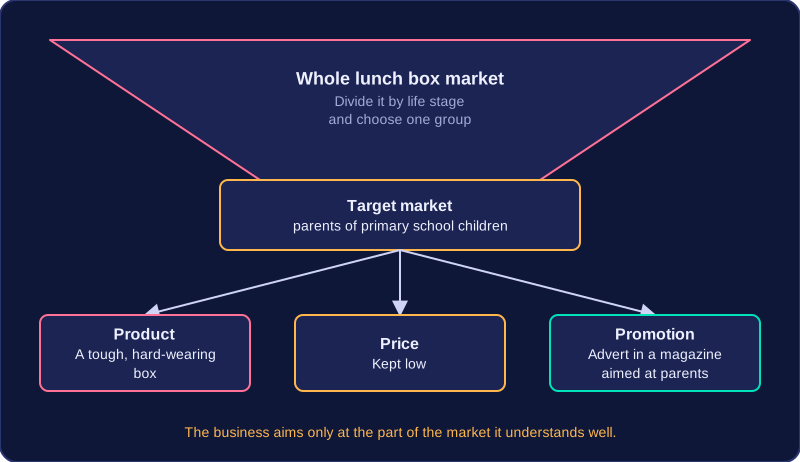
A small business makes lunch boxes with compartments for a sandwich, a drink and a piece of fruit. Dividing the market by life stage shows that parents of primary school children often need something hard-wearing, easy to wash and cheap enough to replace. The business chooses that group as its target market, so it designs a tough box, keeps the price low and advertises in a magazine aimed at parents. The whole market for lunch boxes is far bigger, but the business aims only at the part it understands well.
Practise this
Cambridge National Enterprise & Marketing · 2.5 Types of market segmentation
Cambridge National Enterprise & Marketing · 2.6 Benefits of market segmentation