Types of market segmentation
Market segmentation

Market segmentation is the process of dividing a market into groups of customers who share common characteristics. It helps a business make sense of a varied market before deciding which customers to aim at.
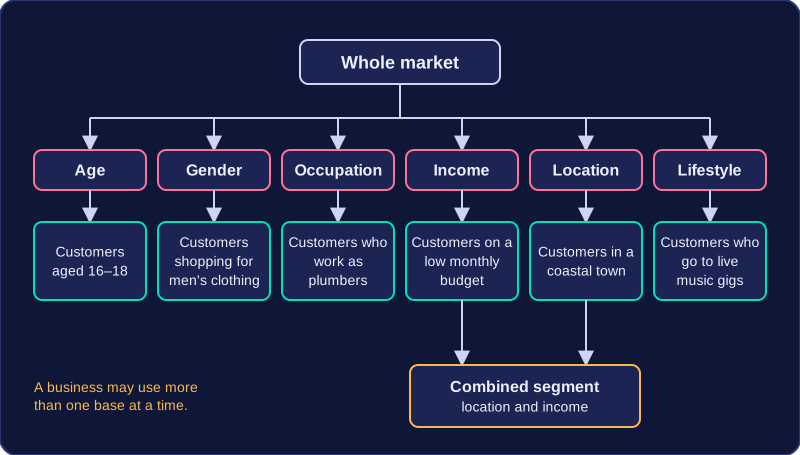
A segment is a group of potential customers who have one or more characteristics in common, so a segment could be customers aged 16–18, customers who work as plumbers, or customers who live in a coastal town. The characteristic used to divide the market is the base — a feature of the customers themselves, such as age or income, rather than a named product or the marketing mix of product, price, place and promotion.
Main ways to segment a market
| Base | Characteristic used to divide the market | Example segment |
|---|---|---|
| Age | Customers' age or life stage | Customers aged 16–18 |
| Gender | Customers' gender | Customers shopping for men's clothing |
| Occupation | The job or profession customers do | Customers who work as plumbers |
| Income | How much customers earn or have to spend | Customers on a low monthly budget |
| Location | Where customers live or work | Customers in a coastal town |
| Lifestyle | Customers' interests, hobbies, values or way of life | Customers who go to live music gigs |
A business may use more than one base at a time. For example, a garden centre could group its customers by location and income, then look at what each group buys. Combining bases like this gives a clearer picture of the customers than one base alone, which helps the business decide which group to aim at.
Practise this
Cambridge National Enterprise & Marketing · 2.5 Types of market segmentation
Cambridge National Enterprise & Marketing · 2.6 Benefits of market segmentation