Market Research to Target a Specific Customer
Types of market segmentation

Contents
Market segmentation is the process of dividing a market into groups of customers who share common characteristics. It helps a business make sense of a varied market before deciding which customers to aim at.
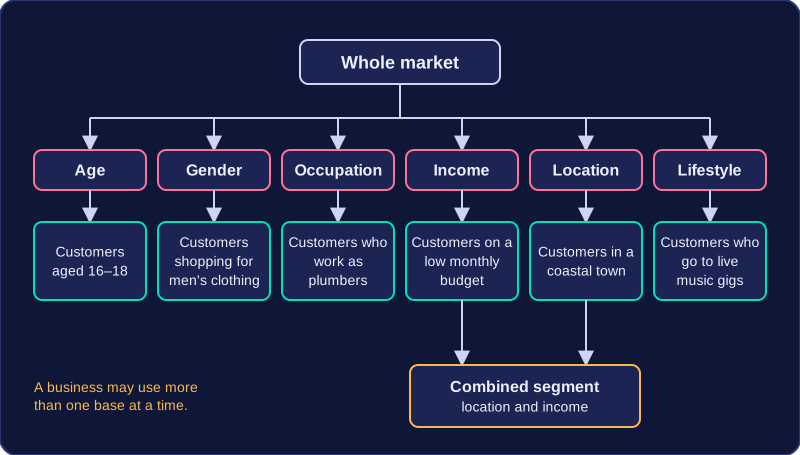
A segment is a group of potential customers who have one or more characteristics in common, so a segment could be customers aged 16–18, customers who work as plumbers, or customers who live in a coastal town. The characteristic used to divide the market is the base — a feature of the customers themselves, such as age or income, rather than a named product or the marketing mix of product, price, place and promotion.
Main ways to segment a market
| Base | Characteristic used to divide the market | Example segment |
|---|---|---|
| Age | Customers' age or life stage | Customers aged 16–18 |
| Gender | Customers' gender | Customers shopping for men's clothing |
| Occupation | The job or profession customers do | Customers who work as plumbers |
| Income | How much customers earn or have to spend | Customers on a low monthly budget |
| Location | Where customers live or work | Customers in a coastal town |
| Lifestyle | Customers' interests, hobbies, values or way of life | Customers who go to live music gigs |
A business may use more than one base at a time. For example, a garden centre could group its customers by location and income, then look at what each group buys. Combining bases like this gives a clearer picture of the customers than one base alone, which helps the business decide which group to aim at.
A target market is the particular group of customers or businesses that a product is aimed at. It is a chosen group inside the whole market, not the whole market itself and not one single customer. A business may aim at one segment or at several.
People or businesses in a target market usually share similar characteristics, such as age, income, location or lifestyle. Because they have things in common, they tend to want similar things from a product, so one clear message can appeal to the whole group.
How segmentation helps
Market segmentation is the dividing up of a market into groups that share characteristics. It helps a business identify a target market because it shows which customers have needs in common and which of those groups the business is best placed to serve. Without that dividing-up step, a business only has a vague idea of who it is selling to.
Once the target market is clear, the business can make decisions that suit that group instead of guessing. It also stops the business from trying to appeal to everyone, which often means appealing to no one in particular.
Worked example
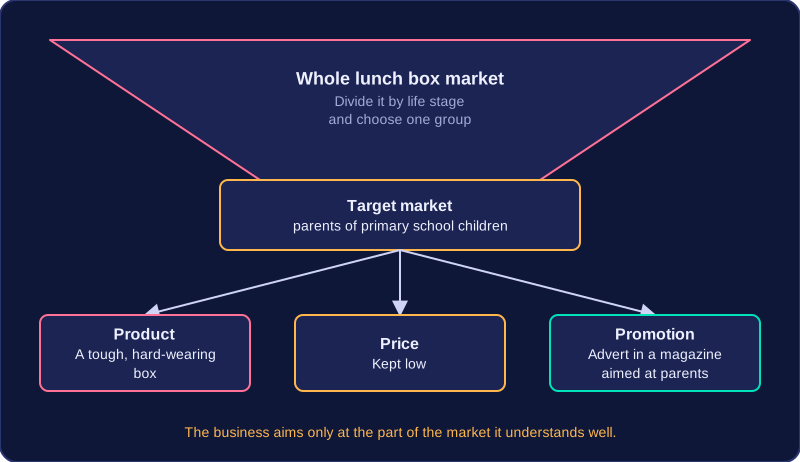
A small business makes lunch boxes with compartments for a sandwich, a drink and a piece of fruit. Dividing the market by life stage shows that parents of primary school children often need something hard-wearing, easy to wash and cheap enough to replace. The business chooses that group as its target market, so it designs a tough box, keeps the price low and advertises in a magazine aimed at parents. The whole market for lunch boxes is far bigger, but the business aims only at the part it understands well.
Age segmentation groups customers by how old they are, or by their life stage, because what people need changes as they get older. A five-year-old needs a bike with stabilisers; a fifteen-year-old wants one they can ride to a friend's house. Life stage can be more useful than an exact age, because a student living away from home, a parent with young children and someone who has retired have very different needs even when their ages are similar. For example, a company that rents out flats might aim at students moving to a new city, rather than at everyone aged 18 to 25.
Some products are aimed at obvious age groups. A shop selling nursery products stocks toys and waterproof coats for toddlers, and a coach company that plans short days with plenty of rest stops is aiming its trips at retired customers.
Gender segmentation
Gender segmentation groups customers by gender. Many products are gender-neutral, such as a reusable water bottle or a desk lamp, and are sold to everyone in the same way. Even so, a business may design a product for a particular gender or aim its marketing at one. A running shoe brand might make a version with a narrower fit, and a swimming pool might advertise women-only sessions to attract customers who would not otherwise come. Gender segmentation does not mean every product has to be gendered: a business only uses it when it believes the difference affects what people buy or how they choose.
Age and gender are often combined with another base, such as income or lifestyle, so the business builds a clearer picture of its customer. A garden centre could target retired customers who have a comfortable income, rather than every retired person.
Occupation segmentation groups customers by their job or profession. People doing similar work often share needs because they use similar tools, face similar problems and work similar hours. A supplier of van phone holders and dashboard cameras could aim at couriers, plumbers and mobile hairdressers. A firm selling simple bookkeeping software could aim at sole traders such as electricians and dog groomers, who must record income and expenses but have no accounts department. Grouping by occupation lets a business use words its customers recognise and advertise where they spend time.
Income segmentation
Income segmentation groups customers by how much money they have coming in. Income affects what people can afford and whether they look for luxury products or budget ones. A customer on a higher income may choose a premium version with extra features, while a customer on a lower income may want value for money, easy payment options or a basic version that does the job. A gym, for instance, might sell a cheap off-peak membership to one group and a premium membership with classes and a personal plan to another. Offering budget and premium ranges lets a business serve both without aiming everything at one income level.
Two separate bases
Occupation describes the kind of work a customer does; income describes how much they earn. They are separate segmentation bases, even though the two often overlap. A solicitor usually earns more than a shop assistant, but a shop manager can earn more than a newly qualified teaching assistant, so knowing a customer's job does not tell you their income. Assuming everyone in a job earns the same can lead a business to price a product wrongly.
| Business | Base used | Why it works |
|---|---|---|
| Supplier of van phone holders and dashboard cameras | Occupation | Couriers, plumbers and mobile hairdressers drive for work and need hands-free equipment |
| Cinema with a cheap weekday ticket | Income | A lower weekday price brings in families on a tight budget who could not pay weekend prices |
| Garage selling a premium service plan | Both | Taxi drivers with high mileage and a bigger budget pay for convenience |
Location segmentation groups customers by where they live or work. The area can be local or national: a family bakery may aim at people in its own town, while an online model-kit shop serves customers across the country. It can also be urban or rural: a city-centre repair shop may rely on customers travelling a short distance, while a rural customer may need home delivery or a mobile service. Climate is another location factor because it affects demand. In a wet climate, waterproof coats and umbrellas are in greater demand; in a dry one, garden sprinklers sell better. Location segmentation uses geography as the base, not a customer's age or income.
Lifestyle segmentation
Lifestyle segmentation groups customers by their interests, hobbies, values or way of life. For example, a pottery painting studio may aim at keen crafters and promote through weekend workshops, while a vegan recipe box service may aim at customers who value animal welfare. Other lifestyle groups include keen gardeners, board-game players and volunteers.
Lifestyle is not the same as age or income. Two 30-year-olds on the same income could have very different lifestyles: one might spend free time training for a fun run and the other decorating celebration cakes. A product that suits one may not suit the other, so a business that groups customers by lifestyle can choose products and promotions that fit their interests rather than guessing from age or income alone.
Social media targeting means using the advertising tools on a social media platform to put marketing in front of a chosen group of people, based on their interests and the information held in their profile. Instead of paying for an advert that is shown to everyone, a business describes the audience it wants and the platform finds the matching users.
Platforms collect a lot of detail as people use the site. They hold information such as the pages a person likes, the groups they join, the posts they react to, watch or share, and the interests listed on their profile. Because this information is stored against each account, the platform can sort users into audiences.
Choosing the audience
The advertising tools let a business choose an audience by interests, and then narrow it with other details such as age or location. For example, a local skate shop selling beginner roller skates could pick people who follow roller-skating pages or join nearby skate groups, then limit the audience to people living within 10 miles so that they can visit the shop. The advert is therefore mostly shown to people who are more likely to be in the business's target segment, rather than to the whole platform.
Reaching older customers
Social media targeting works from what people actually do on the platform, so it is not only for young people. Different platforms, pages and groups attract different audiences, so a business selling garden tools can reach older gardeners through the pages and groups they follow.
Market segmentation brings benefits because it lets a business aim at a specific group of customers with shared characteristics rather than trying to please everybody at once. That group can then become the target market, and every decision can be made with those customers in mind.
Aiming at the right people
A major gain is targeted marketing. Product features, price, promotion and place can be designed for one group, so the message feels as though it was written for them. This helps develop the brand, because a relevant message is remembered and repeat buyers start to trust it.
A focused campaign also reduces marketing costs. Money is spent where likely buyers actually are instead of on people who would never be interested. For example, a firm selling customised phone cases for 13- to 17-year-olds would put its money into social media clips and school-holiday promotions, not a national newspaper advert read mainly by older adults.
Understanding and keeping customers
Studying a segment helps a business understand the wants and needs of its target market, so it is easier to satisfy those needs because customers are better understood. That knowledge also sparks ideas for growth and improvement, such as adding a shockproof version after hearing that buyers drop their phones.
Customers whose needs are met properly are more likely to return, which raises customer retention. More sales and repeat custom can increase profits and profitability, and leading a segment can build market share.
Segmentation makes these outcomes more likely, but it does not guarantee them: a competitor may target the same group better, or the product may still be priced wrongly.
If a business does not segment its market, it treats every customer as if they belong to one big group. The product and the marketing are aimed at everyone, and that creates several problems.
A weaker competitive edge
A competitive edge is something that makes customers pick a business instead of its rivals. Competitors that do segment can aim straight at one group, such as keen gardeners or families on a tight budget, and shape the product around what that group wants. A business aiming at everyone often pleases nobody in particular, so rivals win the customers whose needs they understand best.
Loyalty and trust are harder to build
Brand loyalty is when customers keep coming back to the same brand. It grows when people feel a product was made with them in mind. If the marketing speaks to everybody, customers are less likely to feel recognised, so they are slower to trust the brand and less likely to return.
Vague messages and a stretched budget
With no clear audience it is hard to write a message that speaks to anyone in particular, so messages turn generic — lines like “great quality for everyone” that say little and appeal to few. A marketing budget is the money set aside for promotion, and it is used up faster because adverts reach plenty of people who will never buy.
For example, Crunchtime Cereals sells one plain cereal to all shoppers and advertises it with the slogan “tasty cereal for the whole family”. A rival launches a high-energy version for people with active lifestyles and a low-sugar version for older shoppers, and both sell well. Crunchtime’s slogan sounds dull beside them, and much of its budget pays to reach people who never eat cereal.
Not segmenting does not mean the business does no marketing at all. It still advertises, but the marketing is untargeted, so it is less efficient and less effective.