Making Operational Decisions
Managing quality

Contents
Quality means a good or service is fit for purpose: it does the job the customer bought it for and meets their needs. Quality is not the same as luxury or a high specification. A cheap product can be good quality, and an expensive one can be poor quality if it fails at what it promises.
Fit for purpose, not fancy
A £10 school bag that keeps books dry and survives a year of being thrown about is good quality. A designer bag whose zip breaks in a week is not, however much it costs. The same idea applies to services. A barber who gives you a neat cut at the time you booked has delivered quality, even without free drinks or a fancy salon.
Expectations vary
Different customers need different things, so they judge quality differently.
| Customer | What they need | What quality means to them |
|---|---|---|
| A student cycling two miles to school | A safe, cheap bike | Working brakes and a sturdy frame; £140 is enough |
| A courier making 40 deliveries a day | A bike that rarely breaks down | Strong components and low repair bills; £900 is worth it |
Both customers are right. A bike that suits one may not suit the other, so a business needs to know who its target customers are before it decides what quality means for them.
Value for money affects the price customers will pay
The price a customer is willing to pay depends on the value for money they expect: what they get compared with what they pay. Value for money does not mean the lowest price. Headphones costing £60 with a two-year guarantee may feel like better value than £25 ones that break in three months. If a product looks poor value at its price, customers go elsewhere; if it beats their expectations, they may happily pay more next time.
Consistent quality means that every item a business produces, or every service it provides, reaches the same standard each time a customer buys. The second visit should feel as good as the first, and the tenth product should be as reliable as the first.
Customers rely on this. When someone buys again, they are judging the business on what happened last time, and they expect the same experience. A service is really a promise about how it will be delivered, so a business that keeps that promise builds a reputation customers trust.
Why inconsistent quality causes problems
- Disappointment: a customer whose first visit was excellent and whose second was poor feels let down, because the business itself set the expectation.
- Complaints: faulty or rushed work leads to refunds, replacements and staff time spent putting things right, all of which cost money.
- Reduced trust: a customer who cannot predict what they will get may stop buying altogether, and unhappy customers often tell friends and family.
These effects damage customer satisfaction, reputation and sales. Bad experiences spread quickly by word of mouth and can cancel out the good reviews a business has earned.
For example, a car wash charges £9 for a full clean. One Saturday the staff take their time and the car leaves spotless; the next Saturday they rush and miss the wing mirrors and the wheels. The customer cannot rely on the service, switches to a rival down the road and warns two friends. Nothing about the price changed, but the standard did.
Standardising to keep quality steady
Businesses aim to standardise their processes so that quality does not depend on who is working or when. Written procedures, set recipes, set scripts and regular training mean a busy Saturday shift performs like a quiet Tuesday one. This matters just as much for services, because the customer judges the whole experience, including waiting time, how staff behave and the final result, not just a finished product.
A competitive advantage is something that makes customers choose one business instead of its rivals. Good quality can be a competitive advantage because it makes a product or service different from what competitors offer. If customers believe your goods or services meet their needs better, they have a reason to choose you.
Good quality also encourages customer loyalty. Customers who trust the standard are more likely to buy again and recommend the business to others. Loyalty gives a business steadier revenue and makes customers less likely to switch to a rival over a small price difference. Some customers will pay a higher price for quality they trust. A higher price increases revenue per sale; if the extra income is greater than any extra cost of providing the quality, profit can rise.
For example, a mobile bike repair service that arrives on time, explains the work clearly and uses reliable parts might charge £10 more per repair than a rival. Riders trust it, rebook and recommend it, so sales and profit can grow.
Poor quality compared with competitors works against a business. Faulty goods or a poor service experience damage reputation, especially when customers post reviews or tell friends. Sales can fall as customers switch to rivals, and the business may have to spend money fixing mistakes or winning customers back. Quality therefore affects competitiveness, not just customer satisfaction. It can support a brand image in the marketing mix, but the business must actually deliver the standard it promises.
| Good quality | Poor quality |
|---|---|
| Customers trust the product or service to meet their needs | Customers lose trust after faults or poor service |
| Repeat purchases and recommendations are more likely | Customers may switch to a rival |
| Some customers will accept a higher price | Discounts may be needed to keep sales |
| Revenue and profit can rise | Reputation and sales can fall |
Quality control is the process of checking that goods or services meet a required standard. It detects faults by comparing output with the standards the business has set.
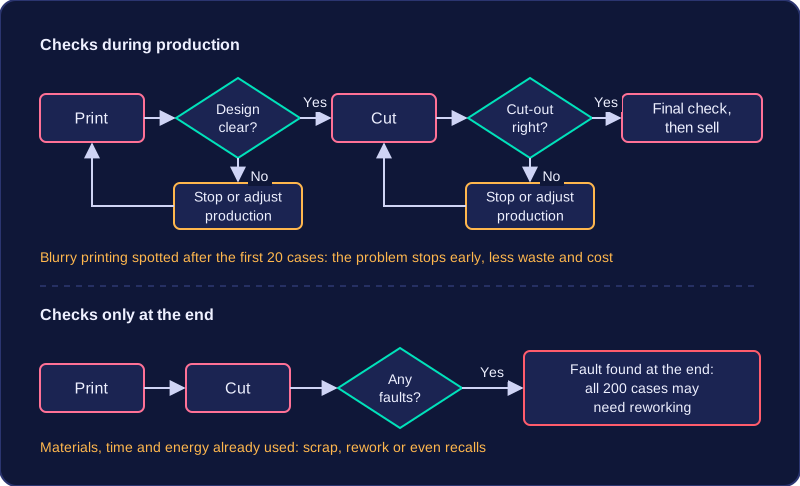
Quality control usually involves inspecting output. Many businesses check finished goods before they are sold, but checks can also take place at stages during production. Imagine a firm making phone cases. It might check the printed design after printing and the camera cut-out after cutting. If the printing is blurry, staff can stop or adjust production before more cases are printed badly. If 200 cases are printed before the fault is spotted at the end, all 200 may need reworking; a check after the first 20 could stop the problem much sooner.
Why the timing of checks matters
Checking during production can identify problems early and reduce waste and cost. Relying only on checks at the end means faults may be found after materials, time and energy have already been used, so the business may have to scrap or rework items, or recall products from customers. Quality control still detects faults after they have happened, so it cannot prevent every fault. It is not the same as quality assurance, which manages quality throughout production rather than checking output at the end.
| When the check happens | What it can do | Possible result |
|---|---|---|
| During production | Spots a fault early so production can be stopped or adjusted | Less waste and lower cost |
| Only at the end | Finds the fault after resources have been used | More waste, rework or recalls |
Quality control in services
Services need quality control too. A service is often delivered and used at the same time, so checks happen as it is delivered rather than only once it is finished. A mobile bike repair service, for example, might test the gears straight after adjusting them, then test the brakes before handing the bike back. If something is wrong, it can be put right before the customer rides away, instead of becoming a complaint later.
Quality assurance is the system a business uses to make sure that the quality of production meets customer needs throughout the whole production process. Rather than leaving quality to be checked once the item is finished, it builds quality into every stage, from choosing materials to packing the finished item.
This makes quality assurance broader than quality control. Quality control checks output against a standard and aims to detect faults. Quality assurance looks at the whole process and aims to prevent faults from happening in the first place. In a business using quality assurance, every employee is often responsible for quality at their own stage. A machinist making waterproof jackets might check the stitching before passing the jacket on, rather than leaving every check to an inspector at the end.
Quality assurance in practice
For example, a bike manufacturer could set a standard for each frame weld, train staff to check their own welds, and record measurements at the welding stage. If a measurement is outside the standard, the problem is corrected before the frame moves on. The business is trying to stop faulty frames being completed, not just finding them later.
Quality assurance and quality control
| Quality assurance | Quality control | |
|---|---|---|
| Main aim | Prevent faults | Detect faults |
| Focus | The whole production process | Output checked against standards |
| Responsibility | Often every employee at each stage | Often inspectors or checkers |
Large businesses and limits
Large businesses may have a separate quality assurance department. Its staff measure and check each stage, keep records and increase confidence that the process is working. But quality assurance does not guarantee that no faulty products will ever be made: people can still make mistakes, and materials or equipment can still fail.
Monitoring quality means checking regularly whether your goods or services match the standard customers expect, and finding out where they fall short. It is not a one-off inspection: a business that monitors continuously spots problems while they are still small and cheap to fix. Two practical ways to monitor and maintain quality are collecting customer feedback and training staff.
Collecting customer feedback
Customers are the people who actually judge quality, so asking them directly gives information the business cannot get any other way.
- Surveys ask customers to rate specific things, such as how quickly they were served or whether an item arrived in good condition. Because the questions are planned, surveys let you compare results over time.
- Reviews and complaints come in the customer's own words, so they often reveal details that internal checks miss, such as a missing part in the box or instructions that were hard to follow.
Read together, feedback shows patterns rather than one-off grumbles. For example, a bike repair shop reads its online reviews and notices that four customers in a month mention waiting over two weeks for a service. No single comment is dramatic, but the pattern points to a scheduling problem that the workshop's own checks never picked up. The shop can then change how it books jobs in and reduce complaints.
Training staff
Staff deliver the quality standard, so training is one way to make sure everyone knows what it is. Training helps employees understand the standard expected, carry out checks correctly and give the same service to every customer, rather than each person working to their own idea of what is acceptable. Trained staff also help monitor quality: because they know what good work looks like, they can spot a problem as it happens and put it right on the spot, before the customer leaves and posts a negative review.
Feedback and training work best as a loop: the feedback identifies the problem, and training or a changed process fixes it. That is why the information gathered should be used to improve how the business operates, not just filed away.
Managing quality means the checks and systems a business uses to make sure its goods or services meet the standard customers expect. It can protect a business from expensive problems, but setting it up and running it is not free.
Why managing quality costs money
Managing quality can be expensive because it may need:
- Specialist equipment – for example, a firm printing custom T-shirts might buy a colour-testing device to check every print.
- Trained staff – employees need time and training to inspect work properly and follow quality procedures.
- Quality systems – record sheets, checklists and testing routines all take time and money to set up and keep up to date.
A business must weigh these costs against the benefits. Spending £2,000 on training and testing may be worthwhile if it prevents £5,000 of faulty work, but not if it prevents almost nothing.
How good quality management saves money
Effective quality control and quality assurance can reduce costs by lowering:
- Waste – fewer materials and products are thrown away.
- Rework – fewer items need to be repaired or made again.
- Returns and recalls – fewer faulty products come back or have to be withdrawn.
- Complaints – fewer refunds and replacements to pay for, and fewer customers lost to rivals.
For example, a firm assembling mountain bikes could check the welds on every frame and test the brakes before each bike is boxed. If a fault is spotted at that stage, it can be put right in minutes. Once the bike has been packed and shipped, correcting it means unpacking it, paying for return delivery and rebuilding it. That helps the business control production costs, which can increase profit.
More checks are not always better. Extra inspection adds time and wages, so it only helps if it improves customer satisfaction or prevents costly faults. The right level of quality management balances the cost of prevention against the savings from fewer faults.