Making Operational Decisions
Working with suppliers

Contents
Stock is the goods or materials a business holds for use, sale or distribution. Anything a business keeps in order to make something or sell it counts. In a small print shop, the plain T-shirts stacked in the back room are stock, and so are the printed tops on the rail ready to sell.
Stock comes in three forms:
- Raw materials and components – inputs not yet used, such as plain T-shirts, ink or timber. Components are parts bought in ready to fit, like the wheels for a bicycle.
- Work in progress – items partway through production, such as a half-built bookcase or a T-shirt that has been printed but not yet bagged and labelled.
- Finished goods – products that are complete and waiting to be sold or delivered to a customer.
Equipment used again and again, such as the print shop's presses or its delivery van, is not stock: it is not bought to be used up or sold on.
Holding enough stock
Enough stock means you can make and sell what customers want without waiting for a delivery. If someone orders 20 printed hoodies and the plain hoodies are already in the stockroom, you finish the job on time and the customer comes back. Too little stock causes stockouts – moments when a product has run out. That leads to lost sales, because the customer simply buys from a rival, and to production delays, because workers stand idle waiting for materials. Customers who leave disappointed may never return, which damages your reputation.
Holding too much stock
Too much stock ties up cash. Money sitting in boxes on a shelf cannot pay wages, bills or promotion. It also raises storage, insurance and handling costs: bigger premises, higher cover against fire or theft, and more staff time spent moving and counting goods. Extra stock can be damaged in store, and it can become obsolete – out of date and unsellable. A shop left with 500 phone cases for a handset that has just been replaced must discount them heavily, so it may never sell them at full price.
Stock control is managing the amount of stock a business holds so that it has enough at the right time, without holding too much. Enough stock keeps production and sales moving; excess stock uses space and cash that could be used elsewhere.
Good stock control improves productivity because employees are less likely to wait for materials, and efficiency because less time and space are wasted storing and checking stock. It improves profitability by reducing wasted stock and lost sales. For example, a bike shop that runs out of helmets during a busy weekend loses sales, while one holding hundreds of spare helmets ties up cash and may have to discount old colours.
Computerised stock control
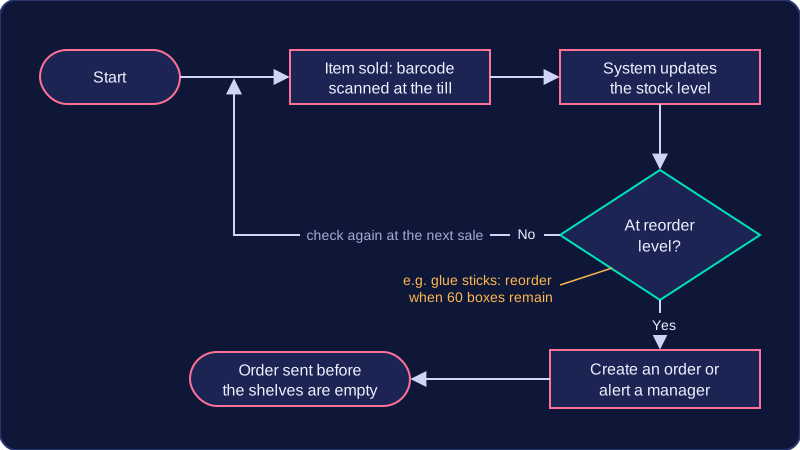
A computerised stock control system records stock levels each time an item is sold or used, such as when a barcode is scanned at a till. It applies the same principles as a bar gate stock graph: the business sets the levels and triggers that show when stock needs attention, and the system checks the stock level continuously.
When stock falls to the reorder level, the system can create an order automatically, or alert a manager to approve one. This reduces the chance of running out, cuts the time spent counting stock and gives managers up-to-date information for decisions. For example, a stationery supplier could set its system to reorder glue sticks when 60 boxes remain, so the order is sent before the shelves are empty.
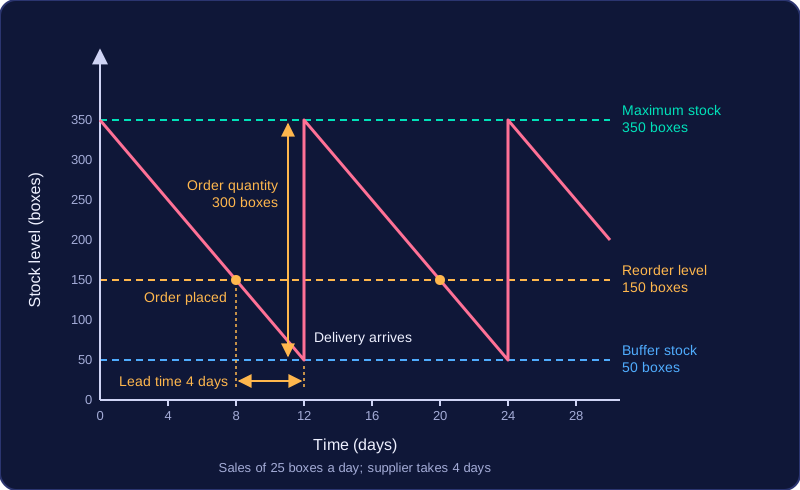
A bar gate stock graph shows how a business's stock level changes over time. Time runs along the bottom and stock level up the side. The line slopes down as stock is used or sold and jumps straight up when a delivery arrives, making a shape a little like a gate.
Reading the levels
- Maximum stock level: the most stock the business plans to hold, shown by the top of the vertical rise.
- Buffer stock (minimum stock level): emergency stock kept so the business does not run out. It is the level stock should not normally fall below.
- Reorder level: the stock level that triggers a new order. It must be set high enough that the delivery arrives before buffer stock is used.
- Lead time: the time from placing an order to receiving the delivery. On the graph it is the horizontal gap between reaching the reorder level and the vertical rise.
- Order quantity: the amount ordered, shown by the size of the vertical rise.
For example, a craft shop sells 25 boxes of card a day. It holds a maximum of 350 boxes, reorders at 150 boxes and keeps 50 boxes as buffer stock. Its supplier takes 4 days. When stock reaches 150, four days of sales use 100 boxes, so stock falls to 50 just as the delivery arrives. The shop orders 300 boxes, so the delivery raises stock back to its maximum of 350.
What it can show
A bar gate graph helps a business judge whether its reorder level and buffer stock are sensible. If no further delivery arrives, you can follow the downward slope to see when stock will run out. The graph usually assumes stock is used at a steady rate and deliveries arrive instantly. Real sales can be uneven and deliveries can be late, so the actual stock line may not be as neat.
Responding to stock problems means changing stock control when sales or deliveries differ from the plan. The aim is to keep enough stock to trade without holding far more than needed.
| Situation | What happens to stock | How the business may respond |
|---|---|---|
| Sales are higher than expected | Stock falls faster and may go below buffer stock, the safety minimum held. | Reorder sooner, increase the order size or review forecasts. |
| Sales are lower than expected | Stock stays high because it is being used or sold more slowly. | Delay orders, reduce order quantity or use promotions to reduce stock. |
| A supplier delays delivery | Lead time — the time from ordering to receiving — increases. | Set a higher reorder level, hold more buffer stock or use an alternative supplier. |
If sales are higher than expected, the business is using stock faster than planned. Ordering sooner or in larger amounts helps protect the buffer and reduces the chance of a stockout, where shelves or production lines have no stock. Reviewing forecasts helps the next order match demand more closely.
If sales are lower than expected, stock can build up. Delaying orders or cutting order quantity stops stock building up further, and a promotion such as a discount encourages customers to buy the slower stock.
If a supplier delays delivery, the gap between ordering and receiving grows. A higher reorder level makes the business order earlier, and more buffer stock gives it a safety margin. If delays continue, an alternative supplier may keep production or sales going.
A worked example
A garden centre sells bird feeders. A TV gardener features one of its feeders and sales are much higher than forecast. The manager reorders sooner and increases the order size, then reviews the forecast. When sales later slow, the centre delays its next delivery and runs a weekend promotion on feeders. If the feeder supplier then delays delivery, the centre raises its reorder level and keeps extra buffer stock until a second supplier can deliver.
Just in time (JIT) stock control means holding as little stock as possible and having supplies delivered only as they are needed for production or for sale. Stock arrives shortly before it is used, so hardly anything sits in a storeroom.
Why businesses use JIT
- Lower storage and warehousing costs: a smaller stockroom means less rent and insurance to pay, so fixed costs fall; there is also less handling.
- Better cash flow: less money is tied up in stock, leaving cash free for wages, bills or repaying borrowing.
- Less waste: stock held for months can be damaged, go out of date or become obsolete when tastes change.
- Matches stock to demand: supplies are ordered to match what customers are actually buying, so there is less unsold excess stock needing discounting.
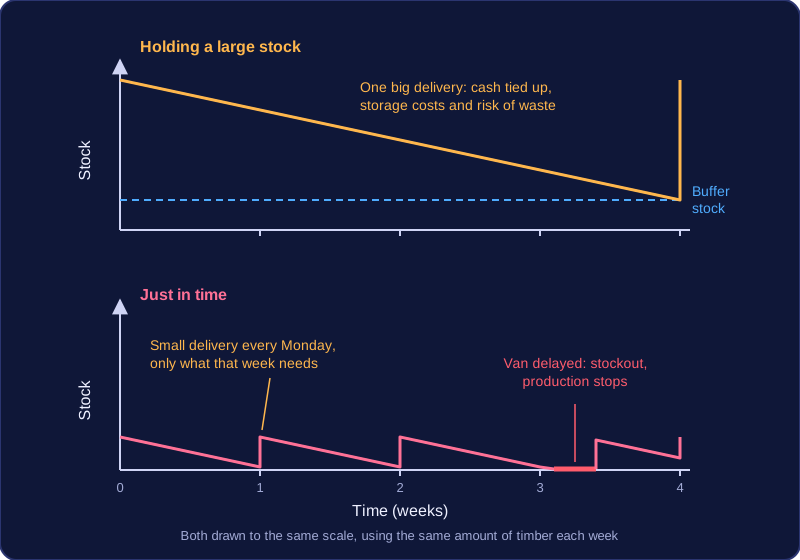
For example, a small workshop making wooden garden planters might take a timber delivery every Monday and hold only the timber it expects to use that week. The owner checks the order book first, so cash is not locked up in a pile of boards.
What JIT relies on
JIT only works with reliable suppliers, accurate demand forecasting, efficient logistics, good communication and trust between the business and its supplier. If a van is delayed, production can stop, the business suffers a stockout and customers may buy from a rival instead. JIT does not mean holding no stock at all: a small amount is still needed to keep work going.
The drawbacks
- Deliveries are frequent and in small quantities, which raises ordering and transport costs and can lose bulk-buying discounts and economies of scale, as larger orders usually cost less per unit.
- There is very little buffer stock, so any disruption to the supply chain hits the business quickly.
- JIT is unsuitable where demand is unpredictable, or where suppliers cannot be trusted to deliver on time.
Procurement is how a business finds suppliers and agrees terms for buying goods or services. It is more than buying stock: it means choosing and managing suppliers so the right goods arrive on the right terms.
Procurement aims to secure the best value goods or services and have them available on time. Best value means the right mix of cost, quality and reliability, not just the lowest price. Late or poor-quality supplies can disrupt production or sales, so procurement looks at the whole deal, not the headline price alone.
What procurement involves
Procurement includes selecting suppliers: comparing possible suppliers and choosing one that can meet the business's needs. The business then negotiates the main terms:
- Cost — what the business pays, including any discount for a larger order.
- Quality — the standard or specification the goods or services must meet.
- Delivery — how quickly and reliably supplies arrive, and the cost of delivery.
- Availability — whether the supplier can provide the quantities needed, including extra if demand rises.
- Payment terms — when payment is due, such as paying 30 days after delivery.
Negotiating these terms helps the business control costs and reduce the risk of delays or unsuitable supplies.
Supplier relationships
Building supplier relationships means communicating clearly, keeping promises and treating suppliers fairly. This builds trust: confidence that the supplier will keep its promises about quality, delivery and availability. A strong relationship can make a supplier more willing to help, such as fitting in an urgent order or warning the business early about a problem, reducing disruption and making problems easier to solve.
For example, a bike repair shop expecting a busy summer selects a supplier of brake cables. It agrees a lower cost for a bulk order, checks the cables meet safety standards, arranges delivery two weeks before the rush, confirms the supplier can send extra cables, and agrees to pay 30 days after delivery. Keeping in regular contact means the supplier warns the shop early if a delivery will be late, so the shop can order elsewhere.
When choosing a supplier, a business compares more than price. It looks at quality, delivery, availability, cost and trust.
Quality and trust
Quality means supplies meet the standard the business needs for production or sale. A joiner buying oak boards for shelves needs boards that are straight and dry. Warped or damp wood causes faulty shelves, wasted material, rework, returns and late orders, which can damage the joiner’s reputation. A business should aim for sufficient quality rather than always the highest: furniture-grade oak may cost much more than the job needs. The extra price only makes sense if customers will pay for it.
Trust means confidence that a supplier will keep promises about quality, delivery and availability. A trusted supplier is more likely to offer better terms, priority supply when stock is short, flexibility over order changes and fewer disputes.
Delivery and availability
Delivery includes delivery cost, delivery speed and delivery reliability. Reliable delivery means supplies arrive when promised. This matters greatly when a business uses just in time or keeps a small buffer stock, because a late delivery can stop production. Faster delivery often costs more, so speed and delivery cost must be balanced. Delivery cost also adds to the total cost of supplies.
Availability means the supplier can provide the quantities required when the business needs them. This is especially important for JIT and businesses with small buffer stocks, where a shortage can quickly stop work.
Cost
Cost is the price paid for supplies. A business seeks competitive prices, but should consider total cost and value, not just the headline price. The cheapest supplier may be poor quality, unreliable or unable to meet demand, so savings can be lost through waste, returns, delays and lost sales. For example, a bike repair shop may save £1 per brake cable from a cheap supplier, but if cables snap, refunds and fitting time cost far more.
Logistics is the management of the movement of goods. For a business it covers how materials and finished products travel from supplier to warehouse, from warehouse to shop or customer, and how they are stored and handled along the way. It is more than transport: choosing a courier, deciding how often deliveries arrive and planning storage space are all logistics decisions. A small business selling scented candles online, for example, must decide how often to have wax and glass jars delivered and which courier to use for customer orders.
Effect on costs
Logistics and supply decisions change costs in several ways: transport (how goods travel and how often), storage (warehouse or stockroom space, heating, insurance), stockholding (cash tied up in goods sitting still), waste (materials spoiling, breaking or going out of date), and delays and lost sales (orders that arrive late or cannot be met, which lose the business money). The candle seller who orders a large crate of jars once a month pays less per delivery but needs more storage space and risks breakages; ordering every week costs more in transport but frees up cash and space.
Effect on reputation and customer satisfaction
Customers judge a business on whether the product is available when they want it, whether its quality is consistent and how quickly it arrives. Late, poor-quality or unavailable supplies damage customer trust: someone who waits two weeks for a candle promised in three days may never order again. A reliable supplier, a sensible amount of stock and a courier that delivers on time protect reputation and keep customers satisfied.
The opposite is also true: a courier that loses or damages parcels may charge less per delivery, but refunds, replacement stock and lost customers usually cost more than the saving. Well-judged logistics and supply decisions can lower costs, improve reliability, protect reputation and raise customer satisfaction, while poor ones raise costs, cause delays and lose customers.