Making Operational Decisions
Business operations

Contents
Business operations are the activities a business carries out to produce goods and provide services that satisfy consumer needs and wants. They turn inputs, such as materials or labour, into something a customer will pay for, and happen in every business, whether it sells physical items or provides a service.
Production is the process of making goods or providing services. Goods are physical things you can touch and own; services are activities carried out for a customer that you pay for but do not own. Both count as production: a workshop building a wooden bookcase is producing a good, and a mobile bike mechanic repairing a puncture is providing a service.
What affects the process a business chooses
A business can organise production in different ways, such as job, batch or flow production. Which suits it depends on four things:
| Factor | Why it matters |
|---|---|
| The product | The size, weight and nature of the item affect how it can be made and moved. Small, light items are easier to pass along a line than bulky or delicate ones. |
| Amount of customisation | If every customer wants something different, the same steps cannot be repeated exactly each time, so a flexible approach is needed. |
| Size of the market | Lots of customers wanting the same thing means production can be repeated. A small, specialist market keeps volumes low. |
| Skills and equipment required | Skilled craft work suits unique products, while expensive machinery is only worth buying when high volumes spread its cost. |
For example, a small firm printing names onto leavers' hoodies for local schools faces lots of customisation and a small market, so it makes each order separately. A firm making plain reusable water bottles sold in thousands of shops faces the opposite situation, so identical bottles can be made continuously and cheaply.
The choice matters because it affects how much each worker produces and how much each unit costs to make. Getting that right helps a business charge competitive prices and still make a profit.
Job production makes a single, one-off product designed around one customer's exact requirements. Each item is completed before work starts on the next, so the output is unique rather than a standard product made again and again.
Because every job is different, job production usually relies on highly skilled or specialist workers. A furniture maker building a fitted desk to a customer's measurements, for example, must measure, cut, shape and finish materials to suit that space. The business can be flexible and adapt the product to individual requirements, rather than forcing the customer to accept a standard size or design.
Varied tasks can also motivate workers, because they are not repeating the same small action all day. A craftsperson may enjoy seeing a whole product through from start to finish and using different skills on each job.
The trade-off is that job production usually has lower productivity and higher unit costs than batch or flow production. Workers spend time planning, setting up and solving problems for each individual item, so fewer units are made per worker per hour. Job production therefore suits low-volume, unique or highly customised output, such as a made-to-measure outfit or a one-off piece of stage scenery. It is not automatically poor quality; it can be skilled and carefully made, but it is slower and more expensive per unit than making standard items in larger quantities.
Batch production makes a group of similar goods — a batch — using the same machinery. A set quantity is produced, then the machinery is cleaned or reset so that a different batch can be made.
How a batch is made
A business chooses a batch size, such as 150 units, and runs the machinery until that quantity is complete. The equipment is then stopped, cleaned and set up again for the next batch, which could be a different size, colour or product. For example, a furniture workshop might run a batch of 150 oak chairs, then stop to reset its saws and jigs to produce 150 walnut chairs.
Why businesses use batch production
- It is faster than job production, because one run of the machinery turns out many similar items instead of a single one-off product.
- Workers repeat the same tasks, so less employee skill is usually needed than for individually made products.
- Output per worker is higher than in job production and unit costs are lower, because machinery and setup time are shared across the whole batch rather than one item.
- It allows some variety: each batch can be a different product, size or colour, which flow production cannot easily do because it makes a continuous run of identical items.
Drawbacks of batch production
Every changeover creates downtime — time when the machinery is being cleaned and reset and nothing is produced. That lost time lowers productivity and pushes up costs, so a batch producer cannot match the speed and low unit cost of a flow line, which carries on running without pausing to switch products. This is why productivity sits between job and flow production, and unit costs do too: lower than job production, but higher than flow production.
Flow production turns out large volumes of identical items by passing them continuously along a production line. Each item follows the same sequence of stages, with workers or machines repeating one task as the product moves along.
Why businesses use flow production
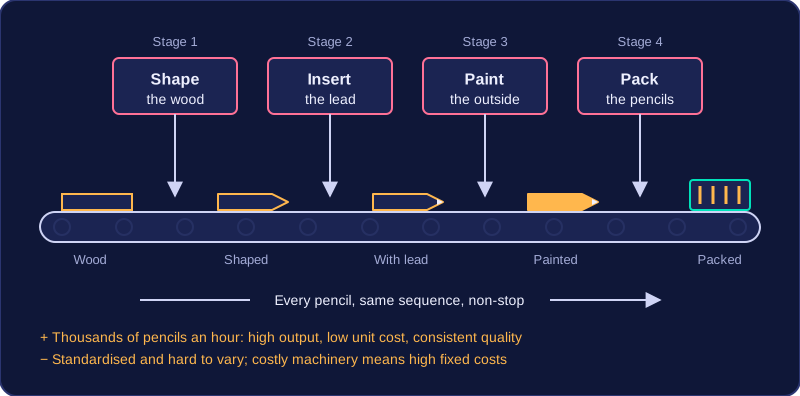
Flow production is usually automated or highly mechanised, so machines do most of the work. This gives high output and high productivity: a large number of identical items can be made in a short time with fewer workers needed for each item. Because every item goes through the same process, it gives a consistent standard of quality. The business can also spread its costs over many units, giving low unit costs per item. High volume means flow production can meet large-scale demand.
For example, a factory making identical wooden pencils could use a line that shapes the wood, inserts the lead, paints the outside and packs the pencils. Running continuously, the line makes thousands of pencils per hour, so each pencil carries a small share of the machine and labour costs.
Drawbacks of flow production
Flow production is less flexible. The product is standardised, so it is difficult to vary, and changing the design often means stopping the line and adjusting machinery. It also needs a large investment in machinery, which gives high fixed costs that must be paid even when sales are low. Automation can produce to a consistent standard, but it does not guarantee perfect quality: the machinery must be set up and checked correctly.
Productivity is how much output is produced per worker. It is often measured as output per worker per period, such as output per person per hour or per week, so it shows how efficiently labour is used to make goods or provide services.
Measuring productivity
Divide total output by the number of workers, or by the total hours worked. A garden bench workshop with four staff making 80 benches a week has productivity of 20 benches per worker per week. If those four staff work 160 hours in total, productivity is 0.5 benches per hour.
Productivity is not the same as total output. Making 200 benches with 10 staff may give the same productivity as making 80 with four staff, even though total output is much higher.
How productivity rises
Productivity increases when the same workers produce more output in the same time, or when the same output is produced with fewer resources. If the workshop makes 100 benches with four staff, productivity rises to 25 benches per worker. If it still makes 80 benches but with three staff, productivity has also risen, to about 26.7 benches per worker.
Why it matters for price and profit
Higher productivity helps keep unit costs down because wages and overheads are spread over more output. The business can set competitive prices and still protect its profit margin, the gap between price and cost per item. If it lowers prices to win customers, lower unit costs help stop that gap shrinking too much.
Automation means using machines and systems to carry out production tasks with little or no continuous human effort. Robotics is a form of automation where programmable machines perform physical tasks, such as moving, cutting or packing items. Once set up and switched on, they can keep working without a person operating them every second.
Improving quality
Automated equipment can improve quality because it repeats the same movement to a consistent standard. A machine set to cut panels to 40.0 cm will cut every panel to 40.0 cm, rather than one at 39.8 cm and the next at 40.3 cm. This gives greater accuracy and fewer human errors, such as a tired worker fitting a part the wrong way round. Quality still depends on the machine being programmed, checked and maintained correctly.
Improving or reducing flexibility
Technology can improve flexibility when it is reprogrammable. A business can change the machine's instructions so it switches quickly from making one product to another, or from one task to another, without buying new equipment. For example, a small furniture workshop could use a computer-controlled cutter to make chair parts in the morning and shelf parts in the afternoon by loading a different design file.
However, highly specialised technology may reduce flexibility. If a machine is built to perform only one task or make only one product, it cannot be switched to something else when demand changes. A machine that only attaches handles to a particular mug design is very efficient at that job, but useless if customers start asking for a different shape.
A trade-off means gaining more of one thing by accepting less of another. When a business chooses how to produce, it balances four aims: keeping costs low, raising productivity, improving quality and staying flexible enough to make different products. These aims can pull against each other, so managers choose the mix that best suits their market.
Automation and productivity
Investing in automation, such as robots, can raise productivity because machines work faster and for longer. It can also make quality more consistent, as each item is made the same way. However, automated equipment is expensive to buy and install, and a highly specialised machine may only make one product, which reduces flexibility. A garden bench maker that buys a robot welder gets more frames per hour and identical joints, but changing to a new bench design may need costly reprogramming or new tooling.
Flexibility and variety
More flexible technology lets a business offer greater variety. A laser cutter can cut many different shapes for personalised shop signs, so customers can order unusual designs. The trade-off is cost: flexible equipment often costs more per item than a specialised machine that repeats one job cheaply. A specialist press might stamp one bracket at a very low unit cost, while the laser cutter is slower and dearer to run but can make twenty different designs.
Quality and cost
Improved quality can reduce production costs. If fewer items are faulty, there is less waste, fewer errors to correct and less rework, saving materials, time and wages. For example, a pottery that checks each mug's glazing before firing can remove faulty ones, so it does not waste kiln energy on mugs it cannot sell.
| Change | Likely gain | Possible trade-off |
|---|---|---|
| More automation | Higher productivity and consistency | Large investment; less flexibility |
| More flexible technology | Greater product variety | Higher cost than specialised equipment |
| Better quality checks | Less waste, errors and rework | Extra checking time and cost |