Business operations
Flow production

Flow production turns out large volumes of identical items by passing them continuously along a production line. Each item follows the same sequence of stages, with workers or machines repeating one task as the product moves along.
Why businesses use flow production
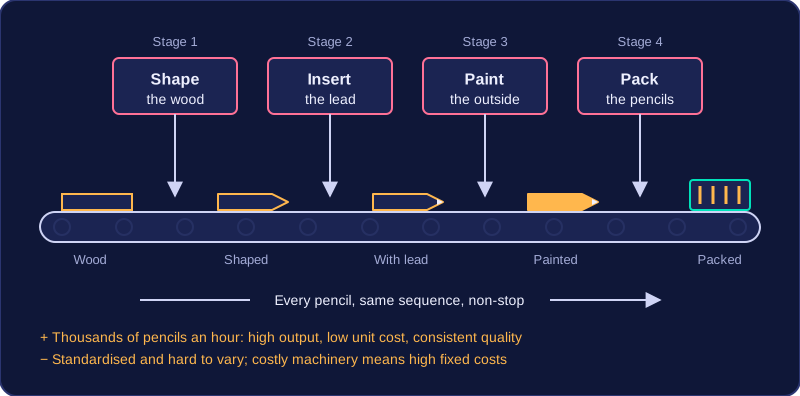
Flow production is usually automated or highly mechanised, so machines do most of the work. This gives high output and high productivity: a large number of identical items can be made in a short time with fewer workers needed for each item. Because every item goes through the same process, it gives a consistent standard of quality. The business can also spread its costs over many units, giving low unit costs per item. High volume means flow production can meet large-scale demand.
For example, a factory making identical wooden pencils could use a line that shapes the wood, inserts the lead, paints the outside and packs the pencils. Running continuously, the line makes thousands of pencils per hour, so each pencil carries a small share of the machine and labour costs.
Drawbacks of flow production
Flow production is less flexible. The product is standardised, so it is difficult to vary, and changing the design often means stopping the line and adjusting machinery. It also needs a large investment in machinery, which gives high fixed costs that must be paid even when sales are low. Automation can produce to a consistent standard, but it does not guarantee perfect quality: the machinery must be set up and checked correctly.
Practise this
Edexcel GCSE Business · 2.3.1 Business operations