Working with suppliers
Just in time JIT

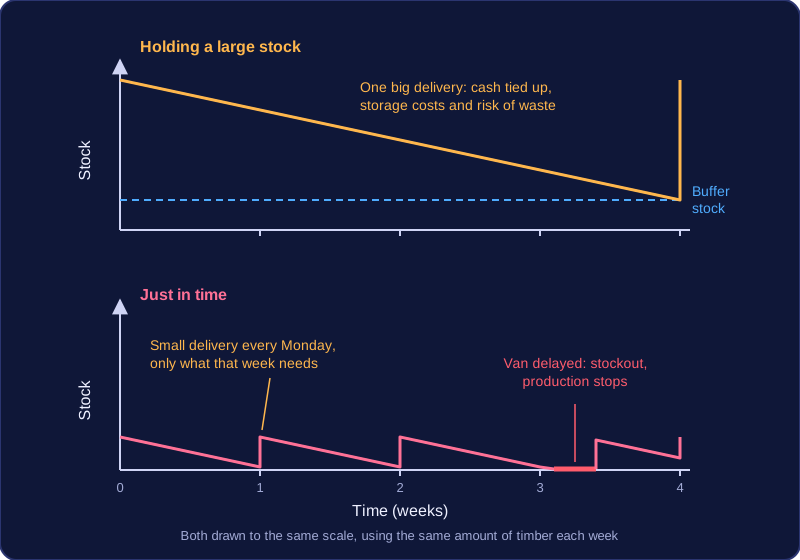
Just in time (JIT) stock control means holding as little stock as possible and having supplies delivered only as they are needed for production or for sale. Stock arrives shortly before it is used, so hardly anything sits in a storeroom.
Why businesses use JIT
- Lower storage and warehousing costs: a smaller stockroom means less rent and insurance to pay, so fixed costs fall; there is also less handling.
- Better cash flow: less money is tied up in stock, leaving cash free for wages, bills or repaying borrowing.
- Less waste: stock held for months can be damaged, go out of date or become obsolete when tastes change.
- Matches stock to demand: supplies are ordered to match what customers are actually buying, so there is less unsold excess stock needing discounting.
For example, a small workshop making wooden garden planters might take a timber delivery every Monday and hold only the timber it expects to use that week. The owner checks the order book first, so cash is not locked up in a pile of boards.
What JIT relies on
JIT only works with reliable suppliers, accurate demand forecasting, efficient logistics, good communication and trust between the business and its supplier. If a van is delayed, production can stop, the business suffers a stockout and customers may buy from a rival instead. JIT does not mean holding no stock at all: a small amount is still needed to keep work going.
The drawbacks
- Deliveries are frequent and in small quantities, which raises ordering and transport costs and can lose bulk-buying discounts and economies of scale, as larger orders usually cost less per unit.
- There is very little buffer stock, so any disruption to the supply chain hits the business quickly.
- JIT is unsuitable where demand is unpredictable, or where suppliers cannot be trusted to deliver on time.
Practise this
Edexcel GCSE Business · 2.3.2 Working with suppliers