Making Operational Decisions
The sales process

Contents
The sales process is the sequence of activities a business uses to sell a product or service to customers. It is more than the moment a customer hands over money: it starts before a sale is made, as soon as someone asks a question or weighs up their options, and it carries on long after handover, through any guarantee period and the support that follows.
Picture a customer buying an electric bike from an independent shop. Staff explain how the battery range and gears work, the bike is adjusted and handed over without a long wait, the shop keeps in touch and asks how the first month has gone, and when a brake cable fails inside the guarantee it is repaired without a fuss. Every one of those steps belongs to the same process.
The main elements
Five elements make up the sales process:
- product knowledge
- speed and efficiency of service
- customer engagement
- responses to customer feedback
- post-sales service
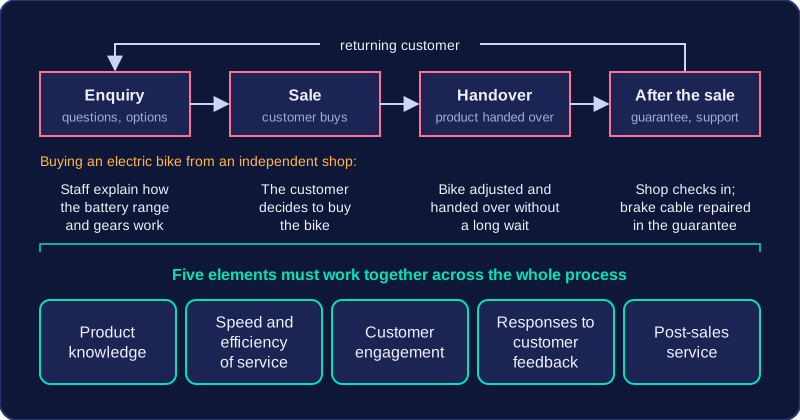
Why the elements must work together
The process only works when all five elements pull in the same direction. A weakness in one can wreck the work done on the others: a garden centre whose staff can name every shrub, but where the tills queue for twenty minutes and emails go unanswered, will still lose sales, because the customer remembers the wait, not the expertise. Strong performance across the whole process is what turns an enquiry into a sale and a sale into a returning customer.
Complex and technical products
The process becomes more demanding when the product or service is technical or complex, such as fitting home solar panels and a battery. Customers need more explanation before they buy, more support while the system is installed, and more after-sales help if the app or inverter develops a fault. The business must therefore stretch every element further, and a weak link is more likely to cost it the sale.
Product knowledge means sales staff fully understand what they are selling: its features, how it works and what it is suitable for. Customers expect staff to know the product well enough to answer their questions confidently.
If you ask about a product and staff hesitate, guess or cannot answer, you start to doubt them. An unanswered question can make you leave and buy elsewhere, so the sale may be lost even when the product itself was suitable. Confidence in the staff is part of what makes a customer willing to buy.
Good product knowledge helps staff in three main ways:
- Explain features clearly, saying what each feature does and why it matters, rather than reciting a list.
- Match the product to the customer's needs by asking questions and recommending a suitable option.
- Deal with objections, such as a customer saying a product is too expensive, by explaining the differences between models and why one costs more.
This matters for every product, not only technical or complicated ones. A customer buying a saucepan, a pair of trainers or a phone case still expects staff to know the whole range and the differences between options.
For example, a customer wants a tent for a family camping trip but is unsure whether a three-person tent will be big enough. Staff who know the dimensions, sleeping space and ventilation can explain the difference and suggest a four-person tent. The customer feels confident in the choice and buys. If staff shrug and say they are not sure, the customer may go to another shop.
Speed and efficiency of service means serving customers quickly while avoiding wasted time and resources. Speed is about how quickly a customer is served or receives what they bought. Efficiency is about providing that service without wasting staff time, stock or money.
Why speed matters in some markets
In some markets customers expect a fast service and will go to a rival if they have to wait. Think of a website selling tickets for a pop concert: when tickets go on sale at 9am they can sell out within minutes, so a fan will buy from whichever site loads quickly and takes payment without fuss. A site that is slow, or that crashes under the rush, loses the sale to a rival.
Efficient service helps the business keep the cost of serving each customer low. The ticket website might store a customer's card details so checkout takes one click, send the tickets by email instead of paying for postage, and run enough server capacity to cope with the rush. Customers are served quickly and the business avoids wasted time and duplicated work, so it can keep its booking fee low and still make a profit.
When a slower pace is acceptable
In other markets a slower pace is acceptable or even expected. If you buy a made-to-measure suit or a new violin, you want the staff to spend time understanding what you need, checking measurements and explaining the options. Rushing that conversation could lead to a poor fit and a lost sale. Efficiency still matters, but not at the expense of careful service.
Finding the right balance
The right balance depends on the market. A quick-service outlet is judged on speed, while a high-value or technical purchase may need a slower, more detailed sales conversation. In both cases, efficient service keeps costs down while still meeting customer expectations.
| Market | What customers expect | How efficiency helps |
|---|---|---|
| Fast-moving market, such as a concert ticket website | Tickets bought within minutes of going on sale | Stored card details, emailed tickets and enough server capacity reduce waiting and waste |
| Slower market, such as a made-to-measure tailor | Time for fittings, advice and changes | Accurate measurements and a clear booking system avoid wasted fabric and repeat visits |
Customer engagement means communicating and interacting with customers to build a relationship with them. The aim is to earn customer loyalty, so customers come back and buy again instead of drifting to a rival.
Why businesses work at it
Loyal customers are valuable: they buy repeatedly, spend more over time and recommend the business to friends and family. Engagement is the regular contact that keeps that relationship alive between one purchase and the next.
For example, an independent board game shop replies to every comment and question on its social media and runs a free games evening each month. Regulars chat with staff about what to try next, and when they want another game they head back to the shop rather than ordering online.
Two-way, across many channels
Engagement can use a range of communication channels: social media, email newsletters, live chat on a website, text messages, phone calls or in-store events. What makes it engagement is that the messages flow both ways. The business listens and replies rather than only sending out adverts, which is just promotion. When customers find it easy to get a response, their whole experience of dealing with the business improves, which strengthens the relationship and makes repeat purchases more likely.
Not the same as customer service
Customer engagement is closely linked to customer service but is not the same thing.
| Customer engagement | Customer service |
|---|---|
| An ongoing conversation, with replies going both ways | The whole experience a customer has of dealing with the business |
| Builds the relationship between purchases | Meets the customer's needs around a purchase, such as sorting a complaint or a late delivery |
| Replying to comments, newsletters, live chat, customer events | Serving at the counter, arranging a refund, fixing a delivery problem |
Customer engagement is one of the five elements of the sales process. Customer service is not one of the named elements, so it is engagement, not service, that appears in the list.
Responses to customer feedback means asking customers for their views, then taking action on what they say. Asking is the easy part; the response is what changes anything.
Why businesses ask for feedback
Businesses collect feedback to listen to customers and find out how they really experience the product, rather than guessing. It shows what is working and what needs fixing, so money and effort go where they are needed most. Typical methods include:
- Surveys sent by email or printed on a receipt
- Online reviews and star ratings on a business's own website or a review site
- Complaints made in person, by phone or by message
- Conversations with customers at the till or after a delivery
For example, a small independent cinema that emails a short survey after each online booking might learn that several customers found Screen 2 too cold in winter. Without asking, the owner would never know the temperature was putting some people off booking again.
Acting on feedback
Feedback is only genuinely useful if the business acts upon it. If the cinema asks for views and then changes nothing, customers feel ignored and stop bothering to reply. If it repairs the heating in Screen 2, the feedback has done its job: the customer experience improves, customers feel valued, loyalty grows, and they return and recommend the cinema to others, increasing ticket and snack sales. Acting on feedback in this way builds repeat business.
Some feedback is unreliable
Some feedback may be biased. Customers who had a bad experience are more likely to write a review than those who were satisfied, and a single angry comment can make a problem look bigger than it is. A business should look for patterns across many responses before spending money on changes.
Post-sales service is all the support a business gives a customer after a sale has been made. It starts once the customer has paid and can continue long after, for example while a guarantee is still running.
What it includes
It is much wider than repairs. A business offering strong post-sales service might:
- give a guarantee — a promise, often lasting 12 months or more, that the business will put right a faulty product, usually by repairing or replacing it
- run helplines, web chat or a support desk to answer questions about setting up or using a product
- handle complaints quickly and fairly when a customer is unhappy
- offer related products, add-ons or servicing to customers who have already bought
For example, a bike shop that sells you a helmet, rings you a month later to check the fit, adjusts it free of charge and tells you when a new model of light arrives is providing post-sales service.
Why it is worth doing
Generous post-sales service can give a business a competitive edge: if you know one business will replace a faulty item without argument, you may choose it over a rival, even at a higher price. It also builds a long-term brand image and customer trust — you believe the business will look after you, so you come back, show customer loyalty and are more willing to buy its related products. Because satisfied customers tell friends, post-sales service can also bring in word-of-mouth recommendations without spending on advertising.
The drawbacks
The catch is that post-sales service can be costly, needing paid staff, vehicles and spare parts, and time-consuming, so complaints may wait while staff travel or investigate. Refunds and replacements also reduce the money the business keeps, and if guarantees are too generous the extra sales may not cover these costs, which eats into profit.
Customer service is the whole experience a customer has with a business, not only the moment of sale. It covers everything from asking questions before buying to what happens after a sale, including delivery and any problems that follow.
Good customer service makes customers feel valued. A customer who is listened to, kept informed and treated politely feels the business cares about them, rather than just about taking their money.
It includes problems, not just friendly service
Customer service is not only serving customers pleasantly. It also includes handling complaints and delivery problems. Good customer service means these issues are dealt with properly, not that they never happen. For example, if a customer orders a flat-pack desk from a small furniture shop and one panel arrives scratched, good service means the shop answers quickly, apologises, arranges a replacement panel and tells the customer when it will arrive.
How it relates to the sales process
The sales process is the sequence of activities a business uses to sell a product or service. Customer service is wider: it covers the whole experience the customer has around those activities, before, during and after the sale. A shop might have a quick, well organised sales process, but if staff ignore a complaint afterwards, the customer's overall experience is still poor.
Good customer service is how a business treats customers before, during and after a sale. When customers feel valued, the benefits spread well beyond that one purchase.
Spending, loyalty and reputation
Good service can encourage a customer to spend more in the same visit. A customer helped to find an item, or whose problem is sorted quickly, may add extra items to their basket. Higher spending raises revenue, and profit rises if the cost of serving that customer does not rise as much. Good service also builds customer loyalty and retention: people return because they trust the business, giving it repeat purchases and steadier sales that help it survive quiet periods.
Satisfied customers often leave positive reviews and recommend the business by word of mouth. That is free promotion, so the business may need to spend less on advertising. A strong brand and reputation can also let a business charge slightly higher prices than rivals, raising its profit margins and so its profits if costs stay the same.
Standing out and growing
Good service differentiates a business from its rivals and gives it a competitive advantage. If two shops sell similar products, customers may choose the one where staff are more helpful, taking business away from competitors. This can raise demand, sales revenue and market share — the percentage of total sales in a market that a business holds.
From customer to profit
A benefit works as a chain of steps, from the customer's response to the business result. For example, a garden centre helps customers carry heavy compost bags to their cars. Customers feel valued, so they return each spring and buy more plants. They tell neighbours, who visit too. Demand and revenue rise, and the centre wins market share from a nearby DIY superstore.
Profit, however, only rises if the extra revenue is greater than the cost of providing the service. The garden centre may pay staff for longer shifts or replace damaged pots free of charge. If those costs are higher than the extra revenue, profit falls instead.
Poor customer service leaves customers feeling let down: a phone that rings unanswered, staff who seem uninterested, a delivery that arrives late with no apology, or a complaint that is shrugged off. The damage goes well beyond the one sale that is lost.
A damaged reputation
A business's reputation is what customers believe about it, built from their own experiences and from what others say. Unhappy customers post one-star reviews and tell friends, family and workmates, and that word of mouth puts off people who have never used the business. Many who are treated badly simply switch to a competitor and never come back.
Lower sales, market share and profit
The effects then run in a chain. Customers switching means fewer sales, so revenue falls. As rivals win those customers, the business's market share, its slice of all sales in the market, shrinks. Profit falls from two directions: less revenue coming in, and money spent on discounts or advertising to win back trust.
Lost repeat business
Repeat customers are the dependable part of future sales: the people who return for servicing, refills or an upgrade without being persuaded. Poor service breaks that habit, so income becomes less steady and more must be spent finding replacements. If enough customers leave, the fall in sales can threaten the business's survival.
Worked example: A bike repair workshop keeps a customer's bike a week longer than promised and then charges her again to fix a brake fault it had missed. She posts a one-star review, tells her cycling club, and moves her twice-yearly servicing to a rival shop. The workshop loses that repeat business and the club's recommendations, its sales and market share slip, and the owner spends on posters and a discount to attract new customers, which cuts profit further.