The product lifecycle
Product lifecycle

The product lifecycle is a model showing how sales of a product change over time, from development through to decline. It helps a business work out where a product is in its life so that it can plan its marketing.
The five stages, in order, are development, introduction, growth, maturity and decline. Development comes first, before the product is launched, and decline is the final stage, so maturity is not the end of the lifecycle.
Sales pattern at each stage
| Stage | What happens to sales |
|---|---|
| Development | No sales yet, because the product has not been launched. |
| Introduction | Sales start low after launch. |
| Growth | Sales rise quickly as the product becomes more popular. |
| Maturity | Sales reach a peak or stay broadly steady. |
| Decline | Sales fall. |
The lifecycle is usually shown as a sales-against-time graph. Time runs along the horizontal axis and sales along the vertical axis. The line starts at zero during development, rises through introduction and growth, levels off at maturity, then falls during decline. Each stage therefore has its own recognisable sales pattern.
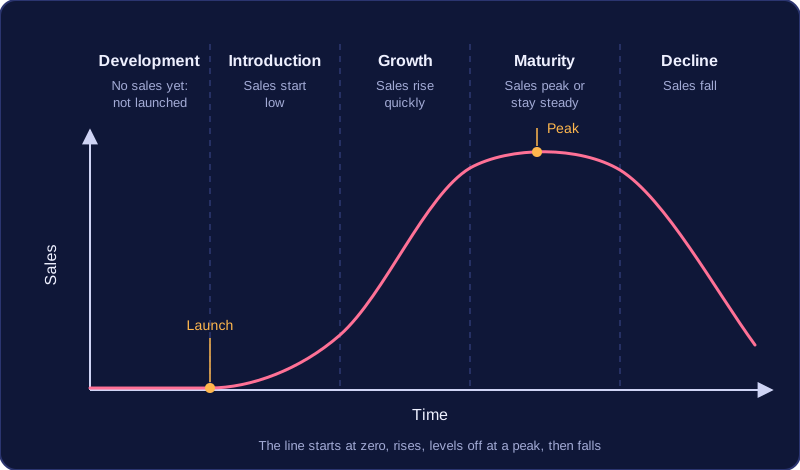
For example, imagine a new magnetic pencil case that clips inside a school locker. Before launch there are no sales while it is being designed. Just after launch only a few students buy one, so sales are low. Sales then climb quickly as word spreads. Once most students who want one have bought it, sales settle at a high, steady level. When a newer design appears, sales begin to fall.
Practise this
Cambridge National Enterprise & Marketing · 4.7 The product lifecycle
Cambridge National Enterprise & Marketing · 4.9 Factors to consider when pricing a product