Creating a Marketing Mix to Support a Product
Factors to consider when pricing a product
Contents
A pricing decision is a choice about how much to charge for a product. The price must help the enterprise achieve its aims and appeal to its target market — the group of customers it is aiming at. Price is never just a number: it sends a message about the product, helps decide whether customers buy, and affects whether the business makes a profit.
Supporting the aims
Every enterprise has aims — what it is trying to achieve, such as building a premium image, growing quickly to win market share, surviving its first year or making a healthy profit. The price has to point in the same direction as the aim. A start-up selling scented candles in gift boxes that wants a premium image cannot charge £1.50 a candle: many customers judge quality by price, and a gift that looks cheap wins few buyers. The same business aiming to be seen as good value by teenagers buying presents for friends would need a price they see as affordable. Neither price is wrong on its own — each suits a different aim and a different target market.
Attracting and keeping customers
A suitable price attracts customers in the first place and keeps them coming back. Customers who feel they paid more than a product was worth do not return, and they tell their friends. A price that feels like fair value builds repeat custom, which matters most to a new enterprise with only a handful of customers to its name.
Still making a profit
The price must also be high enough to cover costs and leave a profit. A price that delights customers but sits below the cost of production loses money on every sale, so the business cannot survive however popular it becomes. Set the price too high, though, and few customers buy, so the profit on each sale is large but total profit may be small.
A pricing decision is therefore a balancing act: what the target market will happily pay, so the enterprise attracts and keeps customers, against what it needs to earn to meet its aims and make a profit.
Income levels of target customers is about how much money the customers in your target market have available to spend. Customers can only buy what they can afford, so a price above their budget reduces the number of customers who are able and willing to buy. A higher price can also shrink the target market by excluding customers on lower incomes.
Income affects how customers judge value. A £30 personalised water bottle may look reasonable to a group with more spare money, but expensive to a group with less. Same product, same price, different reaction. Before choosing a price, a start-up should research or estimate the income profile of its target customers, for example by looking at the area it sells in or asking potential customers what they can afford. Age alone tells you little about affordability; the useful question is what income customers have available.
Lower-income target customers
If your customers have less money available, a lower price or a clear value offer may be needed. A value offer makes the price feel worth it, such as a refill pack, a bundle or a simple version with fewer extras. Example: a start-up selling revision stationery to students might offer a £4 basics pack rather than a £12 deluxe set.
Higher-income target customers
If your customers have more money available, a higher price may be acceptable, but only if the product's quality and value support it. Example: a start-up selling handmade leather phone cases to office workers could charge £40 if the stitching, packaging and personalisation clearly feel premium. The price must still match what that group expects.
Competitor prices are the prices that other businesses charge for similar products. When you set a price, customers often compare your price with rival prices to judge whether it seems fair. For example, if three shops sell similar personalised water bottles for £12 to £16, a price of £14 feels reasonable, but £24 may look expensive unless your bottle is clearly different or better quality.
Researching competitor prices helps you understand the market price range – the range of prices that rival businesses charge for similar products. You can check rival websites, market stalls or shops to see what customers are already used to paying. This research stops you pricing too far above or below competitors without a reason.
Pricing above, below or matching rivals
| Your price choice | Possible effect |
|---|---|
| Higher than competitors | Can lose price-sensitive customers – buyers who care a lot about price and switch to a cheaper option. It may work if your product is clearly different or offers better value. |
| Lower than competitors | Can attract customers, but you earn less profit per sale. Rivals may cut their prices too, starting a price war where businesses keep undercutting each other and everyone's profit can fall. |
| Matching competitors | Reduces the risk of losing customers on price alone, but your product may not stand out from the crowd. |
Pricing below competitors is not automatically the best choice, and matching is not automatically the safest. Each choice has a trade-off between attracting customers and protecting profit. A start-up selling printed tote bags might find rivals charge £9 to £13. Setting £11 matches the middle of that range and keeps your price within the range customers already expect, but it gives no strong reason to choose the bags over another stall's.
Cost of production is the total cost of making or supplying a product. It includes materials, labour and other business costs, such as packaging, delivery or rent for the space where the product is made.
To work out the cost per unit, add the costs of making one item, including a share of fixed costs, or divide total costs by the number of units made. The selling price must normally be higher than the cost per unit. Each sale then covers its costs and adds to profit. If the price is below the cost of production, the business makes a loss on every sale. A business that keeps doing this may not survive.
Cost of production helps set a minimum price. You need to know your costs before you can decide how much profit to add. For example, a student makes personalised phone cases. Materials cost £2.50, packaging is 40p, and labour and workshop costs add £1.60 per case, so the cost per unit is £4.50. Charging £4.00 would lose 50p per case. Charging £7.00 gives £2.50 profit per case.
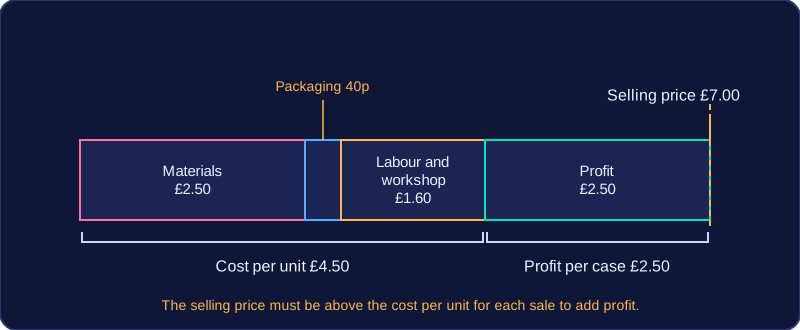
Reducing costs can let you charge a lower price or keep a higher profit margin at the same price. For instance, buying plain phone cases in bulk might cut materials to £2.10, so the cost per unit falls to £4.10. However, price should not be based on cost alone; other factors, such as income levels and competitor prices, also matter.
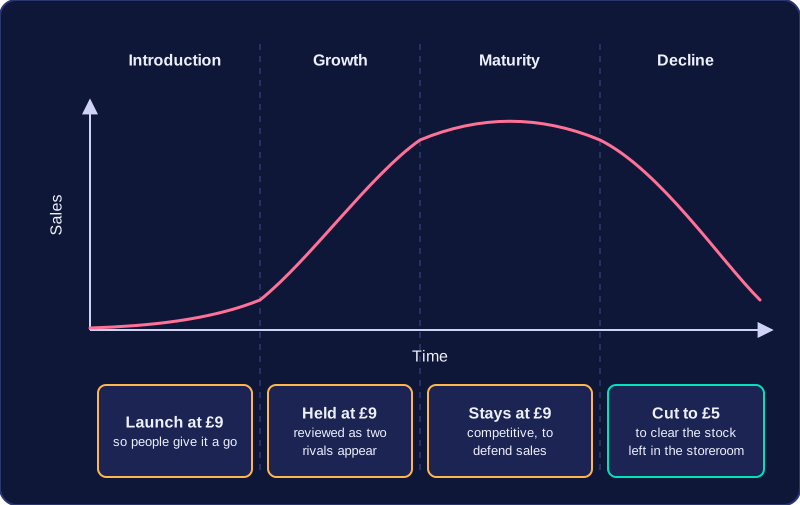
As a product moves through the product lifecycle, sales and competition change, so the price that worked at launch may not work later. Price should be checked and reviewed at each stage, because the same product can need different pricing as it ages.
| Stage | What is happening | Possible pricing response |
|---|---|---|
| Introduction | The product is new, customers do not know it and sales are low | A low price to encourage customers to try it, or a higher price if demand is expected to be strong and the product is distinctive |
| Growth | Demand rises and competitors notice, so they enter the market | The price may need to be reviewed as rivals appear |
| Maturity | Sales level off and competition is often strong | A competitive price, to maintain sales |
| Decline | Sales fall | Cut the price to boost sales, clear stock or attract price-sensitive customers |
A low launch price gives customers a reason to try something unfamiliar, because the risk of wasting money is small. A higher launch price only works when the business expects demand to be strong and the product is distinctive enough that customers cannot easily buy something similar. Avoid a high price when rivals already sell something alike, because customers will simply go elsewhere.
Worked example: Skyline, a start-up selling a new card game, launches at £9 so people will give it a go. In the growth stage two rival card games appear, so the price is reviewed and held at £9 to stay attractive against them. In maturity, sales level off and the price stays competitive to defend those sales. In decline, the business cuts the price to £5 to clear the stock left in its storeroom. One game, different prices, because the stage changed.
Weighing up pricing factors means deciding which influences matter most before choosing a price. The factors do not act separately: customer income and competitor prices shape what customers will pay, production costs set a minimum price, and lifecycle stage affects when and how the price should be adjusted.
In a particular start-up, some factors matter more than others. Weigh them against the business aims, target market, costs, competition and product stage, then explain your priority.
Prioritising the factors
| Situation | Factor likely to matter most | Why it shapes the price |
|---|---|---|
| Customers have tight budgets and affordability is the main issue | Income levels | A price above what customers can afford reduces the number willing or able to buy. |
| Competitors are numerous and products are similar | Competitor prices | Customers compare easily, so being too far above the market range can lose sales. |
| Costs are high or finance is limited | Cost of production | The price must cover costs, so costs set the minimum price the business can accept. |
| The product is new or declining | Lifecycle stage | A launch price can encourage trial, while a declining product may need a lower price to slow falling sales. |
A pricing decision is justified when it explains why the chosen factors were prioritised and how they influenced the final price. For example, a town-centre skateboard shop with three similar shops nearby may find competitor prices matter most: its price must sit close to the local market range to attract buyers. Production costs still set a minimum, and customer income shows whether that price is affordable, but the competitor comparison drives the final figure.