Creating a Marketing Mix to Support a Product
Pricing strategies
Contents
A pricing strategy is the overall approach a business takes to choosing its price. It is not the same as calculating an exact price; the strategy is the thinking behind the price: is it set to match what rivals charge, to appear lower than a round amount, to launch high, or to launch low?
| Strategy | The approach behind the price |
|---|---|
| Competitive pricing | The price is set close to the prices charged by rival businesses. |
| Psychological pricing | The price is placed just below a round amount so it appears lower than the round amount. |
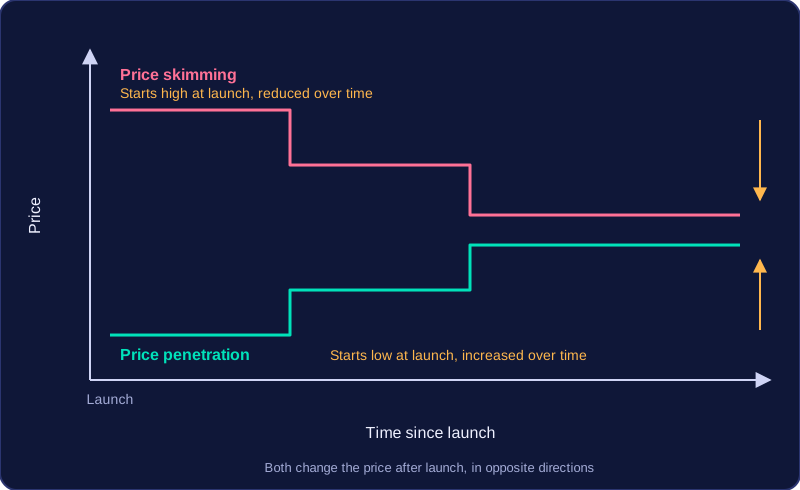
| Price skimming | The price starts high at launch and is reduced over time. |
| Price penetration | The price starts low at launch and is increased over time. |
What is not a pricing strategy
A free gift with every purchase, a prize draw to win concert tickets or a loyalty card that gives a free drink after ten stamps are all sales promotions, not pricing strategies. A sales promotion is an incentive used to attract customers, often for a limited period, whereas a pricing strategy is the approach the business takes to setting the price in the first place.
When naming a pricing strategy, use one of the four above; a sales promotion is a different marketing method and will not match the question.
Competitive pricing means charging a price that is similar to the prices your competitors charge. The price is set in line with the market: you check what rivals charge and price close to that, rather than picking a number at random.
How it works
You can slightly undercut rivals by charging a little less, or charge slightly more if you are a market leader (the biggest seller in the market) with a strong reputation. Either way, the starting point is competitors' prices. Competitive pricing does not mean you must be the cheapest — a business charging a little more than rivals is still using it, as long as its price sits in line with the market.
For example, a new skate shop sees that other shops in town sell a complete skateboard for around £70. It charges £68: a little below the going rate, but still a price customers recognise as normal.
Advantages
- Price matching reduces the risk of losing customers to a rival on price alone — nobody can say you are obviously more expensive.
- Customers are more likely to accept a price that is common in the market, because it feels normal and fair.
- You can still gain a competitive advantage: as the cheapest provider, or as a market leader whose brand justifies charging slightly more.
- It can stop competitors from having a price advantage, and it is quick and easy to set because you only need to check rival prices.
Disadvantages
- Trying to match or beat the lowest prices risks low profits, or even a loss, because the price may not cover your operating costs.
- It can mean lower revenue or smaller profit margins than a business charging more.
- A smaller or newer business may struggle to match larger competitors that benefit from economies of scale — lower costs per unit because they buy in bulk.
- You may still lose out to a competitor with stronger brand loyalty, so you need other ways to stand out.
Psychological pricing sets a price so that it appears lower than it really is, usually by placing it just below a round amount. A skate shop might sell a deck for £49.95 instead of £50. Your eye lands on the 49, so the deck feels like a forty-something price even though the saving is only five pence. The aim is to encourage sales by changing how the price is perceived.
Advantages
- It encourages sales because customers perceive the price as closer to the lower round amount than to the higher one, so it feels like a better deal than it is.
- It can help build a reputation for good value, which suits a business whose target customers compare prices carefully before they buy.
Disadvantages
- Customers may become aware of the tactic. If every item on a shelf ends in 95p, shoppers learn that the ending is a trick and it stops influencing them.
- It can cause rounding problems when a percentage discount is applied. Take 15% off a £6.99 water bottle: you get £5.9415, so you have to round to £5.94, which leaves an untidy price and a small gap between what you calculated and what the customer pays.
Psychological pricing is a pricing strategy, not a sales promotion. Nothing extra is thrown in and nothing is cut by a large amount: the saving is only a few pence, so it is the way the price is presented, rather than a real bargain, that persuades customers.
Price skimming is a pricing strategy where a business sets a high price when a product first launches, then reduces the price over time. The high price comes first, and the reductions follow — the opposite direction to price penetration.
How it works
It suits a product where demand at launch is expected to be very high, often because it is new or exciting and eager customers want it straight away. Those early buyers pay the top price. Other customers cannot afford it, or are not willing to pay it, so they hold back and wait for the later price cuts. The business still sells to them, just further down the line.
For example, a small firm launches the Aero camera drone at £620. It sells 4,500 units in the first two months to hobbyists who want one immediately. Six months later the price falls to £510, then to £430 the following year, picking up the buyers who waited.
Advantages
- A high price can make the product seem more desirable, and it helps maximise profits while demand is strongest.
- It creates a perception of quality and a premium image, which suits a product the business wants to look top of the range.
- Fewer products need to be sold at the high price to break even, because each sale brings in more money towards covering costs.
- Revenue and profit per sale are higher, so the business can recover its launch costs more quickly.
Disadvantages
- Rivals have plenty of room to come in cheaper. A competitor could bring out a newer product at a lower price and win over the customers who feel priced out.
- High prices may deter some customers altogether, so the business risks losing sales rather than gaining them later.
Price penetration is a pricing strategy where a product is launched at a low price, which is then gradually increased over time. The low price pulls customers in at the start, and the price only creeps up once the product is better known.
For example, an escape room opening in a town where nobody knows it might charge £8 per player for the first two months, then £12 once word has spread, and £15 after six months.
Advantages
- A low initial price is attractive, so customers are more willing to try something new or switch from a competitor they already use.
- It helps a new business establish itself in the market, because a steady stream of early customers builds awareness and gets people talking about the product.
- Customers may stay loyal when the price goes up, because they already know and like the product and are used to buying it.
- The low price only lasts a short time, so as it rises each sale brings in more money and revenue can recover over the following months.
Disadvantages
- A low price means low profits, especially in the short term. Each sale brings in less money, so the business may struggle to cover its costs at first.
- There is no guarantee customers will keep buying once the price rises. Some may decide the higher price is not worth it and leave.
Price skimming and price penetration move in opposite directions, so keep them apart: skimming opens with a high launch price that falls over time, while penetration opens with a low launch price that rises.
| Strategy | Launch price | Price over time | Why a business uses it |
|---|---|---|---|
| Price skimming | High | Falls | To earn more per sale and create a premium image at launch |
| Price penetration | Low | Rises | To attract customers now and earn profit later |
How price skimming works
The high price at launch is the key feature: it makes the product seem desirable, gives it a premium image and brings in more revenue per sale, so fewer sales are needed to break even. A new board game launched at £38 and cut to £25 six months later is skimming — the £38 launch price and the quality image it signals are what matter, not the later cut.
How price penetration works
The low price attracts customers to try a new product or switch from a rival, which helps a new business become established. Because the low price holds profits down at first, any profit benefit is a long-term outcome: it arrives once customers stay loyal as the price is raised. A revision app launched at £1 a month and later charged at £4 is penetration.
The direction of the price is what separates the two strategies. A high price that drops is skimming; a low price that climbs is penetration. Calling skimming a low start, or penetration a high start, describes the wrong strategy.