Creating a Marketing Mix to Support a Product
Extension strategies

Contents
An extension strategy is an action taken to prolong the life of a product and increase or maintain its sales when they may be falling. It is used when a product has reached a later stage of its product life cycle and its sales need supporting, rather than when the business is creating a completely new product. Keeping an existing product selling is often cheaper than launching a new one, and customers already recognise it.
Products include both goods, such as a backpack, and services, such as a mobile phone contract, so extension strategies can apply to either.
The main extension strategies are:
- Advertising
- Price changes
- Adding value or improving specifications
- Exploring new markets
- New packaging
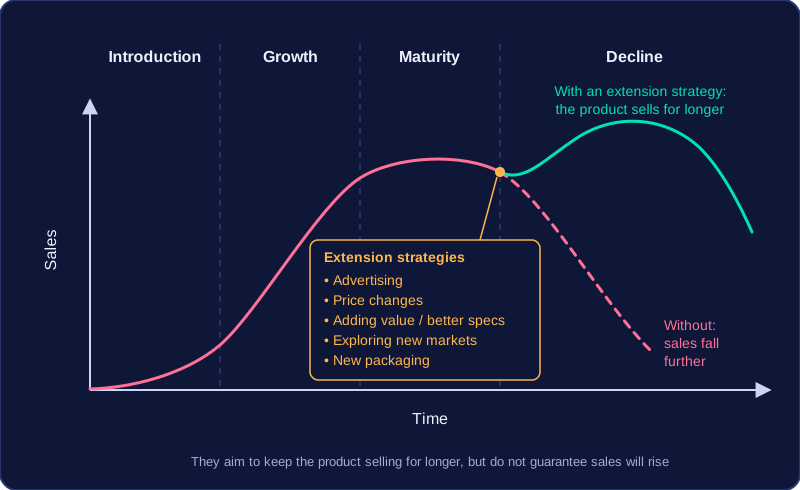
Each one works in a different way, but they all aim to keep the product selling for longer. For example, a business might advertise to remind customers about a product that has been around for years, or explore a new market to find new customers. Extension strategies do not guarantee that sales will increase or that decline will stop, but they give the product a better chance.
Extension strategies are not the same as sales promotion. A sales promotion is a short-term incentive, such as a money-off coupon or a free gift, designed to boost sales quickly. An extension strategy is a longer-term action designed to keep the whole product selling for longer. For example, a business might run an advertising campaign over several months to remind customers of a product's benefits, rather than offering a one-week discount.
Advertising is an extension strategy that uses promotional activities to remind customers about an existing product and its benefits, aiming to keep sales steady or push them up. It is not the same as a sales promotion such as a two-for-one offer: advertising communicates a message rather than giving a short-term deal.
Advertising can be aimed at a particular group. If a board game's sales are falling only among families with primary-age children, the maker could advertise in a parenting magazine or on a family film channel. This focuses the budget on the customers whose buying has slipped, rather than paying to reach everyone.
Working alongside other strategies
Advertising can be used alongside another extension strategy, or to promote a change made through one. For example, if a backpack has been given a stronger zip, an advert can show that improvement and remind buyers why the backpack is useful.
Its main advantages are that it reminds people what the product does and why it is worth buying, and it can be targeted at a specific market. A campaign can therefore be more relevant than a general message.
Drawbacks to weigh up
- Campaigns can be expensive, and there is no guarantee that sales will rise, so the money spent may never be earned back.
- Any sales increase may be short-lived, because once the campaign stops the reminders stop and customers may forget the product again.
- An advert may reach people outside the target market, so some of the spending does not persuade the customers who are most likely to buy.
For example, a small business selling a puzzle book might pay for adverts on a hobby website used by adults who enjoy puzzles. If the adverts appear on a general news site instead, many readers may ignore them, reducing how effective the campaign is.
A price change used as an extension strategy means deliberately altering what you charge for a product so that it looks more attractive or more competitive than rivals, keeping sales going when they would otherwise fall. A price change can be a reduction or a rise, although reductions are the more common way to extend a product's life.
How a lower price can help
Cutting the price makes your product look better value next to competitors. That can do two jobs:
- Encourage brand switching – a customer who normally buys from a rival may give your product a go because the saving is worth trying something new.
- Create more demand – people who thought the product was too pricey may now buy it, and existing customers may buy again or buy more.
Businesses use different pricing approaches at different points in a product's life. A product might launch at a high price to recover its development costs, then be cut later when rival versions appear and sales begin to slip. For example, Ridgeway Bikes sells a children's bike at £180. Sales fall after two competitors launch similar bikes at £160, so Ridgeway drops its price to £155 as an extension strategy, hoping families comparing models will choose theirs.
The cost of cutting prices
The big drawback is profit, because the business keeps less money from each sale. If making and supplying a bike costs Ridgeway £110, it used to make £70 per bike and now makes only £45. It must sell far more bikes just to earn the same profit as before, so sales can rise while profit falls. A price rise would protect profit per sale, but it usually slows sales rather than extending them, so it is rarely the first choice.
A planned change, not a quick offer
A price change used as an extension strategy is a deliberate, planned decision to keep a product selling for longer. It is not the same as a short-term sales promotion, such as a weekend "20% off" deal to clear old stock. It also does not guarantee that sales will recover.
Adding value is an extension strategy where you improve the specification or features of an existing product. The aim is to make the product more desirable, so it sells more and its life is extended.
Adding a feature that rivals do not offer can create a unique selling point (USP). For example, a reusable water bottle brand might add a built-in filter that removes chlorine from tap water. That gives customers a clear reason to choose it over cheaper bottles, which could boost sales and attract new customers.
| Advantage | Why it helps | Disadvantage | Why it matters |
|---|---|---|---|
| More desirable | Extra features can make customers choose your product over rivals. | Costly | Designing and making new features costs money, reducing profit. |
| New USP | Gives a reason to buy that competitors do not offer. | Upsets customers | Loyal customers may prefer the original; you may need to tell them about changes. |
| Boosts sales | Can attract new customers and encourage existing ones to buy again. | May not solve the cause | If sales fell for another reason, a new feature might not fix it. |
However, adding value is not guaranteed to work. Designing and producing a new feature is often costly, which can reduce profit per sale. Changing an existing product can also upset current customers who liked the original version, so you may need to inform them about the change and explain the benefits.
Most importantly, adding value only helps if it tackles the real reason sales were falling. If a rival is simply cheaper, a new feature might not solve the problem because customers may still prefer the lower price.
Exploring new markets is an extension strategy where you sell an existing product to a new geographic area or to a new target demographic. The product itself can stay largely the same, so this is often a relatively cheap way to improve sales because further product development may not be needed.
Two types of new market
- New geographic area: selling in a different town, region or country from the one you already serve.
- New target demographic: selling to a different group of customers, such as a different age group, income level or type of user.
For example, a business that sells model aeroplane kits to hobby shops in one city could supply hobby shops in another region, or it could market the same kits to after-school STEM clubs rather than to individual hobbyists.
Why it can help
A new market can provide an opportunity for immediate sales growth, because you are selling a product that already exists and already works. Selling in more than one market also spreads the balance of decline and growth across markets: if sales are falling with one group or in one area, rising sales in another market can keep total sales steadier.
A business selling garden games might find UK sales drop in winter. Selling the same games to customers in Australia, where the seasons are opposite, can balance that seasonal decline.
The product must fit
Entering a new market is not automatically successful. The product must suit the new market and be accepted by customers there. A board game with English-only instructions might suit a new age group in the UK, but it may not be accepted in a country where customers need translated rules. If the product does not fit, you may have to change it, which reduces the cost saving that made this strategy attractive.
New packaging is one of the extension strategies: it means changing the container or wrapping of a product. It often goes with a rebranding, when a business updates how it looks so customers see it differently.
Why change the packaging?
New packaging can attract new customers. A fresh design may stand out on a shelf, and some shoppers may think the product itself is new or improved, so they try it. For example, a fictional business called Paws & Claws sells dog biscuits in a plain brown box. It moves to a resealable pouch with a hanging tab and a bold illustration of a dog. The pouch can hang on a shop hook, so it is easier to spot, and the resealable top may persuade owners that the biscuits will stay fresh.
It can also be cheaper to produce. If the new wrapper uses less material or is simpler to print, the business may spend less on every item, which can lower costs. Packaging that uses less plastic or paper can also be more environmentally friendly.
What can go wrong?
Existing customers may no longer recognise the product. If they walk past the shelf expecting the old box, they may not spot the new one and may buy a rival instead. The new design may also appeal less than the original, even if the business likes it.
Changing packaging can be expensive to design and produce. The business may pay for designers, test versions and new printing equipment, and those costs can be high compared with the extra sales the change brings.
The best extension strategy for a product is not the same in every case. You need to match it to the product itself, its target customers, the reason sales are falling, the likely cost and the expected effect on sales and profit. A strategy can look clever but still fail: customers may not notice it, may not like it, or the cost may be higher than any extra profit. No extension strategy guarantees success.
What shapes the choice
Start with why sales are falling. If customers are switching because a rival offers a useful feature, a price cut may only reduce profit per sale. If the product is still good but customers have stopped noticing it, advertising may fit better. The target customers matter too: a campaign or design aimed at the wrong group wastes money. Brand recognition and reach count as well — a product that few people have heard of needs a different approach from one that is already well known, and a strategy only works if it reaches the customers it aims at. Always compare the cost with the likely gain.
Making a recommendation
For a named product, compare at least two options and give an advantage and a disadvantage of each before you judge which is best. For example, PulsePop sells refillable water bottles to secondary school students. Sales are falling because rival bottles now have built-in straws. New packaging might make the bottles look fresher on the shelf, but new designs and printing could cost £3,000 and would not solve the feature problem. Adding a leak-proof straw lid would cost about £1.50 per bottle and directly answers the reason customers are leaving. It may raise unit costs, but the improved specification is more likely to protect sales and could support a slightly higher price. On balance, adding value is the better choice for PulsePop, although its success still depends on students liking the new lid and the business being able to produce it reliably.