What Makes a Product Financially Viable
Cost of producing the product
Contents
Fixed costs are costs that do not change when the level of output or sales volume changes. They are paid whether the business produces or sells anything or not, so they are still incurred when output or sales are zero.
“Fixed” means fixed with respect to output or sales, not that the amount can never be reviewed. A landlord could put the rent up next year, but for the period you are working with, the rent stays the same however much is made or sold.
Fixed cost examples
| Fixed cost | Example | Why it is fixed |
|---|---|---|
| Rent for premises | A small bakery pays £850 a month for its shop. | The £850 is due whether it sells 100 loaves or 1,000. |
| Salaries | A full-time dental receptionist is paid an annual salary of £22,800. | Salaries are annual or monthly pay for core staff and are treated as fixed regardless of output. |
| Insurance | A bike repair enterprise pays £240 a year to insure its tools. | The cover is paid for the year, even in weeks with no repairs. |
| Advertising and promotion | A new games café spends £120 a month on adverts. | The spending is planned to attract customers and is not set by how many visit. |
| Utilities | A studio pays for electricity, gas and water. | The bills are paid across the period and are not worked out from how many products are made or sold, so they are classed as fixed costs even though real bills can rise and fall with use. |
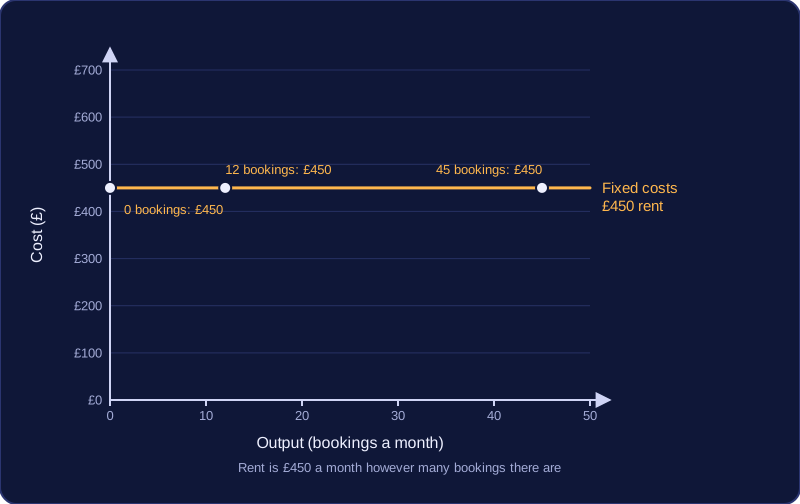
A dog-grooming enterprise rents a unit for £450 a month. The rent is £450 in a busy month with 45 bookings, a quiet month with 12 bookings, and even a month with no bookings at all.
Variable costs are costs that change in total with the amount a business produces or sells. If output goes up, total variable costs go up; if output goes down, total variable costs go down. They are not a fixed amount you pay whatever happens.
What counts as a variable cost
Variable costs include:
- Raw materials and components — the physical parts that go into a product, such as flour for a bakery or fabric for a clothing maker.
- Packaging — the boxes, bags, labels and wrappers used for each item sold.
- Wages — usually hourly pay for work. Wages are treated as variable because the number of hours worked, and so the wage bill, changes with output. Salaries are different: they are a fixed cost.
Why they rise and fall
Each extra unit made or sold usually needs more materials, more packaging and more hourly labour. So total variable costs rise as production increases and fall as production decreases. If output falls to zero, total variable costs from making products fall to zero because no materials, packaging or hourly wages are needed for production.
Worked example
A small business makes scented candles. Each candle uses £2.50 of wax and wicks, £1.20 of jar and label packaging, and 12 minutes of a worker's time at £10 per hour. That is £2.00 of wages per candle. The variable cost per candle is £2.50 + £1.20 + £2.00 = £5.70.
| Output (candles) | Total variable costs |
|---|---|
| 0 | £0 |
| 100 | £570 |
| 200 | £1,140 |
| 300 | £1,710 |
The table shows total variable costs rising in direct proportion to output: double the candles, double the total variable costs.
When a business borrows money, the charge for using that money is loan interest. Interest is a fixed cost because it is paid for the period of the loan whether output is high or low. If a business borrows £8,000 at 6% per year, the interest is £480 for the year, so £480 goes into fixed costs for that year, or £40 a month if spread evenly.
A loan repayment is not treated as a fixed cost. Each repayment is made up of part of the borrowed amount plus interest. Only the interest part belongs in fixed costs; the rest reduces what the business owes. If the monthly repayment on that £8,000 loan is £700, only the £40 of interest is a fixed cost, and the other £660 pays off part of the loan.
The loan itself is a separate liability, meaning money the business owes. It is not part of the fixed cost calculation at all. Adding the whole repayment would mix up paying back a debt with the ongoing cost of borrowing, which is why only the interest counts as a fixed cost.
Total costs are the fixed costs plus the variable costs for the same time period. Fixed costs do not vary with output or sales volume, while variable costs rise and fall with the number of units produced or sold. Classify each cost before you calculate totals or any per-unit cost, so costs are grouped correctly. For this qualification, salaries, rent, insurance, advertising and utilities are fixed; raw materials, packaging and wages are variable; only loan interest is fixed, not the repayment.
To find total fixed costs, add together every individual fixed cost for the period. To find total variable costs, multiply the variable cost per unit by the number of units produced or sold. Then add the two totals. Use one time period throughout: multiply a monthly figure by 12 for a year, or divide an annual figure by 12 for a month.
Worked example
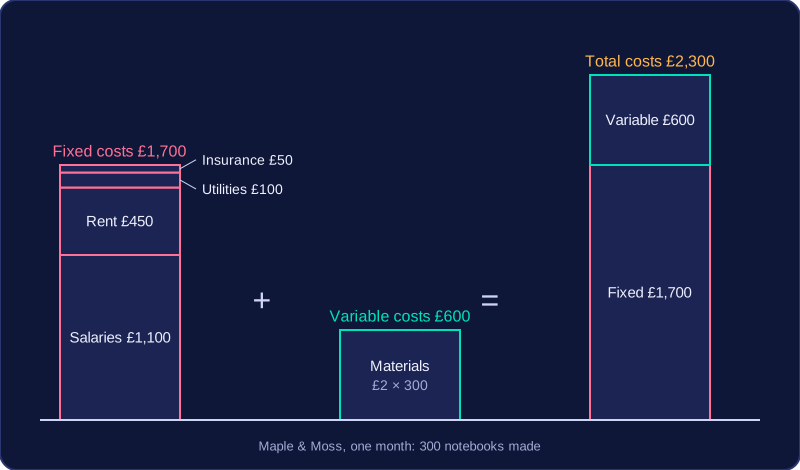
Maple & Moss makes handmade notebooks. Its monthly costs are rent £450, salaries £1,100, insurance £50 and utilities £100. Materials cost £2 per notebook and 300 are made in the month.
| Cost | Monthly amount | Type |
|---|---|---|
| Rent | £450 | Fixed |
| Salaries | £1,100 | Fixed |
| Insurance | £50 | Fixed |
| Utilities | £100 | Fixed |
| Materials | £2 × 300 = £600 | Variable |
Total fixed costs = £450 + £1,100 + £50 + £100 = £1,700. Total variable costs = £2 × 300 = £600. Total costs for the month = £1,700 + £600 = £2,300. If you converted to a year, use the same period for every figure: annual fixed costs = £1,700 × 12 = £20,400 and annual variable costs = £600 × 12 = £7,200 (assuming the same output each month), so annual total costs = £20,400 + £7,200 = £27,600.
Cost per unit is the average cost of producing or selling one item. You find it by dividing a total cost by the number of units sold or produced in the same period. Businesses use it to work out the price they need to charge to cover their costs and make a profit.
The number of units must be for the same period as the costs, so a month of costs is divided by the units made in that month.
The three calculations
| Cost per unit | Calculation | Example: 800 packs |
|---|---|---|
| Total cost per unit | total costs ÷ number of units | £1000 ÷ 800 = £1.25 |
| Variable cost per unit | total variable costs ÷ number of units | £400 ÷ 800 = £0.50 |
| Fixed cost per unit | total fixed costs ÷ number of units | £600 ÷ 800 = £0.75 |
Meadow Melts makes wax melts. In one month its fixed costs are £600, its variable costs are £400 for 800 packs, so total costs are £1000. The two per-unit figures add up to the total cost per unit: £0.50 + £0.75 = £1.25.
Why fixed cost per unit falls
Total fixed costs do not change when output changes. The £600 of rent and insurance is paid whether the business makes 400 packs or 1200 packs, so the same £600 is shared between more units. At 400 packs the fixed cost per unit is £1.50, but at 1200 packs it drops to £0.50.
Variable cost per unit normally stays the same, because each pack uses about the same amount of wax and packaging. So as output rises, total cost per unit falls as well, even though the total costs themselves go up.
If you know a business's total costs and its variable costs, you can find its fixed costs by subtracting the variable costs from the total costs. Total costs are made up of fixed costs plus variable costs, so the missing part is the total minus the part you already know. You subtract rather than add, because the variable costs are already included in the total, so adding them would count them twice.
For example, a youth club runs a pop-up smoothie stall. One weekend, total costs are £1,260 and variable costs for fruit, cups and wages are £740. Fixed costs are £1,260 - £740 = £520. The pitch rent and insurance are the stall's fixed costs.
You can use the same idea the other way round. If total costs and fixed costs are known, variable costs are total costs minus fixed costs. Suppose another weekend has total costs of £1,500 and fixed costs of £600. Variable costs are £1,500 - £600 = £900. Subtracting the known cost from the total leaves the missing cost.
| What you know | What is missing | Calculation |
|---|---|---|
| Total costs £1,260; variable costs £740 | Fixed costs | £1,260 - £740 = £520 |
| Total costs £1,500; fixed costs £600 | Variable costs | £1,500 - £600 = £900 |