Cost of producing the product
Total costs
Total costs are the fixed costs plus the variable costs for the same time period. Fixed costs do not vary with output or sales volume, while variable costs rise and fall with the number of units produced or sold. Classify each cost before you calculate totals or any per-unit cost, so costs are grouped correctly. For this qualification, salaries, rent, insurance, advertising and utilities are fixed; raw materials, packaging and wages are variable; only loan interest is fixed, not the repayment.
To find total fixed costs, add together every individual fixed cost for the period. To find total variable costs, multiply the variable cost per unit by the number of units produced or sold. Then add the two totals. Use one time period throughout: multiply a monthly figure by 12 for a year, or divide an annual figure by 12 for a month.
Worked example
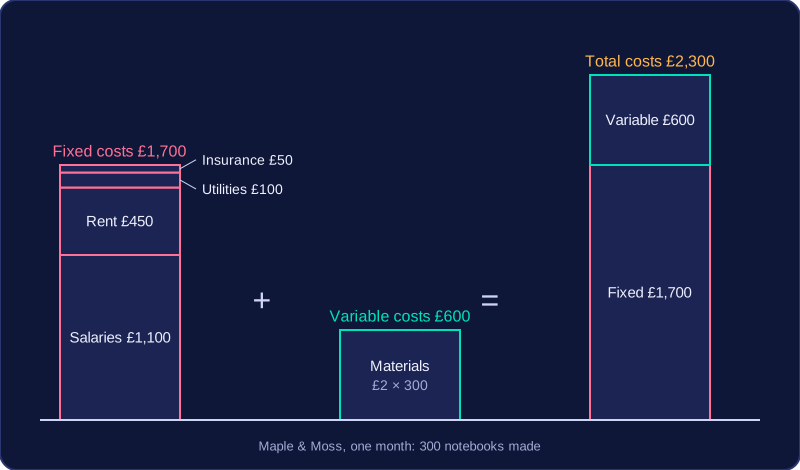
Maple & Moss makes handmade notebooks. Its monthly costs are rent £450, salaries £1,100, insurance £50 and utilities £100. Materials cost £2 per notebook and 300 are made in the month.
| Cost | Monthly amount | Type |
|---|---|---|
| Rent | £450 | Fixed |
| Salaries | £1,100 | Fixed |
| Insurance | £50 | Fixed |
| Utilities | £100 | Fixed |
| Materials | £2 × 300 = £600 | Variable |
Total fixed costs = £450 + £1,100 + £50 + £100 = £1,700. Total variable costs = £2 × 300 = £600. Total costs for the month = £1,700 + £600 = £2,300. If you converted to a year, use the same period for every figure: annual fixed costs = £1,700 × 12 = £20,400 and annual variable costs = £600 × 12 = £7,200 (assuming the same output each month), so annual total costs = £20,400 + £7,200 = £27,600.
Practise this
Cambridge National Enterprise & Marketing · 3.1 Cost of producing the product
Cambridge National Enterprise & Marketing · 3.3 Profit/loss
Cambridge National Enterprise & Marketing · 3.4 How to use break-even for decision making