The purpose of market research
Market research definition

Market research is the process of collecting and analysing information about a particular market, good or service. It gives an entrepreneur facts and opinions to work with, instead of guesses.
There are two parts to the process, and both matter:
- Collecting information — gathering data about customers, competitors or the market itself, for example by asking people questions or reading existing reports.
- Analysing information — looking at what has been gathered, sorting it and working out what it tells you.
The second part is the one people skip. Raw answers on their own are just a pile of responses and cannot be used confidently to make a choice. Findings should be analysed before they are used to make decisions, so market research is far more than simply asking questions. Analysing turns scattered answers into a clear finding you can act on.
For example, imagine you plan to sell handmade phone charms at a school fair. You ask 40 students which colours they would buy and what they would pay. On their own, the answers are just a long list. When you sort and count them, you might spot that 28 of the 40 chose blue or green, and that most said they would pay no more than £2.50. That is an analysed finding: it tells you which colours to make and roughly what to charge.
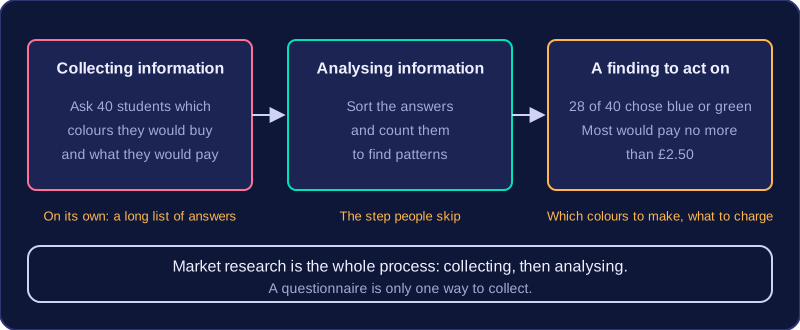
Because the analysing step takes time and thought, market research is a proper task in its own right, not a quick chat. A questionnaire is only a method used to collect information — the research itself is the whole process of collecting and then analysing.
Practise this
Cambridge National Enterprise & Marketing · 2.1 The purpose of market research