Market Research to Target a Specific Customer
The purpose of market research

Contents
Market research is the process of collecting and analysing information about a particular market, good or service. It gives an entrepreneur facts and opinions to work with, instead of guesses.
There are two parts to the process, and both matter:
- Collecting information — gathering data about customers, competitors or the market itself, for example by asking people questions or reading existing reports.
- Analysing information — looking at what has been gathered, sorting it and working out what it tells you.
The second part is the one people skip. Raw answers on their own are just a pile of responses and cannot be used confidently to make a choice. Findings should be analysed before they are used to make decisions, so market research is far more than simply asking questions. Analysing turns scattered answers into a clear finding you can act on.
For example, imagine you plan to sell handmade phone charms at a school fair. You ask 40 students which colours they would buy and what they would pay. On their own, the answers are just a long list. When you sort and count them, you might spot that 28 of the 40 chose blue or green, and that most said they would pay no more than £2.50. That is an analysed finding: it tells you which colours to make and roughly what to charge.
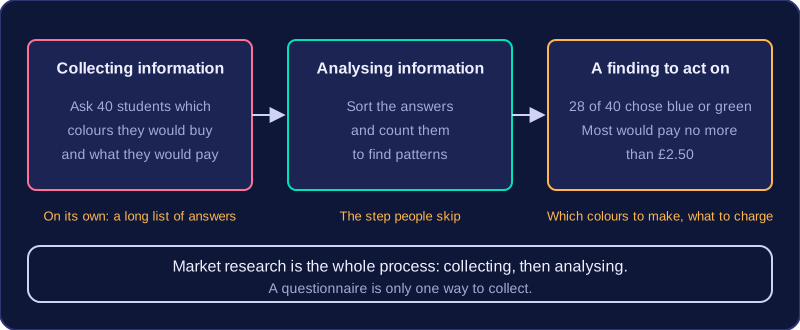
Because the analysing step takes time and thought, market research is a proper task in its own right, not a quick chat. A questionnaire is only a method used to collect information — the research itself is the whole process of collecting and then analysing.
Entrepreneurs carry out market research to reduce risk. Risk means the chance that time, money or other resources are wasted on something customers do not want. Market research gives you information at the planning stage, before you commit those resources, so you make choices using evidence rather than guesswork.
How research lowers risk
Research can show what customers like, what they would pay and whether a product is likely to sell. For example, imagine you plan to print tote bags with local landmarks and pay for a batch of bags, the printing and a stall at a weekend fair. Before ordering, you gather information from shoppers about which designs they prefer and what price feels reasonable. If most dislike the designs or expect a lower price than you need, you can change the design or order fewer bags. That reduces the chance of being left with stock you cannot sell.
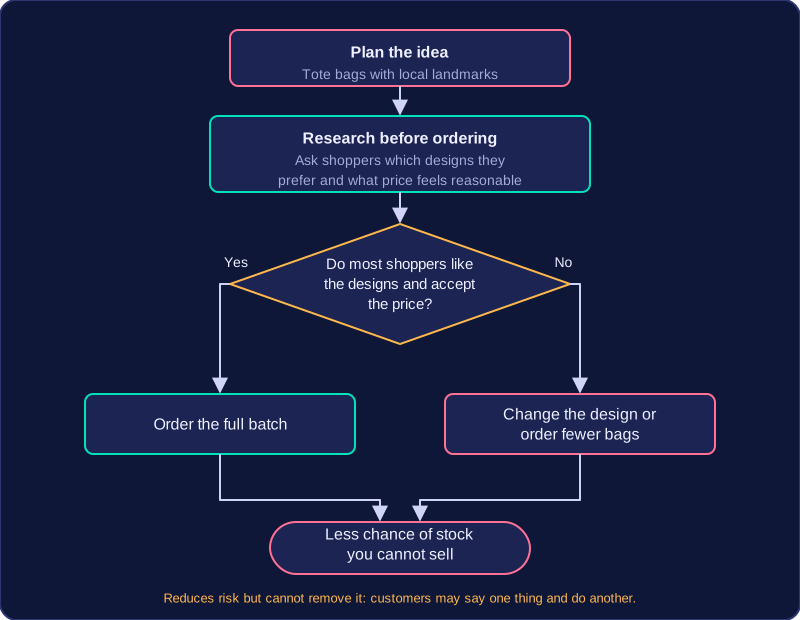
Research also reduces the risk of developing or launching a good or service customers do not want. It is cheaper to find this out before you pay for materials, equipment or advertising than after launch.
Not a guarantee
Market research is not a guarantee of success. Customers may say one thing and do another, the market can change, and a small sample may not represent everyone. Research can reduce risk but cannot remove it completely.
Market research aids decision making because it gives you evidence to support a business choice, rather than leaving you to rely on guesswork.
When a decision matters, a hunch is not enough: evidence lets you compare your options and choose the one most likely to work.
Evidence beats guesswork
Suppose you are unsure whether a weekend dog-walking service would work in your area. Instead of guessing, you ask 30 local households whether they would use the service and which day suits them best. If 21 say Saturday morning, that finding is evidence: it supports a decision to launch on Saturday mornings rather than at another time.
Before significant decisions
Entrepreneurs need market research before making significant business decisions, such as whether to launch a good or service, or when to launch it. Once money, time and effort have been committed, changing direction is harder and costs more, so evidence gathered first makes the decision better informed.
Market research cannot promise that a decision will succeed, but it means the choice rests on evidence rather than a guess. That is how it aids decision making.
Understanding the market means finding out what is already happening in the area where an entrepreneur plans to sell, before they commit time or money. A market is made up of the customers who might buy, the businesses already selling to them, and the products those businesses already offer.
What to find out
Market research is how an entrepreneur builds up this picture, and it means finding out about three things:
| Who or what | What the entrepreneur finds out | Example: pop-up phone case customising stall at a Saturday makers' market |
|---|---|---|
| Customers | Who would buy, what they already buy and how much they usually spend. | Most 13–15 year olds spend under £8 on phone accessories and replace a case when it cracks; older teens buy less often. |
| Competitors | Which other businesses sell something similar, and how they compare on price, quality and speed. | A phone shop in town sells plain cases, and a market stall sells ready-made stickers for decorating cases. |
| What is already offered | The range of products on sale, their prices and what customers think of them. | No stall makes personalised phone cases while the customer waits. |
Finding a gap in the market
Putting all three together can reveal a gap in the market: something customers would buy that no business nearby is providing, or not providing well. In the example, the phone shop only sells plain cases and the sticker stall only sells ready-made stickers, so a custom phone case for £7 made in five minutes fills a space nobody else is using. A gap is only worth pursuing if enough customers want the product and can afford it, which is why you should research the market before building the stall, not after.
Market research is how an entrepreneur finds out what customers actually think. It gives customers a chance to share their views, and it helps the entrepreneur understand their needs and wants instead of guessing.
Gaining customers' views and feedback
Collecting views means hearing from the people who decide whether to buy. Feedback can be positive, which confirms the entrepreneur is on the right track, or negative, which shows what to change. Ravi plans a market stall selling customised phone cases and asks local teenagers what they think of his designs. Several say the cases look good but the price is too high, so he finds a cheaper supplier before ordering any stock.
Needs and wants
A customer's need is something they cannot do without because it is essential. A want is something they would like but could manage without, such as a favourite colour or a stylish design. Both matter: a case that does not fit the phone will not sell however good it looks, and a plain case may attract fewer buyers than one in colours teenagers like. Customers rarely say these things out loud, so an entrepreneur has to ask them.
| Type | What it means | Phone case example |
|---|---|---|
| Need | Something the customer cannot do without | A case that fits the phone properly and protects it if it is dropped |
| Want | Something the customer would like but could manage without | A choice of colours and a design with their name on it |
Identifying the target customer
The target customer is the particular group of people a business aims its good or service at. Research helps the entrepreneur work out who they are — their age, interests, budget and where they spend their time — and what matters to them. Ravi assumes he is aiming at parents buying for their children, but the feedback shows most interest comes from 13 to 16 year olds who want cheap cases that match the colour of their phone. He can then choose his designs, prices and where to advertise around those customers.
Market research informs product development by giving an entrepreneur evidence about what customers want before a good is designed, made or launched. Product development means creating a new product or adapting and improving an existing one. Research can show which features to change, add or remove before the product is sold.
For example, imagine you plan to sell a recycled-plastic desk tidy to students. Before paying for a mould, you ask students who might buy it what they need. They say it is too tall for school lockers, it tips over when a phone is put in it and they would like somewhere to stand a phone. You use this to make it shorter, give it a wider base and add a phone holder. The research has shaped the product before production, when changes are cheaper and easier.
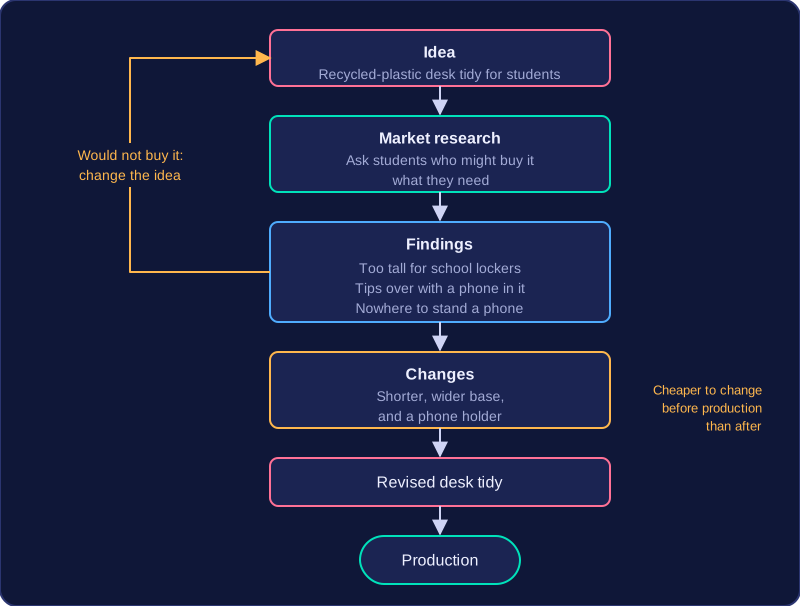
Entrepreneurs commonly need market research before developing a product because it helps them assess its likely success. If customers say they would not buy the product, or would only buy it if it were easier to use, the entrepreneur can change the idea before committing time and money. Research cannot guarantee success, but it gives a better basis for deciding whether to go ahead.
Complementary products are goods or services bought to be used together, so sales of one often lead to sales of the other. Market research helps an entrepreneur understand how their own good or service complements others on the market: what customers buy alongside a product like theirs, and whether they could offer it too or work with a business that already does. A complement is not a competitor. A competitor does the same job and is bought instead, while a complement is bought as well.
A good or service fits with another when each makes the other more useful. An entrepreneur planning to sell refillable water bottles could research what people buy to use with a bottle. Findings might show customers also buy cleaning brushes, carry straps and flavoured water tablets. None of these does the bottle's job, so none competes with it, but each makes it more useful. The entrepreneur could sell a brush with every bottle or add accessories to the range, so every bottle sold becomes a chance to sell something extra.
Complementary or competing?
| Relationship | What it means | Example |
|---|---|---|
| Complementary | Bought as well, because each makes the other more useful | A water bottle and a bottle brush |
| Competing | Bought instead, because they do the same job | A water bottle and a rival water bottle |
Research into complements can change a decision. If the findings show that most customers already own a brush, the entrepreneur might stock straps instead, or team up with a local business that sells tablets so both products are promoted together. Carrying out this research before launch lowers the risk of missing an easy chance to sell more to the same customer.
A purpose of market research is the reason an entrepreneur carries it out: why they do it, not how. A method such as a questionnaire or an interview is how information is collected, so naming a method does not give a purpose.
Two different purposes
When you are asked to state two purposes, give two different reasons, because each correct purpose earns one mark. They must be genuinely distinct: gaining customers' views and understanding customers' wants are too close to count as two, while reducing risk and aiding decision making are different and can earn a mark each. A purpose must explain why research helps: 'to get more customers' or 'to make more profit' are outcomes, and only count once you say how research leads to them.
A purpose applied to a business
When you are asked to explain, give the purpose and then apply it to the business in front of you. Each purpose developed in context can earn two marks: one for the purpose, one for the application. For example, an entrepreneur planning a pop-up stall selling handmade phone charms at a summer fair could write: 'Market research would reduce risk by showing which designs local teenagers actually want, so money is not spent on boxes of beads and charms few people buy.' That links the purpose to a decision and a benefit. Repeating the purpose in different words earns the first mark only.
Reason and stage
When you are asked why or when an entrepreneur needs market research, focus on the reason and the stage, such as before launching a good or service, rather than on how information is collected. Use specification terms accurately, for example reduce risk, understand customers' needs and wants or inform product development.