Factors to Consider When Starting Up and Running an Enterprise
Appropriate forms of ownership for start-ups
Contents
Liability describes who is financially responsible for a business's debts. It is not the same as whether the business makes a profit or a loss; it is about who must pay the business's debts if it cannot.
With unlimited liability there is no cap on the owner's responsibility. If the business cannot pay what it owes, the owner may have to use personal savings or sell personal possessions, such as a car, to settle the debts. Nobody has agreed a limit, so the owner's own money is on the line.
With limited liability the owner's financial responsibility is capped, usually at the amount they invested in the business. Once that money is gone, personal savings and possessions are protected from the business's debts.
| Unlimited liability | Limited liability | |
|---|---|---|
| Cap on what the owner can lose | None | Usually the amount invested |
| If debts cannot be paid | Personal savings and assets are at risk | Personal savings and assets are protected |
| Effect on the owner | More personal risk, so often more cautious | Less personal risk, so more willing to take calculated risks |
Why this matters for a new business
Limited liability lowers the personal financial risk of starting up. An owner who knows their own money is shielded may be more willing to borrow, launch a new product or open a second outlet. Investors may also feel safer putting money in, because the owners' exposure is clear and bounded.
Unlimited liability raises personal risk. Someone facing it may think carefully before taking out a large loan or expanding quickly, since a failure could cost them their home as well as the business. That caution can protect them, but it can also hold the business back from growing.
For example, Priya puts £6,000 into a start-up that later fails owing £25,000. With limited liability she loses her £6,000 and no more. With unlimited liability she could be pursued for the £25,000 owed as well, on top of her £6,000. Different forms of ownership give owners one or the other, so the form chosen affects how much personal risk the owner carries.
A sole trader is a business owned by one person. That person is the only legal owner, even if they employ staff to help run the business.
Control and decision-making
The sole trader makes every decision: what to sell, what prices to charge, which suppliers to use and when to open. Nobody else has to agree, so changes can be made quickly. Total control also means choosing your own working hours, which suits fitting a business around study or caring responsibilities.
The trade-off is that all the pressure sits with one person. There is no co-owner to test ideas with, which can feel lonely, and if the owner is ill or on holiday, the business may not run at all.
Profit, loss and liability
The sole trader keeps all the profit after tax, and carries all losses personally, so a quiet month hits their own income directly.
They also have unlimited liability: the owner is personally responsible for every business debt. If takings cannot cover a bill, the owner may have to use personal savings or sell personal possessions to pay it. This risk is the main drawback of the form, and it can make an owner cautious about borrowing to grow.
Advantages and disadvantages
| Advantages | Disadvantages |
|---|---|
| Quick, cheap and easy to set up | Unlimited liability |
| Keeps all profit after tax | May lack certain skills or knowledge |
| Total control and fast decisions | Harder to raise finance than some other forms |
| Financial privacy: accounts are not made public | No one to share decisions or workload with |
| Flexible working hours and arrangements | Business may stop if the owner is absent |
Take a sole trader running a small pottery studio in a rented workshop. She keeps all of the profit and can decide that evening to run an extra class. But when a clay supplier's invoice for £940 cannot be paid, she must find the money herself, because the debt is hers, not the business's.
A partnership is a business owned by two or more people who share its profits, losses and responsibility according to an agreed arrangement. Each owner is a partner and a legal owner of the business.
Liability and profit sharing
An ordinary partnership has unlimited liability. Responsibility for debts is shared between the partners, but sharing it does not protect anyone: if the business cannot pay, each partner's personal savings and belongings are still at risk. (A limited liability partnership, or LLP, is a separate form with its own rules.)
Partners agree a profit-sharing arrangement before they start trading, so nobody argues later about who gets what. Profit is split according to the agreed share, which is not necessarily equal. For example, Ravi and Sam set up a gardening business. Ravi invests £4,000 and works five days a week; Sam invests £1,000 and works three days, so they agree a 70:30 split. On £10,000 profit, Ravi takes £7,000 and Sam takes £3,000.
Advantages of a partnership
- Partners bring different ideas, skills and experience, covering gaps in knowledge.
- More people can invest capital, so more money is available than with one owner.
- Workload and responsibilities are shared, and the business keeps running if one partner is ill or away.
- Decisions are discussed with someone else, so choices are usually better thought through.
- Financial information stays private, and set-up is cheap and easy.
Disadvantages of a partnership
- Unlimited liability puts personal assets at risk.
- Profits are shared, so each owner keeps less than a sole trader would.
- Partners may disagree over key decisions, so decision-making can be slower.
- Each owner has less control than a sole trader, and conflict can build over workload or the direction of the business.
Because decision-making is shared, you and your partners should agree who decides what: one partner might handle suppliers and pricing while the other handles staff and marketing, and you should also agree what happens when you disagree.
A limited liability partnership (LLP) is a form of ownership that works like a partnership but gives each member limited liability. Members share ownership, decision-making and profits according to the LLP agreement, but their personal financial risk is lower than in an ordinary partnership.
In law, an LLP is a separate legal entity from the members who own it. The business itself can own assets, sign contracts and owe debts, so an LLP is closer to a private limited company than to an ordinary partnership.
How it is run
The owners are called members. Each invests an agreed amount of capital, and the LLP agreement sets out how decisions are made and how profit is split. The split need not be equal, so a member who invests more or works full time can take a bigger share.
For example, Aisha and Ben set up an LLP running a dog-grooming salon and a pet-sitting service. Aisha invests £6,000 and grooms dogs full time; Ben invests £3,000 and handles bookings and marketing part time. Their agreement gives Aisha 60% of profits and Ben 40%, and says either can spend up to £400 on supplies, but larger purchases need both to agree.
Why members choose it
- Limited liability caps each member's loss at the capital they invested, so their personal savings and belongings are protected if the LLP cannot pay its debts.
- Shared skills and workload: members divide tasks and bring different experience, as in an ordinary partnership.
- Shared decision-making means more than one person shapes the business, though it can slow decisions down.
If the pet-care LLP owes a supplier £25,000 and has no money left, Aisha's loss is limited to her £6,000 investment, so she does not lose her home. In an ordinary partnership, both partners could be chased personally for the full debt.
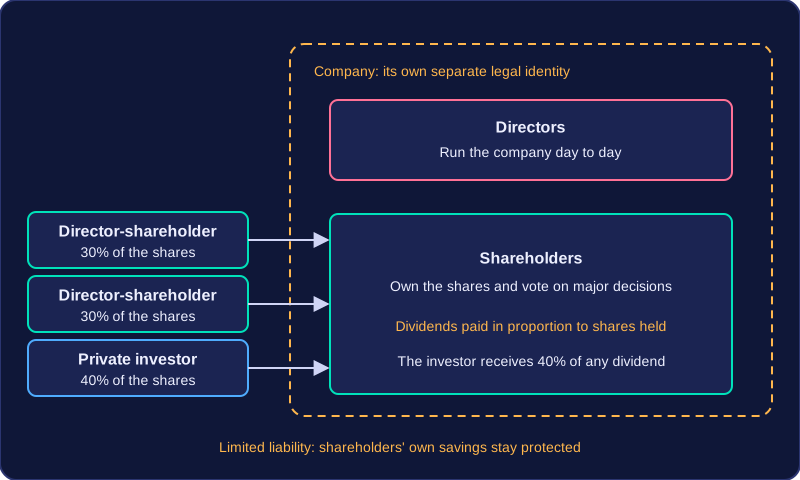
A private limited company (Ltd) is a business that is legally separate from its owners. The company can own assets such as vans and equipment, make contracts with suppliers and customers, and owe debts in its own name.
Owners therefore have limited liability: if the company cannot pay what it owes, shareholders are not personally liable beyond the amount they invested or any unpaid amount on their shares, so their own savings stay protected.
Shares, dividends and who decides
A Ltd raises finance by issuing shares to private investors. Whoever buys shares becomes a shareholder and owns that slice of the company. Profitable companies may pay dividends — a share of the profit — in proportion to how many shares each person holds.
Directors usually run the company day to day, buying stock, hiring staff and setting prices. Shareholders share ownership and major control, voting on big decisions. In many small Ltds the directors are the main shareholders, so both roles sit with the same people.
For example, a company selling hand-painted skateboard decks might have two director-shareholders holding 30% each, with a private investor holding the other 40%. That investor receives 40% of any dividend paid and has a say in major decisions, while the directors do the daily work.
Weighing it up
Advantages include limited liability, easier finance raising through share sales, greater credibility when dealing with suppliers, and a separate legal identity that carries on if an owner leaves.
Disadvantages include a more complex, costly set-up than a sole trader, accounts that must be declared publicly, control diluted among shareholders, profits shared out as dividends, and possible disagreement over the company's direction.
A Ltd is private because its shares are not offered to the general public — not because its financial accounts are private.
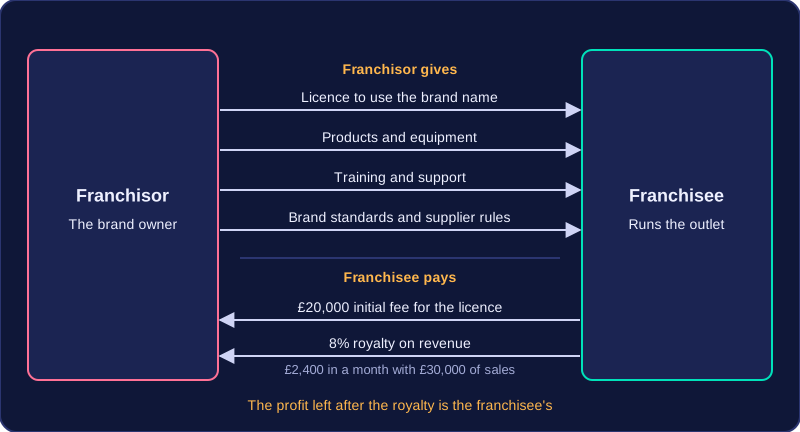
A franchise is a licence to run a business under an established brand, using the franchisor's company name, identity, products and equipment. The franchisor is the brand owner that grants the licence, and the franchisee is the person or business that buys it and runs the outlet. You pay for the right to use a brand that customers already know, rather than building your own from scratch.
What you pay for
The franchisee normally pays an initial fee for the licence, plus an ongoing royalty, which is often a percentage of the outlet's revenue rather than its profit. For example, a franchisee running a sandwich shop under a well-known name might pay £20,000 up front, then 8% of every month's revenue — £2,400 in a month with £30,000 of sales. Whatever profit is left after the royalty is the franchisee's. A franchise is not a true form of ownership, because the brand belongs to the franchisor: the franchisee owns or operates the outlet under the terms of the franchise agreement.
Advantages
- Trusted, recognised brand — customers already know the name, so you win trade faster than a brand new shop.
- Established products and processes — recipes, pricing and operating methods are tried and tested.
- Training and support — the franchisor shows you how to run the outlet.
- Centralised promotion — advertising for the whole network is organised for you and paid for from the fees franchisees pay.
- Ready-made business model — lower risk than starting completely alone.
Disadvantages
- You may be told which suppliers to use, so you cannot shop around for cheaper stock.
- The initial fee and ongoing royalties are expensive and reduce your profit.
- The franchisor may restrict where you can open, and how many outlets you run, so growth is limited.
- A poorly run outlet owned by another franchisee can damage the reputation customers attach to your business too.
- You have little independence, because the franchisor's rules control how you trade.
Decision-making is limited because the franchisor sets brand standards and rules. The franchisee only makes some day-to-day decisions, such as staffing shifts and opening hours, within the agreement.
When you start up, you choose a form of ownership: sole trader, partnership (including an LLP), private limited company, or a franchise. This choice settles four questions at once: who owns the enterprise, who is responsible for its debts, who makes the decisions, and how profit is distributed. Each form answers those questions differently, so choosing one is a series of trade-offs rather than a search for one best answer.
What you give up to get what you want
| What the owner wants | What they may have to accept |
|---|---|
| Total control and all of the profit | Greater personal risk, with nobody to share the workload, skills or losses |
| Risk, skills or finance shared with others | Shared decisions and shared profit, so each owner keeps a smaller share |
| Limited liability and easier access to finance | More formality, more paperwork and less privacy: a private limited company must declare its accounts publicly |
| A simple, private, cheap set-up | Harder to raise finance, and unlimited liability if things go wrong |
An owner who wants total control and every penny of profit may accept greater personal risk; one who would rather share risk, borrow more or bring in missing skills may accept shared decisions and a smaller share of profit. More complex forms bring limited liability and easier finance, but also greater formality and less privacy. The right choice depends on the start-up's own circumstances.
Sharing decisions
When decisions are shared, owners can divide responsibilities using formal job descriptions, or informal arrangements such as “you handle suppliers, I'll handle the website”. Conflicting opinions can cause tension and slow decisions, so agree who decides what before problems appear.
For example, two friends want to open an indoor climbing wall. One has £15,000 saved and coaching experience; the other has no money but strong marketing skills. Alone, one person would carry all the risk of costly premises. A private limited company brings in both people's strengths and protects their personal savings beyond what they invest, but they must share decisions, accept public accounts, and pay for accountancy help. They decide the protection is worth the loss of privacy.