Appropriate forms of ownership for start-ups
Franchise

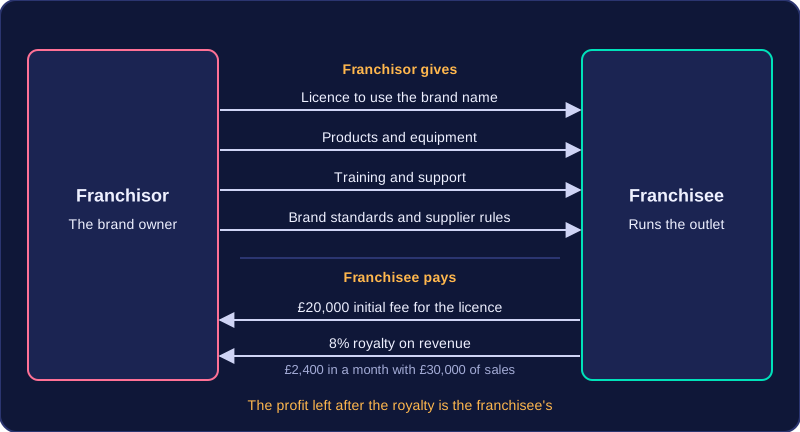
A franchise is a licence to run a business under an established brand, using the franchisor's company name, identity, products and equipment. The franchisor is the brand owner that grants the licence, and the franchisee is the person or business that buys it and runs the outlet. You pay for the right to use a brand that customers already know, rather than building your own from scratch.
What you pay for
The franchisee normally pays an initial fee for the licence, plus an ongoing royalty, which is often a percentage of the outlet's revenue rather than its profit. For example, a franchisee running a sandwich shop under a well-known name might pay £20,000 up front, then 8% of every month's revenue — £2,400 in a month with £30,000 of sales. Whatever profit is left after the royalty is the franchisee's. A franchise is not a true form of ownership, because the brand belongs to the franchisor: the franchisee owns or operates the outlet under the terms of the franchise agreement.
Advantages
- Trusted, recognised brand — customers already know the name, so you win trade faster than a brand new shop.
- Established products and processes — recipes, pricing and operating methods are tried and tested.
- Training and support — the franchisor shows you how to run the outlet.
- Centralised promotion — advertising for the whole network is organised for you and paid for from the fees franchisees pay.
- Ready-made business model — lower risk than starting completely alone.
Disadvantages
- You may be told which suppliers to use, so you cannot shop around for cheaper stock.
- The initial fee and ongoing royalties are expensive and reduce your profit.
- The franchisor may restrict where you can open, and how many outlets you run, so growth is limited.
- A poorly run outlet owned by another franchisee can damage the reputation customers attach to your business too.
- You have little independence, because the franchisor's rules control how you trade.
Decision-making is limited because the franchisor sets brand standards and rules. The franchisee only makes some day-to-day decisions, such as staffing shifts and opening hours, within the agreement.
Practise this
Cambridge National Enterprise & Marketing · 5.1 Appropriate forms of ownership for start-ups