Appropriate forms of ownership for start-ups
Private limited company Ltd

A private limited company (Ltd) is a business that is legally separate from its owners. The company can own assets such as vans and equipment, make contracts with suppliers and customers, and owe debts in its own name.
Owners therefore have limited liability: if the company cannot pay what it owes, shareholders are not personally liable beyond the amount they invested or any unpaid amount on their shares, so their own savings stay protected.
Shares, dividends and who decides
A Ltd raises finance by issuing shares to private investors. Whoever buys shares becomes a shareholder and owns that slice of the company. Profitable companies may pay dividends — a share of the profit — in proportion to how many shares each person holds.
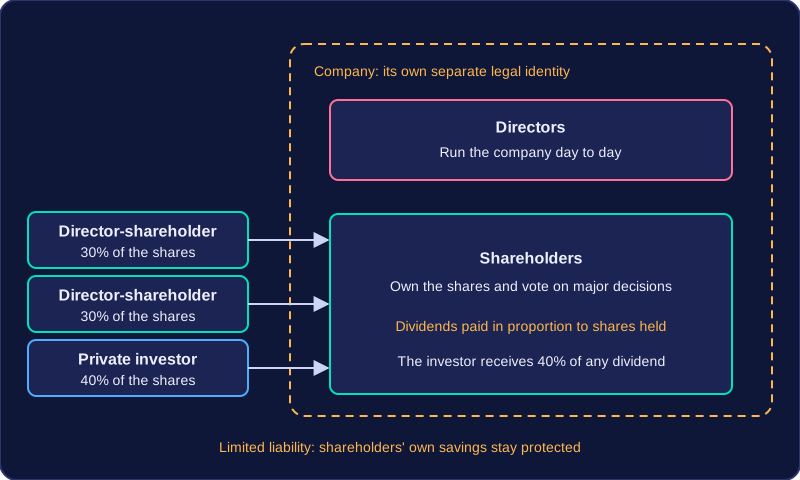
Directors usually run the company day to day, buying stock, hiring staff and setting prices. Shareholders share ownership and major control, voting on big decisions. In many small Ltds the directors are the main shareholders, so both roles sit with the same people.
For example, a company selling hand-painted skateboard decks might have two director-shareholders holding 30% each, with a private investor holding the other 40%. That investor receives 40% of any dividend paid and has a say in major decisions, while the directors do the daily work.
Weighing it up
Advantages include limited liability, easier finance raising through share sales, greater credibility when dealing with suppliers, and a separate legal identity that carries on if an owner leaves.
Disadvantages include a more complex, costly set-up than a sole trader, accounts that must be declared publicly, control diluted among shareholders, profits shared out as dividends, and possible disagreement over the company's direction.
A Ltd is private because its shares are not offered to the general public — not because its financial accounts are private.
Practise this
Cambridge National Enterprise & Marketing · 5.1 Appropriate forms of ownership for start-ups