Ethical and Legal
Impact of AI
Contents
Artificial intelligence (AI) is where a computer system is designed to perform tasks that would normally need human intelligence. Working out the words in a recording, spotting a pattern in a photo, planning a delivery route or deciding what to do next are all jobs that used to rely on a person. An AI system is built to do them instead.
How an AI system works
An AI system runs an algorithm — a set of instructions — and many also use patterns in data. The system follows its instructions, compares what it is given with patterns it has stored, and produces an answer. That answer can look clever, but the system does not think, understand or have intentions. A chatbot answering questions about opening times on a shop's website is not being helpful on purpose: it matches your words to stored patterns and replies with the closest match.
| Task | What a person would need to do | What the AI system actually does |
|---|---|---|
| Writing down the words in a voice message | Listen and understand speech | Compares the sound patterns with stored patterns and picks the closest match |
| Planning the quickest route for a delivery van | Work out a sensible order for the stops | Follows rules that compare possible routes and picks a short one |
| Reading handwritten postcodes on envelopes | Read each address and understand the writing | Checks the shapes of the letters against stored patterns |
AI does not need a body
AI can be entirely software, such as a chatbot or a program that sorts songs into playlists by their style, so it does not need a physical body. A robot is only one form an AI can take, by giving the software a machine with sensors and motors to act in the world.
Machine learning is an approach to artificial intelligence where a system is trained using data instead of being programmed with a rule for every possible case. The system examines large amounts of training data, finds patterns in it and builds a model that it uses to make predictions or decisions about new data.
Learning from examples
Because the system works out the patterns for itself, its performance improves as it is given more or better data, without anyone writing an explicit rule for every situation. This is not ordinary programming with a very long list of rules. In ordinary programming you write the rules that turn input into output; in machine learning you supply examples and the system adjusts itself until it can produce the output.
For example, imagine a camera on a bird feeder that sorts photos of visitors into robins and sparrows. Nobody writes a rule for every combination of colours and markings. Instead, the system is trained on thousands of photos that people have already labelled robin or sparrow. It finds patterns that tend to separate the two, such as a red breast, and builds a model. When a new photo arrives, the model uses those patterns to predict which bird it is.
Why the data matters
The model can only learn from what it is shown. If the training photos are blurry or labelled wrongly, its predictions will be poor, so the training data needs to be accurate and to cover the situations the system will really meet. A model trained only on photos taken in daylight will struggle with a visitor at dusk, because it has never been shown those patterns.
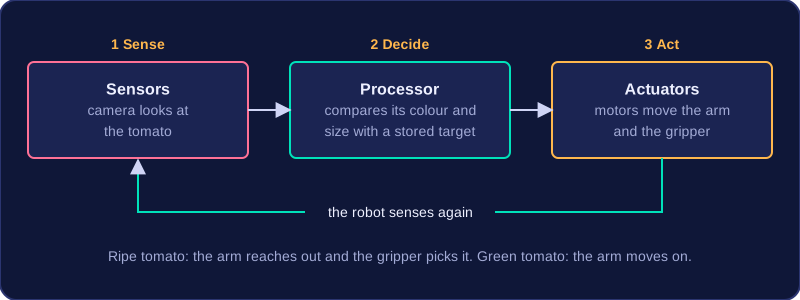
Robotics is the design and use of programmable machines that can sense their surroundings and carry out physical actions. A robot is more than a machine that moves: it uses sensors to detect things such as distance, colour, heat or touch, a processor that runs a program to decide what to do, and actuators — usually motors — that produce movement or operate a tool. Sensing, deciding and then acting is what lets a robot's behaviour depend on the world around it.
That makes a robot different from a machine that repeats a fixed sequence. A conveyor belt in a bakery runs the same way whatever is on it, but a robot arm with a camera can check each item and change what it does. For example, a farm robot uses a camera to look at tomatoes on a plant. Its program compares each tomato's colour and size with a stored target. If the tomato is ripe, the program signals the motors, the arm reaches out and the gripper picks it. If the tomato is still green, the arm moves on. The same program produces different actions because the robot senses first.
Working without a person
Some robots operate with little or no human control. A milking robot on a dairy farm lets each cow walk in when it chooses, reads the tag on its collar to identify it, and attaches the milking cups without anyone steering it. This autonomy is possible because the robot's sensors feed the program continuously, so it responds to what it detects rather than following a fixed set of steps. A lawn-mowing robot that senses an obstacle such as a hedgehog in the grass can stop its blades and wait, because it reacts to the reading instead of working through a fixed sequence of movements.
Accountability means being answerable for the actions, decisions and effects of an AI system, machine learning model or robot. It is not about the computer taking the blame: a program cannot be held responsible in the way a person can, so the people and organisations behind it must remain accountable.
Why responsibility is hard to pin down
Responsibility is often spread across several groups: the designers who decide what the system should do, the programmers who build it, the manufacturers who make the hardware, the operators who run it day to day, the owners who buy it, and the users who rely on its output. Each may affect the result, so it can be unclear who should answer when something goes wrong.
For example, a council puts an AI chatbot on its website to answer residents' questions about bin collections. If it gives hundreds of households the wrong collection day, several groups played a part: the supplier whose software was chosen, the programmer who linked it to the timetable, the staff meant to check its answers and the managers who approved it going live. Saying "the AI did it" explains nothing and leaves nobody answerable.
How accountability is supported
- Keeping records of inputs, outputs, training data and who approved a system makes it possible to trace what happened and who was involved.
- Explaining decisions means the organisation can say why a result was produced, rather than hiding behind an unexplained score or recommendation.
- Human oversight puts a person in charge of reviewing important decisions and able to override or stop the system.
- Independent auditing uses people outside the organisation to inspect how the system behaves and report problems.
Keeping AI decisions open to scrutiny matters because errors, bias and harm can then be found and corrected. If decisions are secret or impossible to inspect, unfair patterns and mistakes can continue unnoticed. Accountability therefore gives people a route to challenge a decision and makes an organisation responsible for putting things right.
Safety in AI and robotics means making sure a system does not harm people or damage property while it is working. It covers physical injury, such as a robot arm striking a worker, and harm caused by bad decisions, such as software that works out the wrong dose of a medicine.
Where the danger comes from
An AI system or robot can put people at risk in three ways. It can malfunction, for example a robotic lawnmower that keeps its blades spinning after it has tipped over. It can produce an incorrect output, such as smart traffic lights that show green to two busy roads at the same moment. Or it can meet a situation nobody planned for — a pavement delivery robot arriving at roadworks, a fallen cone and a temporary ramp all at once — and do something its designers never intended.
Testing before use
Systems where a failure could injure someone are safety-critical, so they must be tested thoroughly before they are used, and not only in the situations the designers expect. Testers try rain, gravel, low sunlight, reflective glass and awkward obstacles such as a black cat lying on the lawn, because a system tested only on a smooth dry floor has not really been tested at all.
Security and fail-safes
Cybersecurity is part of safety: a hacked robot or a hacked AI system can be made to behave dangerously, so access to its controls has to be protected. Since no amount of testing covers everything, autonomous systems often need fail-safe features. If the two position sensors on a robot helping in an operating theatre send conflicting readings, it freezes where it stands and hands control back to the surgeon. A system running without a person watching is not automatically safer — there is simply nobody there to step in.
Algorithmic bias is a systematic unfairness in the output of a computer system that favours or disadvantages a particular group of people. The computer is not being deliberately prejudiced — it has no opinions — but the pattern it has learned, or the way it was built, gives results that are consistently skewed against or in favour of one group.
Where the bias comes from
- Training data that is incomplete, unrepresentative or based on past prejudice. A voice assistant trained mostly on adult recordings from one region may mishear young children or people with other accents, so it works worse for them.
- Poor design. A motion-sensing game tuned to adult arm movements may miss a smaller player's gestures, so the game does not respond for them.
- Unconscious bias of developers. The people building the system decide which factors count as important, and their own assumptions can slip in — say, treating a fast-moving player as a skilful one, which rewards players who move quickly and disadvantages those who play carefully.
Feedback loops
Bias often gets worse over time. Suppose a library reading app gives prizes to pupils who log books online. A pupil with no internet at home cannot log books, so gets no prize, loses interest and logs even fewer books; the app concludes they are a reluctant reader and offers them fewer rewards. This is a feedback loop: biased outputs shape the future data or decisions the system learns from.
Why it matters
Algorithmic bias leads to unfair decisions, discrimination and unequal treatment, and it causes a loss of trust — once people suspect a system is unfair, they stop believing its results even when it gets things right. Bias can affect any group, not only groups defined by gender or ethnicity: age, disability, income, language, location or a health condition all count. A chatbot that only understands formal English may give less help to pupils who use regional slang, so it is biased by language and location just as surely as a system that treats one ethnicity differently.
Algorithmic bias is not the computer being deliberately unfair, and it is not inevitable: it comes from the data the system learned from and from the choices made when it was designed and used. Because those causes are human ones, they can be found and reduced, even if bias is rarely removed completely.
More representative training data
The strongest fix is usually the data. A machine learning system copies the patterns it is trained on, so if a group is missing or rare in the training data, the system will make weaker decisions for that group. Collecting representative training data — data that reflects the real mix of people or cases the system will meet — gives the model a fairer picture to learn from.
For example, a leisure centre uses an AI to predict which members are likely to cancel, so staff can offer help. If the records come almost only from adult members, the system barely learns about teenage members and flags them at random. Adding records from every age group, and checking that past decisions in those records were fair, makes the predictions far more balanced.
Testing outputs and auditing
Testing outputs means checking results for different groups rather than only the overall accuracy. A system that is 90% accurate overall could still be wrong far more often for one group, and only group-by-group testing shows that. Auditing goes further: an independent review of the system and the patterns in its decisions over time, including whether biased decisions feed back as new data and make the bias stronger.
People around the system
Technical fixes alone are not enough. Human oversight means a person reviews decisions that really matter, so an unfair pattern is caught before it does harm. Transparency means people can see how decisions are reached, and governance means clear rules and a named person responsible for checking fairness. Involving the people affected matters too, because they notice unfairness that the data does not show, such as wheelchair users testing a hotel booking system that keeps failing to offer accessible rooms.
Legal liability means legal responsibility for harm or damage caused by a product or system. If you are injured or your property is damaged, a person or organisation must answer for it in law and may have to pay compensation. A program cannot be taken to court, so responsibility falls on the people or businesses behind the system, never on the software itself.
Why it can be unclear
An autonomous system can behave in a way that nobody directly chose at the moment the harm happened, and several parties are involved in getting it there:
- Designer — decided what the system should do and what it should ignore.
- Programmer — wrote the code that turns the design into instructions.
- Manufacturer — built the product, tested it and put it on sale.
- Operator — set the system up and chose to run it.
- Owner — the person or business that owns the system and keeps it maintained.
For example, a robot lawnmower runs over a child's foot. Was the sensor range set too short by the designer? Did the programmer fail to handle a child running in from the side? Did the manufacturer fit a cheap sensor? Or did the owner ignore an instruction to keep people away while it ran? Each answer points at a different party, so a court may have to decide where responsibility lies.
Duty of care and consumer rights
Manufacturers have a duty of care to customers: they must make sure products are safe and fit for purpose, meaning they do the job they are sold to do. Consumer protection law gives customers rights, so if a product is unsafe or faulty the buyer can claim a refund, repair or compensation from the seller without having to prove exactly which component or line of code was at fault. That pushes responsibility towards the business that sold the product, which is in a better position to test it and to insure against harm. These rules were written for products a person controls directly, so as autonomous systems spread, the law on liability may need updating.
Artificial intelligence, machine learning and robotics bring real benefits, but each one must be weighed against the ethical and legal risks it creates. What matters is whether the gain is worth what it puts at risk.
Benefits
- Efficiency — a machine learning system can sort a thousand insurance claims in the time a person sorts twenty, so the work is faster and cheaper.
- Consistency — a machine-vision grader on a fruit farm sorts the ten-thousandth apple of the day as carefully as the first.
- Constant operation — software needs no breaks, so a chatbot can answer at 3 a.m.
- Safety — a drone can inspect a crumbling chimney instead of a person climbing it.
Weighing the risks
A fast system can be unfair just as fast, so algorithmic bias can treat a whole group of people worse. A system running with nobody watching raises questions of accountability and legal liability: who answers for a mistake, and who pays for the damage? A system meeting a situation nobody planned for is a safety risk. A computer cannot be blamed or taken to court, so responsibility falls on people and organisations.
For example, a council fits cameras and machine learning to its bin lorries to spot households that sorted their rubbish wrongly and fine them. It saves staff time and checks every street the same way, but a misread camera could fine the wrong household, and the people who set the system up must answer for that. Those risks must be judged worth it before it is switched on.
Why the rules may have to change
Laws are written for situations that already exist, but AI and robotics create situations the rules never covered. Traffic law assumes a person is driving, so a driverless delivery pod on a pavement does not fit, and an automated decision may not be explainable in the way rules of evidence expect. Laws and regulations may therefore need to change — on testing before use, on who must explain a decision, and on who is liable when an autonomous machine harms someone. Something can be legal and still be unethical, so following the rules is not the whole test.