Impact of AI
Robotics
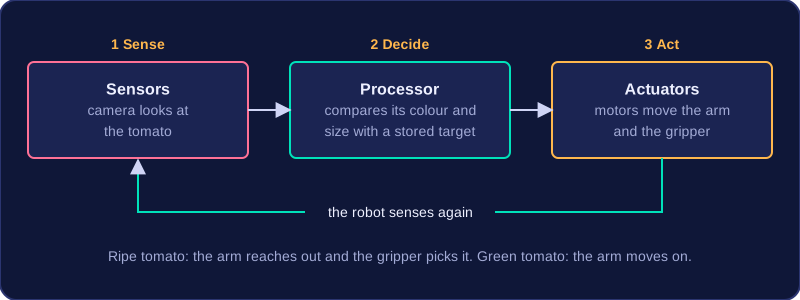
Robotics is the design and use of programmable machines that can sense their surroundings and carry out physical actions. A robot is more than a machine that moves: it uses sensors to detect things such as distance, colour, heat or touch, a processor that runs a program to decide what to do, and actuators — usually motors — that produce movement or operate a tool. Sensing, deciding and then acting is what lets a robot's behaviour depend on the world around it.
That makes a robot different from a machine that repeats a fixed sequence. A conveyor belt in a bakery runs the same way whatever is on it, but a robot arm with a camera can check each item and change what it does. For example, a farm robot uses a camera to look at tomatoes on a plant. Its program compares each tomato's colour and size with a stored target. If the tomato is ripe, the program signals the motors, the arm reaches out and the gripper picks it. If the tomato is still green, the arm moves on. The same program produces different actions because the robot senses first.
Working without a person
Some robots operate with little or no human control. A milking robot on a dairy farm lets each cow walk in when it chooses, reads the tag on its collar to identify it, and attaches the milking cups without anyone steering it. This autonomy is possible because the robot's sensors feed the program continuously, so it responds to what it detects rather than following a fixed set of steps. A lawn-mowing robot that senses an obstacle such as a hedgehog in the grass can stop its blades and wait, because it reacts to the reading instead of working through a fixed sequence of movements.
Practise this
Edexcel GCSE Computer Science · Impact of AI