Characteristics, Risk and Reward for Enterprise
Potential rewards and drawbacks for risk taking
Contents
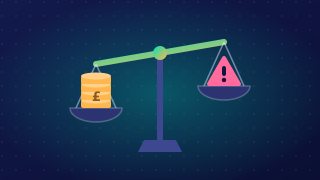
Taking a risk in business means doing something where the result is uncertain. For the entrepreneur who takes it, a risk can bring rewards (positive outcomes) and drawbacks (negative consequences). Both are about the effect on the person, not just a general business problem.
The four reward categories
- Financial reward: the owner gains money, such as profit or a higher income.
- Independence: the owner is in charge of decisions and working hours.
- Self-satisfaction: the owner feels proud or fulfilled by building and running the business.
- Making a difference or change: the business creates a positive change for customers, a community or a cause.
Three of these are non-financial, and they can matter as much as money. The owner of a small plant-pot painting kit business might value choosing their own designs and hours as highly as extra profit.
The four drawback categories
- Financial difficulty: the owner loses money or income, or struggles with debt.
- Poor health and wellbeing: worry and pressure affect the owner's mental or physical health.
- Difficult work-life balance: work takes up too much time and leaves little time for rest or leisure.
- Damage to personal relationships: long hours or stress harm relationships with family and friends.
A drawback must be a consequence for the entrepreneur. Low sales are a business problem; they become a drawback when the owner cannot pay themselves and feels anxious. Setting up a website is a task, not a drawback.
Rewards and success
Rewards also help measure success. The plant-pot kit owner may feel successful once a local school buys kits for its craft club, because they have made a change for their customers, even if profit is small. That personal reward shows success from the owner's point of view, not only in money.
Financial reward is the money an entrepreneur can gain from taking a risk and running a business. It can come as profit, which is the money left after costs are paid, or as a higher income than they might earn working for someone else.
Financial reward can also mean financial security: having enough money to save, cover unexpected costs, or pay bills with less worry. Over time, a successful business may grow in value, which can increase the owner's personal wealth, meaning the total value of the money and assets they own. The extra money might pay for a better lifestyle, such as saving for a car, paying for a family day out, or paying for hobbies.
For example, if Jacob starts a weekend business repairing and selling second-hand skateboards, any profit he keeps could go towards his savings or equipment for his own skateboarding. If the business becomes well known and sells for a higher price later, that could also add to his personal wealth.
Financial reward is often one of the main reasons people set up a business. It is a valid reward for taking a risk because the entrepreneur may gain money if the business succeeds. However, it is not guaranteed: profits may take time to appear, and the entrepreneur may not make a profit at all.
Independence is a reward that gives an entrepreneur freedom and control over their working life. It means being in charge rather than having a boss tell them what to do.
An entrepreneur can make their own decisions. They choose which products or services to offer, how to price them, and how the business is run. They also choose the type of work they do and when and where they work, so work can fit around family or hobbies. For example, someone who sets up a dog-walking business could decide to offer only morning walks and use the afternoons for study.
Independence also lets an entrepreneur be creative. They can use their own ideas and solve problems in their own way, rather than following someone else's instructions. This can give a strong sense of freedom and control.
Independence is a non-financial reward, so it is not about money. It is different from financial reward, which is about income and profit, because independence is about the freedom to decide for yourself. It is different from self-satisfaction, which is about personal achievement, because independence is about being in control.
| Reward | What it gives the entrepreneur |
|---|---|
| Independence | Control and freedom to make decisions and choose how and when to work |
| Financial reward | Money, such as profit or a higher income |
| Self-satisfaction | A sense of personal achievement or pride |
Independence is a valid reward for taking a risk: by running their own business, the entrepreneur gains the freedom to run things their own way.
Self-satisfaction is the sense of personal achievement or fulfilment an entrepreneur gets from running their own business. It is a feeling inside the entrepreneur, not money in the bank.
You might feel proud of building something from scratch: designing the product, finding the first customers, and solving problems you had never faced before. Seeing your idea become real, and knowing you made it happen, can be deeply rewarding. Getting better at practical jobs, like setting prices or keeping records, can add to that feeling of achievement too.
For example, Kai prints his own designs onto tote bags and sells them at a Saturday market. He makes only a small profit each month, but seeing a stranger carrying one of his bags across town gives him a real sense of achievement.
Making a difference or change
Making a difference means creating a positive change in a situation or for a cause. The entrepreneur may improve people's lives, help their local community, offer a product that solves a genuine problem, or support a charity or environmental cause. Any positive change counts, so it does not have to be charity work: a joiner who builds a sturdy bench for a village bus stop makes a difference just as much as someone who raises money for a cause.
For example, Sam repairs the chairs and tables in a village hall for a modest price. The hall can now host events again, and Sam knows his business is the reason the community has its meeting place back.
Telling the two apart
Self-satisfaction is about how the entrepreneur feels: the pride and fulfilment of what they have achieved. Making a difference is about the change that other people or a cause gain from the business. The two often happen together — Sam may feel proud of the restored hall — but they are separate reward categories, so the reward you describe should match the one you name.
A financial drawback is a way that taking a business risk can cost the entrepreneur money. It covers losing money or income, making no profit, putting your own money or possessions at risk, taking on debt, and, in the worst case, going bankrupt — being unable to pay debts you are responsible for.
Setting up usually means paying out before you earn anything: stock, equipment, a website, insurance. Business failure is a financial risk, so if enough customers never arrive, the money you put in may never come back. Profits can also take a long time to appear, so the income you were relying on does not turn up when you expected it.
How the money can be lost
- Losing what you invested: the money you put in at the start is gone if the business does not work.
- Making no profit: sales may only cover costs, leaving nothing for you to live on.
- Putting more money in: to keep trading you may have to feed in extra cash, which is a further loss if it fails.
- Debt: money you borrow personally, such as a loan or credit card balance, must be repaid even if the business closes.
- Bankruptcy: if debts are bigger than you can pay, you may be made bankrupt, which can affect your personal finances.
For example, Amir prints custom T-shirts. He spends £350 on a heat press and plain shirts, and borrows £200 on his own credit card to rent a market pitch for three months. After two months he has made sales of only £120. He must now choose whether to put more of his own money into stock, while the card payment falls due whether or not he sells another shirt.
What makes this a drawback is the effect on you as the owner — money you cannot get back, or a bill you still owe — rather than a general problem for the business.
Taking a business risk can affect the entrepreneur as a person, not just the business. Two drawback categories cover this: the health and wellbeing drawback and the personal relationships drawback.
Health and wellbeing drawback
A health and wellbeing drawback means stress and worry from business uncertainty can cause mental and physical health problems. Running a business can be worrying, especially when sales are low or bills are due. You may feel anxious, get headaches, lose your appetite or find it hard to concentrate. The uncertainty is part of the risk: you cannot be sure customers will buy or that money will come in.
For example, imagine you print custom T-shirts from a spare room. In a quiet month, orders fall but the electricity bill and materials still need paying. The worry gives you headaches and you keep checking your phone for new orders. Low sales are a business problem; the drawback is the effect on your health and wellbeing.
Personal relationships drawback
A personal relationships drawback means long hours and difficulty switching off can put pressure on relationships and family life, and work may take priority over family. Stress from business risk can damage personal relationships. You may spend less time with family and friends, and find it hard to give them your full attention when you are together, which can lead to misunderstandings or leave you feeling out of touch.
Using the T-shirt business again, you might skip a family meal to finish orders, or reply to messages during a friend's birthday. Even when you are there, you may be thinking about the business, so family and friends feel you are not really with them.
Health and wellbeing and personal relationships are separate drawback categories, but they overlap, because stress can affect both.
Work-life balance is the division of time between work and leisure. The work-life balance drawback means that taking the risk of running your own business can leave you finding it hard to switch off, working long hours, and having less time for relaxation, family and friends.
Why it happens
When the business is yours, there is always something left to do: orders to pack, messages to answer, takings to add up. At the start there may be no staff to share the jobs with, so the business depends on you. Your mind stays on it even when you are not working, so the working day never really ends.
For example, Amara leaves her job at a garden centre to run a mobile pet-grooming van. She answers booking messages during a family meal and plans the next day's route while watching her daughter's swimming lesson. Nobody asked her to, but the business is hers, so it follows her everywhere. After a few months she realises she has no free time left.
Why it is a drawback, and what it is not
- Time away from work is when you relax and see family and friends. Without it, those parts of your life are squeezed out, and you may find it harder to run the business well because you never get a proper break.
- It is about how your time is shared between work and leisure, not about balancing tasks inside a working day. Choosing how long to spend on paperwork rather than serving customers is not work-life balance.
- It is one of the four drawback categories. It is a consequence for the entrepreneur of taking the risk.
A reward or drawback earns marks when you name something that happens to the entrepreneur because they took the risk, tie it to the business in the case, and explain the effect on them.
Valid answers
A drawback must be a consequence for the entrepreneur, not a task in setting up the business. For example, ordering stock is a task; being left with boxes of unsold stock you have already paid for is a financial drawback, because you lose the money you spent. A general business problem such as a poor location is not enough on its own unless you say what it does to the owner, such as reduced income or worry. Costs and available finance are barriers to taking the risk, not consequences of it.
If asked for two rewards or two drawbacks, make them genuinely different. Stress and worry are the same idea, so they would not count as two. Pick from the four reward categories (financial, independence, self-satisfaction, making a difference) or the four drawback categories (financial, health and wellbeing, work-life balance, personal relationships). No marks are given for saying a business is popular or well known as a reward.
Application and analysis
Application means tying the point to the scenario. Use the business name and a detail. If the case is about Hassan's late-night taxi service, do not just say he may be stressed; say Hassan may feel stressed because late-night calls leave him exhausted. Analysis means saying what happens as a result: this could make him less able to drive safely, so he may lose customers.
Saying only that the business might fail is not a drawback. Show the consequence for the individual, such as having to sell equipment, owing money to a supplier, feeling overwhelmed, or tension with a business partner.