Sales and Customer Service
The sales process

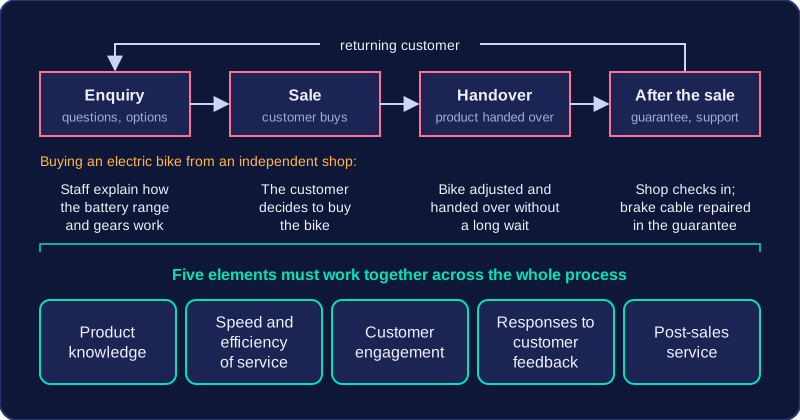
The sales process is the sequence of activities a business uses to sell a product or service to customers. It is more than the moment a customer hands over money: it starts before a sale is made, as soon as someone asks a question or weighs up their options, and it carries on long after handover, through any guarantee period and the support that follows.
Picture a customer buying an electric bike from an independent shop. Staff explain how the battery range and gears work, the bike is adjusted and handed over without a long wait, the shop keeps in touch and asks how the first month has gone, and when a brake cable fails inside the guarantee it is repaired without a fuss. Every one of those steps belongs to the same process.
The main elements
Five elements make up the sales process:
- product knowledge
- speed and efficiency of service
- customer engagement
- responses to customer feedback
- post-sales service
Why the elements must work together
The process only works when all five elements pull in the same direction. A weakness in one can wreck the work done on the others: a garden centre whose staff can name every shrub, but where the tills queue for twenty minutes and emails go unanswered, will still lose sales, because the customer remembers the wait, not the expertise. Strong performance across the whole process is what turns an enquiry into a sale and a sale into a returning customer.
Complex and technical products
The process becomes more demanding when the product or service is technical or complex, such as fitting home solar panels and a battery. Customers need more explanation before they buy, more support while the system is installed, and more after-sales help if the app or inverter develops a fault. The business must therefore stretch every element further, and a weak link is more likely to cost it the sale.
Practise this
Edexcel GCSE Business · 2.3.4 The sales process