Topologies
Star Topology Advantages and Disadvantages
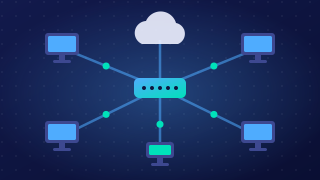
A star topology has a central switch, with a separate cable from each wired device back to it. Wireless devices join through a wireless access point connected to the switch. Judging a star means asking what happens when something breaks, how easily it grows, and what it costs.
Advantages
- Faults stay isolated. If one device or one cable fails, only that device drops off the network. Every other device still has a working link to the switch, so the rest carry on as normal.
- Easy to extend. To add a device you run one cable to a free port on the switch, or let it join through the wireless access point. Nothing already connected has to be moved or rewired.
- Data goes only to the device that needs it. The switch forwards each message along the link to its destination rather than sending it to everybody, so less unnecessary traffic is created.
- Fault-finding is simpler. Each device has its own cable and switch port, so a machine that cannot connect narrows the problem to one lead and one port, rather than a shared cable.
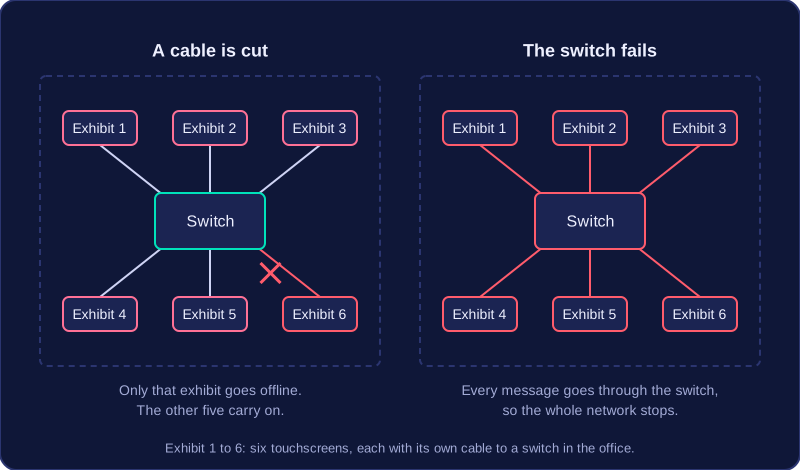
For example, a museum has six interactive touchscreen exhibits, each with its own cable to a switch in the office. A cleaner's trolley cuts the cable to one exhibit. Only that exhibit goes offline; the other five carry on working, and staff know the fault is in that one lead.
Disadvantages
- One switch failure stops everything. Every message travels through it, so if it loses power or breaks, the whole network stops, even though every device and cable still works.
- The switch costs money. A star cannot work without one, so there is a bill for equipment before you connect a single device.
- A lot of cabling. Every wired device needs its own cable back to the switch, so a large building needs a great deal of cable and the time and effort to install it.
Practise this
OCR GCSE Computer Science · Topologies