Topologies
Star Topology
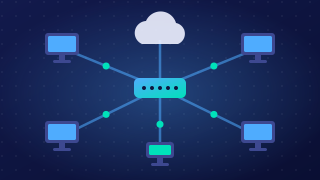
A star topology is a network layout in which every device has its own connection to a central switch. The switch sits in the middle and passes data between the devices, so no device is wired straight to another one.
A separate link for every device
Each wired device has a cable of its own that plugs into a port on the switch. Two computers sitting side by side do not share one cable back to the switch: each has a separate link. The switch sends data to the intended device rather than to everything on the network.
Wireless devices and shared devices
A tablet or phone has no cable, so it connects by radio to a wireless access point. The wireless access point has its own cable to the switch, so wireless devices stay part of the same star: their data travels over the air to the access point, then down the cable to the switch.
Servers and shared printers join the star in the same way, each with a cable of its own to the switch. A computer is never cabled directly to the server.
A switch is not a server: it stores no files and runs no programs for users, it only moves data between the devices connected to it.
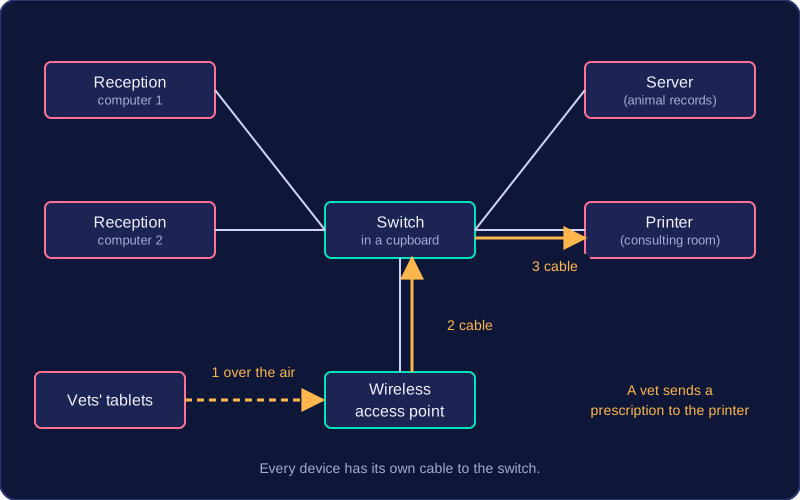
For example, a veterinary practice keeps its switch in a cupboard. The two reception computers, the server holding the animal records and the printer in the consulting room each have their own cable to the switch. The vets' tablets join through a wireless access point that is cabled to the switch, so when a vet sends a prescription to the printer, the data goes over the air to the access point, down its cable to the switch and out through the printer's cable.
The star layout is the most common topology used for a local area network.
Practise this
OCR GCSE Computer Science · Topologies