Topologies
Mesh Topology
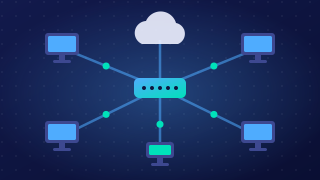
A mesh topology is a network layout where devices connect directly to one another instead of each one plugging into a central switch. Each link joins two devices, and there is more than one route between devices, so data can travel along different paths.
Devices pass data along
Because the devices are joined to each other, one device can relay data for another: it receives a message and forwards it towards its destination. A device sitting in the middle of the network can act as a stepping stone, so two devices can exchange data even when they have no direct link of their own.
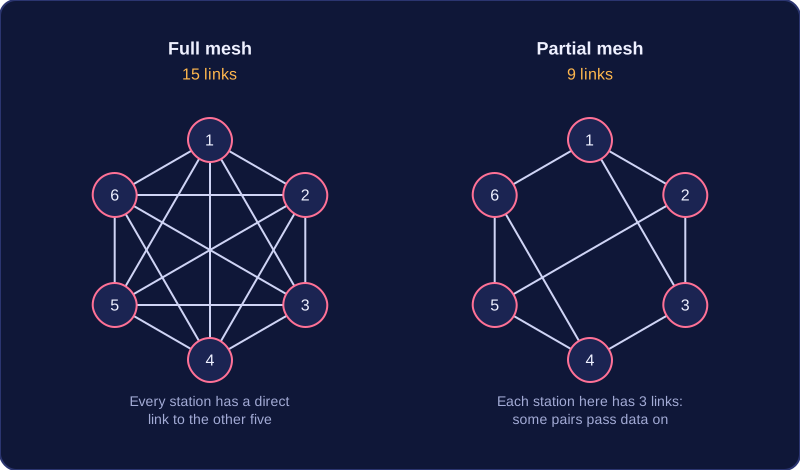
A mesh does not have to connect every device to every other device. Some devices may be joined directly while others reach each other through other devices in between, as long as there is more than one route available. No central switch is needed, because the devices themselves form the network.
Wired, wireless or mixed
The links can be cables, wireless signals, or a mixture of both. In a wireless mesh, each device can relay data for the others, so a device far from the rest can still join in by passing its data through the devices nearer to it. This extends the range of the network further than a single wireless link could reach.
A wired mesh in which every device connects to every other device needs a great deal of cable, which is why it is rare in a local area network. Picture a recording studio with six computers that all have to be cabled to all the others: that is fifteen separate cables, counted as five from the first machine plus four from the second, three from the third, two from the fourth and one from the fifth. Bringing in a seventh computer would mean laying six more cables.
Practise this
OCR GCSE Computer Science · Topologies