Flowcharts
Rules for a Correct Flowchart

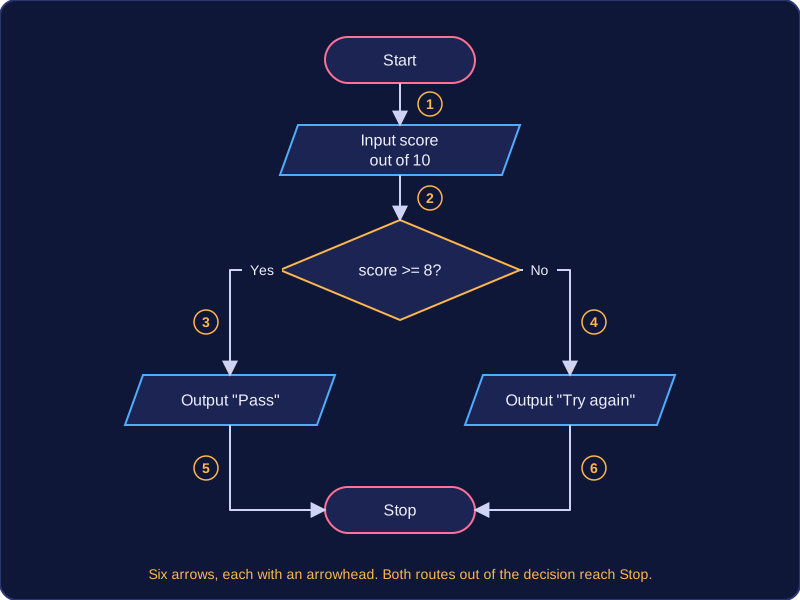
A correct flowchart follows a small set of rules. Use them as a checklist whenever you complete, correct or refine one.
- One Start: exactly one terminal marked Start. More than one gives no single entry point, so a reader cannot tell where the algorithm begins.
- Every path reaches Stop: follow each arrow from Start; every route must finish at a Stop terminal. A branch that ends nowhere is incomplete.
- Arrows join every symbol: flow of control is shown by lines with arrowheads, not by position. An unconnected symbol is never run.
- Two labelled exits per decision: a diamond asks a question and must have exactly one Yes and one No exit, both labelled. An unlabelled exit, or a third exit, is an error.
- Right symbol for the purpose: input and output go in a parallelogram, calculations and assignments in a rectangle, questions in a diamond, and Start or Stop in a rounded terminal.
- Named values: store results in names such as
scoreorattemptsso later symbols can refer to them.
Worked example: a flowchart for a bike-hire kiosk asks for hours hired in an input parallelogram, calculates cost as hours multiplied by 4 in a process rectangle, then asks whether cost is over 20 in a decision diamond. It outputs "Pay deposit" on Yes and "No deposit" on No, and both exits lead to Stop. If the Yes exit had no label, or the calculation sat in a parallelogram, correcting the flowchart would mean fixing that label or shape.
Completing may mean adding a missing arrow, label, symbol or loop update and reconnecting the parts, so the flowchart follows the rules and solves the given problem. Refining means improving a working flowchart: correcting errors, making the order clearer, or using nesting and a sub program symbol to organise it.
Practise this
OCR GCSE Computer Science · Flowcharts