Making Human Resource Decisions
Effective recruitment

Contents
- Job roles in small and large businesses
- Directors and senior managers
- Supervisors, operational and support staff
- Recruitment and the recruitment process
- Job description and person specification
- Application form, CV and letter of application
- Internal and external recruitment
- Benefits of effective recruitment
The number of job roles in a business, and how specialised each one is, depends on the size of the business. A small business has few people who each cover several roles, while a larger business divides work into many specialised roles with clearer responsibilities.
| Feature | Small business | Large business |
|---|---|---|
| Number of roles | Few; one person covers several | Many; each covers a narrower set of tasks |
| Specialisation | Low | High |
| Responsibilities | Shared and flexible | Clearly defined for each role |
| Communication | Quick, face to face | Slower, through more people |
Small businesses: one person, several roles
In a small business, one person may carry out several roles, such as owner, manager and salesperson. Picture a small escape room venue that employs four people. The owner takes bookings, pays the bills and deals with suppliers, but on a busy Saturday she also checks players in and resets rooms between games, while the other three staff swap between running games, mending props and answering the phone. With only four wages to pay, labour costs stay low, and problems are sorted out on the spot because everyone is working in the same few rooms. The downside is that each person needs a very wide mix of skills, and if two staff are off sick the venue struggles to open.
Larger businesses: specialised roles
In a larger business, there is enough work of each type to keep someone busy, so roles become specialised: each employee concentrates on a narrow range of tasks and has clear responsibilities. A large bicycle manufacturer, for example, has separate teams for design, buying components, marketing and finance, each led by its own manager. Repeating a narrow set of tasks helps employees become skilled and fast, and because each person knows exactly what they are accountable for, less is missed. The drawback is that departments can end up working separately and messages take longer to travel, so managers must work harder to keep everyone coordinated.
Directors sit on the board of directors, or senior management team, and lead a whole business function such as production or distribution. They rarely do the day-to-day work themselves; instead they are accountable for it, meaning they answer for how well their function performs and for the staff working in it. A production director at a chain of bakeries, for example, sets the quality standards every kitchen must meet and is answerable when one shop keeps selling underweight loaves.
The chief executive
The chief executive is the most senior director or manager in the business. They are responsible for its overall management and performance and make the major corporate decisions, such as whether to buy a rival chain or close a loss-making site. The other directors and the senior managers report to the chief executive.
Senior managers
Senior managers report to directors and run one particular team or department. Their role has three strands: planning work, deciding what must be done and by when; organising resources and staff, matching people, equipment and budgets to that plan; and monitoring performance, checking output, quality or costs against targets. In the bakery chain, the senior manager for production might plan the weekly baking schedule, arrange shifts across three kitchens and review daily waste figures, then report the results to the production director.
So accountability runs from senior managers to directors: senior managers answer for their team's performance, and directors answer for the functions they lead.
Day-to-day work in a business is often shared out between supervisors or team leaders, operational staff and support staff. Each role does a different job, and together they keep the business running.
Supervisors or team leaders
A supervisor or team leader works closely with a team in one department. They organise the work so targets are met, make routine decisions and solve routine problems. In a pottery painting studio, the studio supervisor might set each day's session plan, decide which assistant covers the kiln, and move staff around when a school group arrives late. These are everyday choices that keep the team on track, rather than big decisions about the future of the business.
Operational staff
Operational staff carry out the main day-to-day work of the business. They follow the instructions and targets set by their supervisor or team leader. In the same studio, operational staff greet painters, explain how to use the glazes, set out materials and fire the finished pieces. Their work is the reason customers visit, so if they fall behind, the business's targets slip.
Support staff
Support staff provide services that help the business function effectively and productively. They do not usually carry out the main activity; instead they make it easier for operational staff to do their jobs. At the pottery studio, a health and safety adviser checks that glazes and equipment are used safely and keeps the studio's risk assessments up to date, while a marketing assistant runs the studio's social media accounts and promotes party bookings to local families. Without them, the studio could not run smoothly or productively, even though neither of them teaches customers to paint.
Recruitment is the process of finding and hiring the best candidate for a vacancy. It is more than placing an advert: it runs from working out what the job needs, right through to helping the new employee settle in.
The stages of the recruitment process
- Analyse the requirements – the business decides what the job involves and what kind of person is needed, setting this out in a job description and person specification.
- Attract suitable candidates – the vacancy is advertised in a way that reaches the right people, so good applicants actually apply.
- Select the best applicant – applications are assessed and the strongest candidates are interviewed.
- Hire – the successful applicant is offered the job and given a contract of employment.
- Integrate – the new employee is introduced to the business, its people and its routines, so they settle in quickly and become useful sooner.
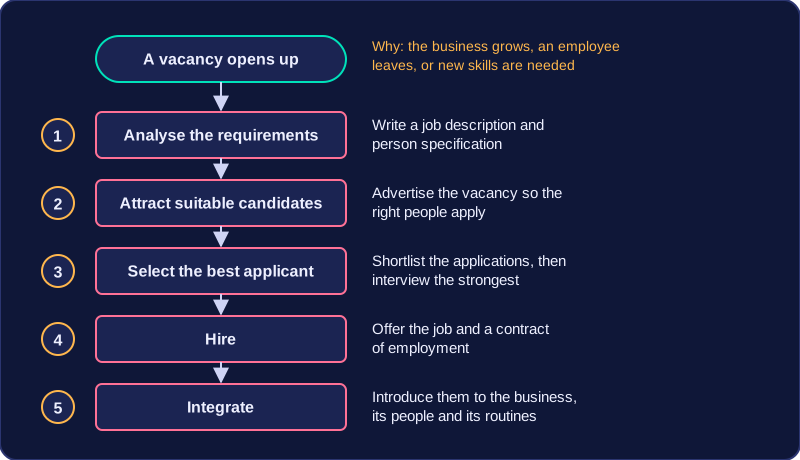
Why a vacancy opens up
- Growth – a bike repair shop that opens a second workshop needs extra mechanics, because the work now exists but there is nobody to do it.
- An employee leaves – through resignation or retirement, yet the tasks they did still need doing.
- New skills are needed – for example, a garden centre that starts selling online needs someone who can run its website and social media, a skill nobody already employed there has.
Selection: shortlisting and interviewing
Selection means assessing applicants to choose the best one. Shortlisting compares each application with the job requirements and keeps only the strongest matches, which saves the business the cost and time of interviewing everyone. Interviewing then tests candidates face to face – their skills, experience and how they would fit the team – so the final decision is based on evidence rather than paperwork alone.
A job description is produced by the business. It describes the job itself: the job title, the working conditions, the main responsibilities and the line of communication. Working conditions include details such as location, hours and whether weekend work is required. The line of communication shows who the employee reports to, so everyone knows who is in charge. This gives applicants a clear picture of what the role involves, and the business can use it to write the advert and plan interview questions.
A person specification is also produced by the business. It describes the person needed to do the job well. It lists the qualifications or education required, the skills and experience needed, and the personal qualities that would suit the role, such as being reliable, patient or able to solve problems. The business can use it as a checklist when shortlisting and interviewing.
The key difference
The job description focuses on the job and its duties. The person specification focuses on the candidate and the qualities they need. They are not the same document: one says what must be done; the other says what sort of person should do it.
| Document | Focus | Typical contents |
|---|---|---|
| Job description | The job | Job title, working conditions, responsibilities, line of communication |
| Person specification | The candidate | Qualifications, skills, experience, personal qualities |
For example, a small bakery advertising a bakery supervisor could use a job description to show that the role is based at its main shop, starts at 6am, involves planning daily baking and reporting to the owner. Its person specification could ask for a food hygiene certificate, two years' baking experience, good time management and a friendly manner. Both documents help the bakery attract suitable applicants and reject unsuitable ones quickly.
When a business advertises a vacancy, it uses several documents to help it choose the best person. Some are produced by the business, while others are produced by the applicant.
Documents produced by the business
An application form is produced by the business and completed by the applicant, who returns it to the business. It asks every candidate for the same details, such as contact information, qualifications and previous experience. This standardises applications, so the business can compare candidates fairly and quickly instead of comparing CVs laid out in many different ways. For example, a garden centre recruiting a trainee supervisor for its busy spring season could use its own form so that every candidate's details appear in the same order, making shortlisting quicker.
The business also produces the job description and person specification before recruiting. After a successful appointment, it may send a contract of employment, which sets out the terms of the job.
Documents produced by the applicant
A curriculum vitae (CV) is written by the applicant. It summarises their skills, experience and achievements, often in a short, easy-to-read format, so an employer can quickly see what the candidate has done before. A letter of application may be sent with a CV. It is also written by the applicant and presents why they are suitable for that particular vacancy, linking their skills and experience to the job.
Applicants may send a CV, a letter of application or a completed application form to the business, depending on what the business asks for.
Who produces each document
| Document | Produced by |
|---|---|
| Application form | Business; completed by the applicant |
| Job description | Business |
| Person specification | Business |
| CV | Applicant |
| Letter of application | Applicant |
| Contract of employment | Business, after a successful appointment |
When a vacancy arises, a business can fill it with an existing employee or with someone from outside. Each approach has different costs and benefits.
Internal recruitment
Internal recruitment fills a vacancy with someone already employed by the business rather than attracting outside candidates. It could be a promotion to a more senior job or a move sideways into a different role. The vacancy may be advertised inside the business, for example on the staff intranet, so current employees can apply.
Internal recruitment is often cheaper and quicker, as it avoids advertising widely and already knows the employee's performance. The employee understands the business, its customers and routines, so they settle in fast, and it can motivate staff to stay because they see a chance to progress.
However, the pool of candidates is limited to existing staff, so the business may get fewer new ideas or skills. Promoting one person can create another vacancy in their old role, and employees who were not chosen may feel resentful, which affects motivation.
External recruitment
External recruitment attracts candidates from outside the business, for example through a job-search website, to reach a wider pool of applicants. This brings fresh skills, ideas and experience, and is especially useful for a specialist role when nobody inside has the needed expertise.
The drawbacks are higher cost and more time spent advertising and selecting. The business cannot be certain how an unknown candidate will perform until they start, and existing staff may feel less motivated if they are overlooked for promotion.
Choosing the right approach
The choice depends on the business need: the skills required, cost, speed, whether fresh ideas are needed, and the effect on staff motivation. For example, a chain of indoor climbing centres starts running school-group sessions. Its instructors know the safety routines, so moving one into the job of organising school bookings is quick and cheap. However, none has sold to schools before, so recruiting an outsider with that experience takes longer and costs more, but brings knowledge the centres lack.
Effective recruitment means the business is clear about what the job involves and what kind of person it needs, attracts a good choice of applicants and selects carefully, so the new starter really fits the role. Getting that match right brings benefits that feed straight into the business's costs, its staff and its products.
Higher productivity and lower unit costs
A well-matched employee already has the skills the job needs, so they start contributing sooner and need less supervision. Productivity — output per worker — rises. Fewer mistakes also mean less time and material wasted, so the workforce is more efficient. Unit costs — the cost of producing one unit — fall when fixed costs such as rent or equipment are spread over more units made. The business can then keep its prices and earn a bigger profit margin, or charge less than competitors to win customers from them.
Vacancies filled quickly and lower labour turnover
Careful selection means people are better suited to their roles, so they are more likely to stay and to be content in them. Labour turnover — the proportion of staff who leave over a period and have to be replaced — falls, which saves re-advertising, re-interviewing and retraining. Recruiting well also fills a vacancy quickly, so customers are not kept waiting and existing staff are not left covering extra work for weeks.
New ideas and growth
Employees recruited from outside the business bring experience from other employers, which can spark innovation: new ways of working, such as a quicker booking system or a smarter way to display stock, or a product idea nobody had tried. If those ideas appeal to customers, the business can launch new products and take a larger market share — a bigger slice of total sales in its market.
For example, a chain of five garden centres recruits an assistant manager who has already run online order picking, a skill written into the person specification. Within weeks the new starter sets up click-and-collect, which cuts queue times and frees staff from the tills to advise customers — lower unit costs and a busier shop.