Making Human Resource Decisions
Organisational structures

Contents
Organisational structure is the way people and roles are arranged in a business. It shows who reports to whom and how work is divided, so everyone knows where they fit. For example, a garden centre might divide work into plant sales, the cafe and the checkout, with each team reporting to a manager.
An organisational chart is a diagram of that structure. It shows the levels of hierarchy, lines of responsibility and channels of communication. The chart is only a picture of the structure, not the structure itself, and it can become out of date when roles change. It also cannot show informal communication, such as two colleagues sorting out a problem in a quick chat.
Hierarchy terms
| Term | Meaning | Example |
|---|---|---|
| Hierarchy | The number of levels of management in an organisation. A taller hierarchy has more levels. | A director, a manager, a supervisor and an assistant form four levels of hierarchy. |
| Chain of command | The route through which instructions and information pass down the hierarchy. | An instruction may pass director to manager to supervisor to assistant. |
| Span of control | The number of employees who report directly to a manager. | A supervisor who directly manages six assistants has a span of control of six. |
A worked example
A garden centre has a director, a retail manager, three department supervisors and twelve assistants. The retail manager directly manages the three supervisors, so the retail manager's span of control is three. Each supervisor directly manages four assistants, so a supervisor's span of control is four. The business has four levels of hierarchy, so its hierarchy is taller than a business with only a director and assistants. An instruction from the director to an assistant travels along the chain of command: director, then retail manager, then supervisor, then assistant.
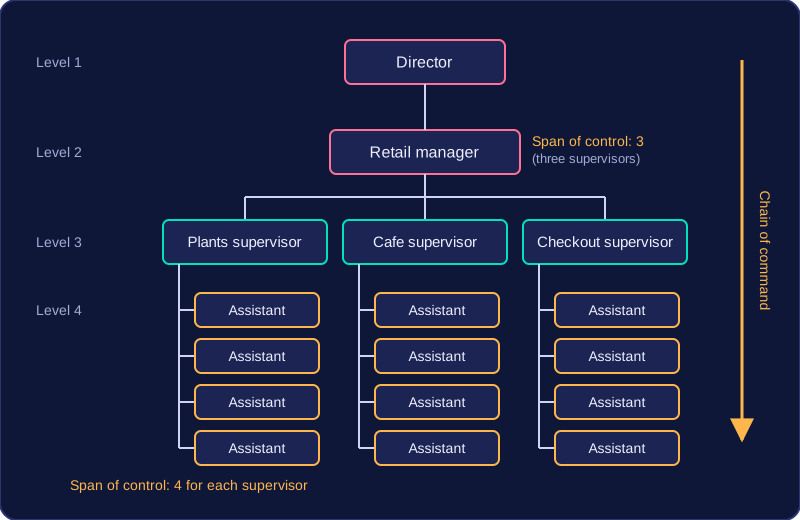
A hierarchical structure (also called a tall structure) has many levels of management. Each manager usually has a narrow span of control, meaning they directly oversee only a few employees. This suits large, complex organisations that need clear lines of authority and close control.
Hierarchical: strengths and weaknesses
Clear roles mean employees know who to report to and what is expected. Close supervision helps managers spot mistakes, and defined promotion steps give staff a visible career path.
However, messages pass through several levels, so communication can be slow and distorted. Decisions take longer because approvals move up the hierarchy, and paying several layers of managers raises costs. The business may also react slowly to customer or market changes.
For example, a 1,200-employee maker of specialist hospital beds may use five management layers, from team leaders to a production director. This keeps safety checks tight, but a customer request for a design change may take weeks to approve.
Flat structures
A flat structure has few levels of management and often a wide span of control: one manager oversees many employees. It suits small businesses or organisations that want quick decisions, teamwork and employee empowerment.
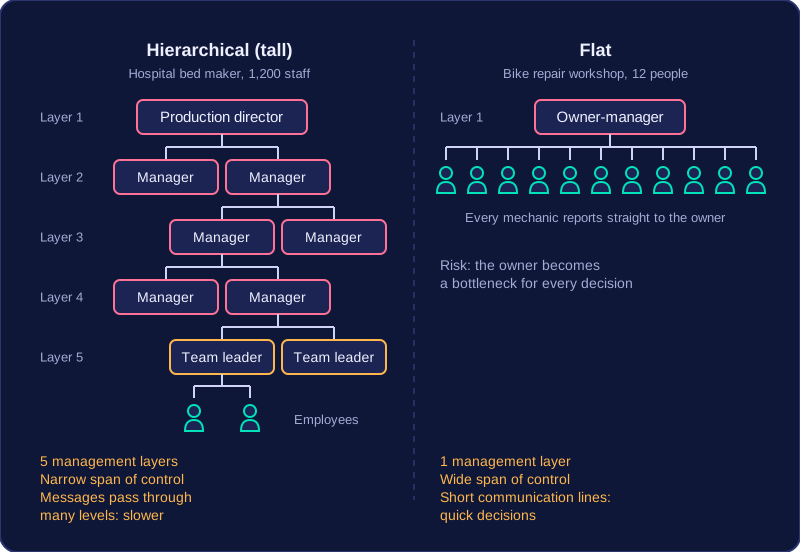
Short communication lines let information move quickly, so decisions are fast and management costs are lower. Giving staff more responsibility can increase motivation and teamwork. The drawbacks are that managers can become overloaded, supervision is less close and there are fewer promotion opportunities; without clear job descriptions, staff may also be unsure who does what.
For example, a 12-person bicycle repair workshop might have one owner-manager who every mechanic reports to directly, so mechanics can agree small extra repairs with customers on the spot. The owner must avoid becoming the bottleneck for every decision.
Centralised structure
A centralised structure is one where most decisions are made by senior managers or head office and then passed down to branches or lower levels. It is appropriate where consistency, control and specialist senior decision-making are important, especially for a business with multiple branches. For example, a chain of five indoor climbing centres could have head office set every site's prices, safety rules and opening hours. Customers get the same experience at each centre, senior staff can apply specialist knowledge, and buying equipment in bulk lowers average costs through economies of scale. Head office also keeps tighter control. However, decisions can be slower because branch staff wait for approval. Local managers may feel demotivated if they cannot respond to a local school wanting a weekday session, and the business can seem remote from local needs.
Decentralised structure
A decentralised structure is one where managers at local or branch level make decisions rather than only senior managers. It suits situations where local markets differ, quick local decisions are needed, or branch or franchise managers operate with independence. In the climbing chain, each centre manager could choose their own class timetable and local advertising. Decisions are faster, local knowledge is used well, and managers feel trusted, empowered and motivated, which can improve customer service. The drawback is inconsistency: one centre might offer a discount that another refuses, so the brand feels uneven. Central control is weaker, tasks such as buying equipment may be duplicated and cost more, and some decisions may lack specialist expertise.
Centralised is about who decides, not how many management layers exist; a flat structure and a decentralised structure are different ideas. Decentralisation is not automatically better, because motivation gains can be outweighed by inconsistency and lost control.
Effective communication takes place when a message passes from a sender to a receiver and both of them give it the same meaning. Sending information is not enough; the receiver must interpret the message as it was intended.
Choosing a method
Communication can be verbal (face to face or by phone), written (letters, notices or reports) or electronic (email or instant message). The method and channel should suit the audience and purpose. For example, a café owner might hold a short team meeting to explain a same-day change to the lunch menu, but email the full allergy information so staff can check it carefully.
Why it matters
Effective communication coordinates work, reduces mistakes, supports motivation and improves efficiency. When people know what to do and why, tasks are less likely to be duplicated and staff feel more involved.
Insufficient communication can leave roles unclear, cause mistakes, lower morale, create conflict and reduce productivity. Excessive communication is also a problem: too many messages can cause information overload, stress, wasted time and confusion, lowering efficiency.
Barriers
Barriers include jargon (specialist words the audience does not know), language differences, noise or a poor channel, information overload, lack of feedback, emotional or personal factors, and cultural differences. Each one can stop the receiver understanding the message as intended. A warehouse manager who uses stock-code abbreviations in a message to new staff may be understood by experienced workers but not by newcomers.
Part-time employees work fewer hours than full-time employees. Full-time employees work the standard full working week for the business. Flexible hours means the total number of hours is agreed, but the times when they are worked can vary.
Part-time working
Part-time working helps a business match staff to busy periods, such as a garden centre taking on two extra assistants for weekend mornings in spring. It also reduces total wage costs because fewer hours are paid. However, recruitment and training costs are spread over fewer hours, so the cost per hour worked is higher, and continuity can suffer if part-time staff are only in for a couple of days each week. Part-time work suits employees with caring responsibilities, study or other commitments, but usually means lower income and fewer chances of promotion. Part-time staff normally receive the same hourly rate as full-time staff; they simply work fewer hours.
Full-time working
Full-time staff give a business continuity and easier scheduling, as they are available throughout the working week. The drawbacks are higher fixed wage costs and less flexibility when demand changes, for example a café that is quiet in January still pays the same wages.
Flexible hours
Flexible hours can help a business match staffing to demand, for example a bakery whose staff all agree to 30 hours a week but start at 5am or 7am on different days. It can also improve motivation and retention, because employees can fit work around personal commitments. Scheduling and coordinating staff is harder, especially when team members need to work together at the same time. Employees gain a better balance with personal commitments, but they may need to be available at less convenient times, which can make arranging childcare harder.
Contracts set out the terms someone works under, including how long the job is expected to last. Businesses mix contract types to match their staffing to demand.
Permanent contracts
A permanent contract has no end date. It continues until the employee resigns or the employer ends it with the agreed notice period. Knowing their income is secure can make staff feel motivated and loyal, so they stay longer and the business spends less on recruiting and training replacements. The trade-off is a fixed wage bill that continues when trade is quiet, and staff who are harder to cut back quickly. The employee gains security but must give notice to leave.
Temporary contracts
A temporary contract lasts for a fixed period or until an agreed end date. A garden centre might take on extra staff for the weeks before Christmas, when demand for trees and decorations peaks. The business can add staff for busy periods, cut back afterwards and use the role as a trial before offering a permanent job. However, temporary staff may be less motivated and loyal, and each intake needs recruiting and training. Workers gain experience and flexibility but have little security or certainty over income.
Freelance contracts
A freelance contract is when a self-employed person, not an employee, carries out short-term work for clients. A wedding photographer who is booked for one event at a time works for themselves and serves several clients. A business can buy specialist skills only when needed, avoid a permanent salary and scale work up or down. The drawbacks are less control over availability, higher hourly rates and less influence over how the work is done. The freelancer gains independence and variety but has no guaranteed income, holiday pay, sick pay or job security.
| Contract | Security for the worker | Flexibility for the business | Cost |
|---|---|---|---|
| Permanent | High: steady income until notice is given | Low: fixed wages and notice periods | Fixed wage bill; lower recruitment costs if staff stay |
| Temporary | Low: ends on a set date | High: staffing matches demand | Recruiting and training each new intake |
| Freelance | None: work is not guaranteed | High: hired for specific jobs | Higher hourly rate, but no ongoing employment costs |