Wireless Connections
Wireless Protocols and Frequency Bands

Wi-Fi and Bluetooth are wireless transmission protocols: agreed sets of rules that let devices send data through the air as radio waves instead of down a cable. Wi-Fi joins a device to a network, while Bluetooth links two devices that sit close together, such as a phone and a pair of earbuds. Wi-Fi and Bluetooth signals can both be blocked by walls and disrupted by other electrical devices, which reduces their range.
A Wi-Fi standard is one agreed version of Wi-Fi. Each standard states how the hardware communicates, and newer standards allow a higher maximum speed. A standard also sets which frequency band or bands the equipment can use, because the band is part of the rules the hardware follows. Buying a newer router or phone therefore only helps if both ends support the same standard.
The two common bands
Wireless networks mostly use the 2.4 GHz band or the 5 GHz band. The number is the frequency of the radio wave, and it changes how the signal behaves.
| Band | Range | Data rate | Walls and solid objects | How crowded |
|---|---|---|---|---|
| 2.4 GHz | Longer | Lower | Passes through more easily | Busier |
| 5 GHz | Shorter | Higher | Absorbed more | Quieter |
Low-frequency waves have a longer wavelength, so they travel further and lose less energy pushing through brick and plasterboard. That is why 2.4 GHz still works at the far end of a building. The drawback is that the 2.4 GHz band is shared with cordless phones, microwave ovens, Bluetooth and every nearby network, so it is crowded and suffers more interference. The 5 GHz band has more space and can send data faster, but its shorter waves are soaked up by walls, so it covers less ground.
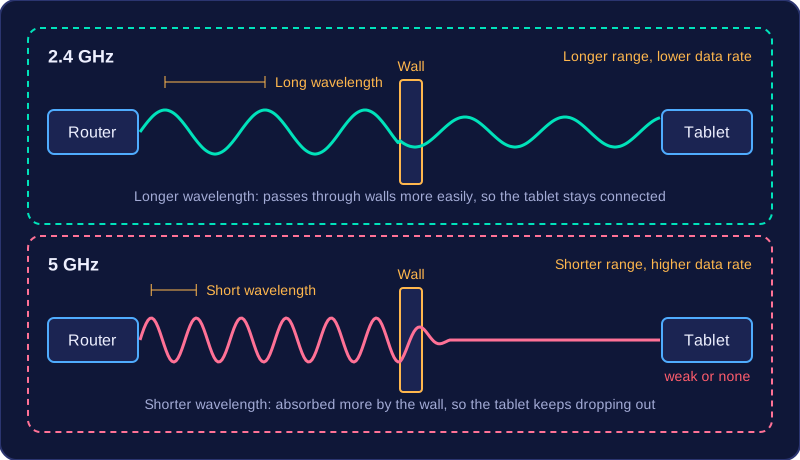
Picture a small guesthouse with the router in the reception office. A tablet taken up to a top-floor bedroom, with two walls and a ceiling in between, holds a steady connection on 2.4 GHz; on 5 GHz the same tablet keeps dropping out. Carry that tablet back down to reception, though, and the 5 GHz download is noticeably faster, because nothing solid is in the way.
Practise this
Edexcel GCSE Computer Science · Wireless Connections
Edexcel GCSE Computer Science · Protocols & Layers