Topologies
Star Topology
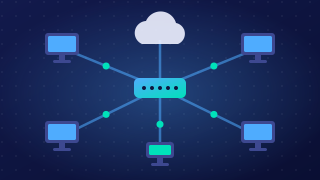
In a star topology, every device has its own cable to a central switch or hub. When one device sends data, it travels to the central device first; a switch then forwards it to the destination device. The central device is a switch or hub, and a router that contains a switch can also act as the centre, but a server is not the central device.
Fast, separate connections
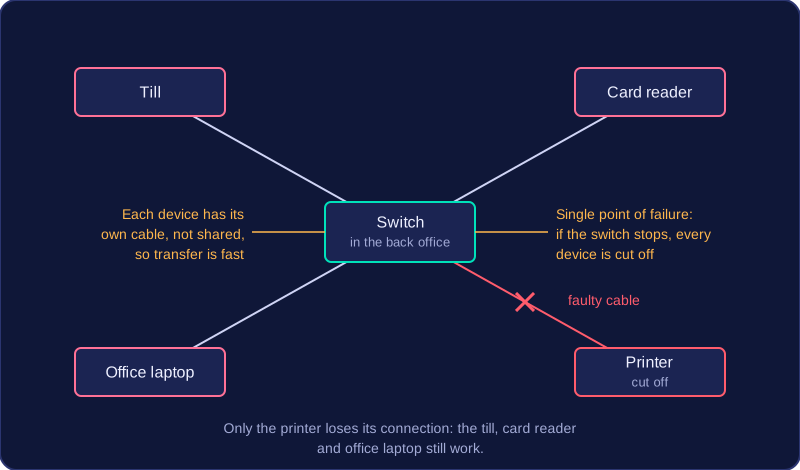
Each cable is used only by the device at its end, so it is not shared with other devices. This gives fast data transfer. If one cable is damaged or one device breaks, only that device loses its connection; the rest keep working. For example, imagine you run a small café and connect its till, card reader, office laptop and printer by cable to a switch in the back office. If the printer cable is faulty, the till, card reader and office laptop still work.
Extra hardware and a single point of failure
A star needs extra hardware: the central switch or hub and a separate cable for every device. Laying all those cables can make setup difficult and expensive, especially if devices are spread across a building. The number of devices is limited by the number of connections, or ports, on the central switch or hub. Most importantly, the central switch or hub is a single point of failure: if it stops working, every device loses its network connection.
Practise this
Edexcel GCSE Computer Science · Topologies