Topologies
Full and Partial Mesh

Full mesh and partial mesh are two ways of arranging the links between nodes. A node is any device that sends or receives data, such as a computer, switch or sensor.
Full mesh
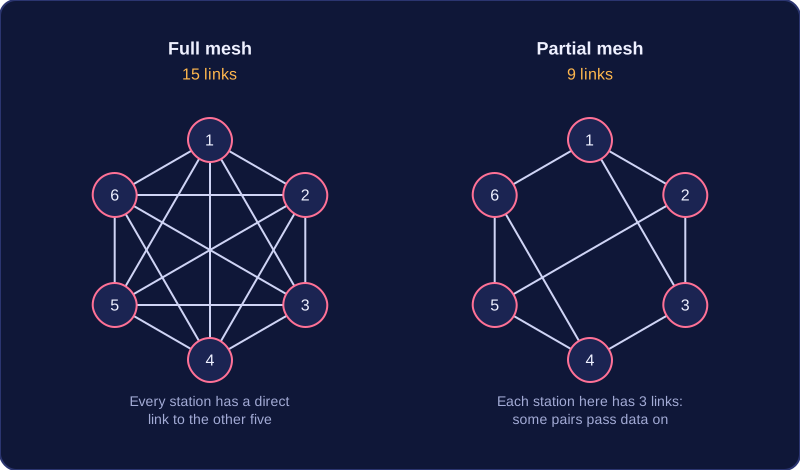
In a full mesh, every node is connected directly to every other node. Data can travel straight to its destination without passing through another device, because every pair of nodes has its own link. If one link fails, traffic can take a different route, so a full mesh gives maximum redundancy.
The cost is the number of connections. Each extra node needs a direct link to every node already there:
| Nodes | Direct links in a full mesh |
|---|---|
| 4 | 6 |
| 6 | 15 |
| 8 | 28 |
For example, six weather stations on a mountain range could share readings in a full mesh, but that means installing and maintaining 15 links. Each station would need five separate cables, one running to each of the other five stations, so even a small network ends up needing a lot of hardware.
Partial mesh
A partial mesh connects some nodes to several other nodes, but not every node to every other node. The same six weather stations could each link to two or three neighbours, using about nine links instead of 15. Some pairs cannot talk directly, so their data is passed through a station in between. Even so, most pairs still have more than one route, so a broken link rarely cuts anything off.
Choosing between them
Partial mesh is the version used most of the time. It keeps the alternative routes of a mesh while cutting the number of connections, which reduces cost. Larger networks often combine several star topologies with a partial mesh linking their central switches, so the whole network gains extra routes. A full mesh is reserved for small networks, or for a few key nodes, where every direct route matters.
Practise this
Edexcel GCSE Computer Science · Topologies