System Modelling
Flowchart rules and common errors

A correct flowchart follows a few rules, so anyone reading it can follow the process without guessing. It has one Start terminator and one End terminator, and every route finishes at that End.
Rules for a correct flowchart
- One Start and one End: keep the End after the last output; the process is not finished until the End is reached.
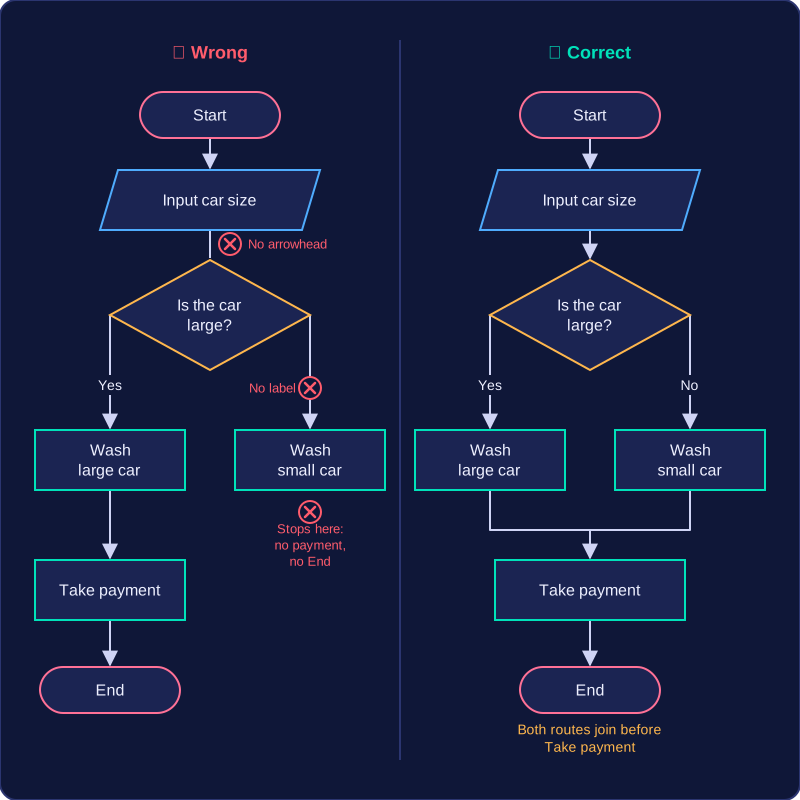
- Label and connect both decision exits: write each decision as a Yes/No question, label both exits and join each one to the next step. An exit with no label or line leaves the reader stuck.
- Finish every path at End: trace each route in turn; a route that stops at a process with nowhere to go is incomplete.
- Use arrows in one direction: lines without arrowheads, or arrows pointing both ways, make the order of steps unclear.
- Repeat a step on every path that needs it: in a car wash, if large and small cars both need "Take payment", show it on both routes or join the routes before it. Showing it on one route only makes the other skip a required step.
- Include a loop only when steps repeat: a loop is a path back to an earlier step. It suits a process where, for example, orders are taken until the customer has finished; a one-off process has no loop.
Spotting what is missing
| Rule | Error to look for |
|---|---|
| One Start and one End | No End after the final output, or two Start terminators |
| Both decision exits labelled and connected | A decision with only Yes, or a No exit with no line leaving it |
| Every path finishes at End | A route that stops at a process with nowhere to go |
| Steps on every path that needs them | Take payment shown on the large-car route only |
| Arrows show a single direction | Plain lines, or arrows pointing both ways |
| Loops only where steps repeat | A loop in a one-off process |
Checking means comparing the flowchart with the scenario: work through every path from Start to End and ask whether each step, label, connection to End and arrow direction is there. A missing step still matters.
Practise this
Pearson BTEC Digital Information Technology · Flowcharts