System Modelling
Data flow diagrams vs information flow diagrams

A data flow diagram (DFD) models how data moves through a system. It focuses on the processes that change data and the data stores where data is kept, together with the flows between them. An information flow diagram takes a different view: it focuses on the information used at points in a system, such as what someone at a desk or workstation needs to see and use to do their job.
These are different forms of notation, so they should not be confused. A data flow diagram answers questions such as “Where does this data go, what changes it and where is it stored?” An information flow diagram answers questions such as “What information is available or needed at this point, and how is it used?”
| Feature | Data flow diagram | Information flow diagram |
|---|---|---|
| Focuses on | Processes and data stores that data passes through | Information used at points in a system |
| Shows | The movement of data between processes, stores and outside parties | The information needed or available at each point, and how it is used |
| Typical question | Where is a repair booking stored before a mechanic sees it? | What does reception need to know before booking a repair? |
For example, in a bike repair shop, a data flow diagram could follow a booking from the customer details entering a booking process, through a repairs store, to the process that prepares the job sheet. An information flow diagram for the same shop could show that reception needs the customer’s name, contact number and bike fault to make a booking, while the mechanic needs the fault description and parts needed to carry out the repair.
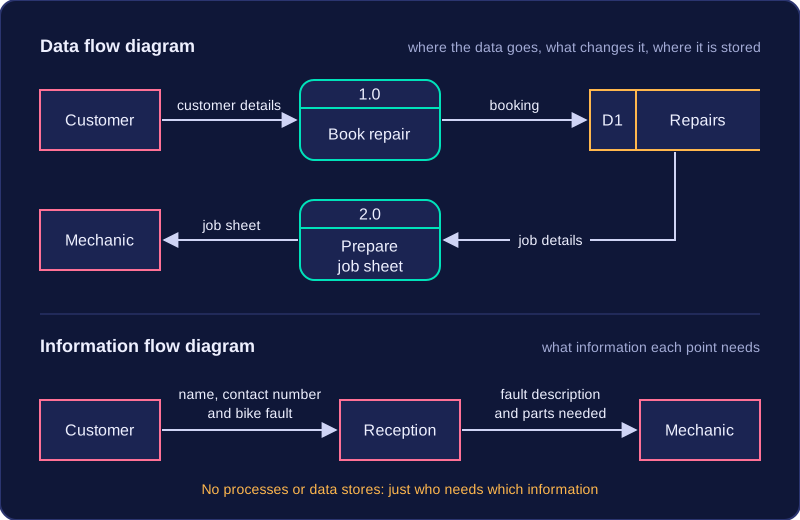
Do not treat the two as the same diagram with different labels: a data flow diagram tracks data through processes and storage, while an information flow diagram shows how information is used at particular points.
Practise this
Pearson BTEC Digital Information Technology · Information flow diagrams
Pearson BTEC Digital Information Technology · Data flow diagrams