Peripheral Management and Drivers
How Device Drivers Work

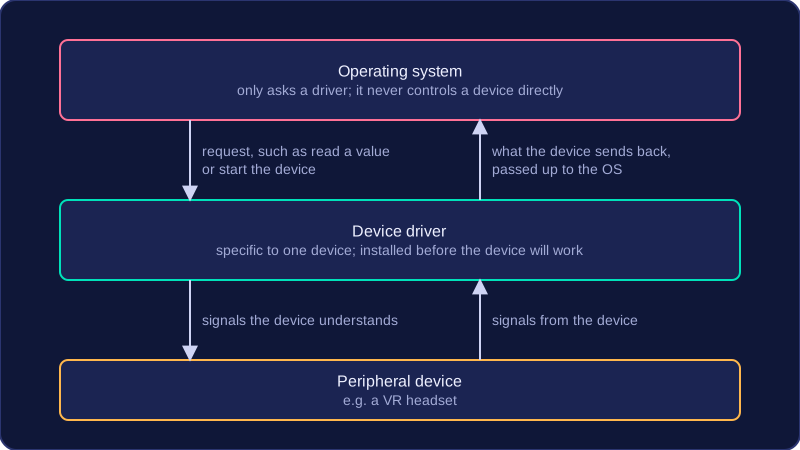
A device driver is software that acts as a translator between the operating system and one connected device. It is not the cable or the device itself. It takes the operating system’s general instructions and turns them into the specific commands that the device understands.
One instruction, translated
Imagine a school’s USB robot arm. The operating system may issue a general instruction such as rotate joint 2 to 45 degrees. The arm cannot act on that wording by itself. Its driver knows the command set for that exact model, so it translates the request into steps the motors understand, such as running motor B for 320 steps and reading a position sensor. Different robot arms can have different motors and commands, so each model needs its own driver.
Why this helps the operating system
Because the driver handles the device-specific detail, the operating system does not need to know how every device works. It can send a general request and let the correct driver deal with the rest. Without drivers, the operating system would need built-in knowledge of every device’s command set, and it would need changing whenever a new device was connected. The driver keeps that detail separate, so the operating system can support many devices through one general way of communicating.
Practise this
OCR GCSE Computer Science · Peripheral Management and Drivers