Sharing Resources
Peer-to-Peer Networks
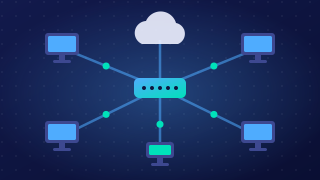
A peer-to-peer network is a network where every computer has equal status as a peer. There is no central server, so no single computer is in charge of sharing resources across the network.
Every peer can be a client and a server
In a peer-to-peer network, a computer can take on either role. It works as a server when it shares its own files or printer with another computer, and as a client when it uses a file or printer that another computer is sharing.
For example, a village photography club has five members, each with a laptop. Priya shares a folder of photos from her laptop. When another member opens one of those photos, Priya's laptop is acting as a server and the other laptop is acting as a client. If Priya then opens a checklist stored on another member's laptop, her laptop switches to acting as a client.
| Action | Role of the computer | What the computer does |
|---|---|---|
| Another member opens Priya's shared photo folder | Server | Sends the shared files to the other computer |
| Priya opens a checklist shared by another member | Client | Requests and receives the file from the other computer |
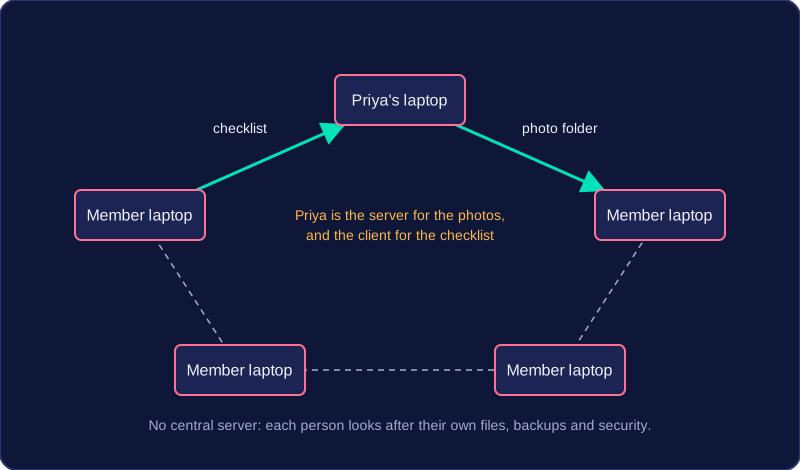
Peer-to-peer does not mean that no computer ever acts as a server. Any peer can provide a shared resource to another peer; the difference is that no central server manages the sharing.
You manage your own computer
With no central server, each user is responsible for their own computer. That includes organising their files, making backups and setting up security. There are no automatic central backups, so each person must back up their own files. If Priya wants her photos kept safe, she has to arrange that herself rather than relying on a server to do it for her.
Practise this
OCR GCSE Computer Science · Sharing Resources