Protocols
SMTP

SMTP (Simple Mail Transfer Protocol) is the set of rules used to send email. It moves a message out of the sender's email software and up to their outgoing mail server; after that it relays the message between mail servers until it reaches the recipient's mail server.
Think of the mail servers as sorting offices. A message is handed over at each stage by SMTP, which agrees how the two computers will exchange the message: which computer sends the commands and which replies, how the sender and recipient addresses are passed across, and how the receiving server confirms the message has been accepted.
Where SMTP does its job
- Your email software uses SMTP to pass your message to your outgoing mail server.
- That server uses SMTP to pass the message to the recipient's mail server — sometimes via another server in between.
- The message waits on the recipient's mail server until their email software collects it.
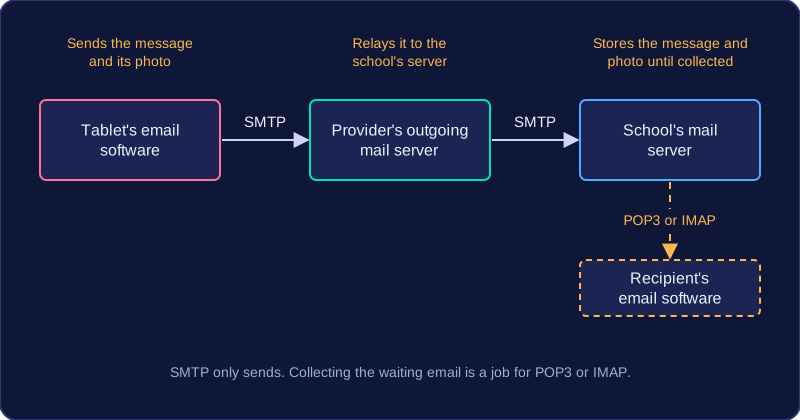
For example, a community garden group emails 14 seed-swap reminders. SMTP is used when each reminder is sent out from the group's email software and passed between mail servers. It is not used when a member later opens their inbox to read the reminder — that is POP or IMAP.
SMTP is for sending only
SMTP is not used to retrieve, download or check email; those jobs belong to POP and IMAP. If a question describes email being sent or handed between mail servers, SMTP is the protocol to choose. If it describes someone collecting or syncing their inbox, SMTP is the wrong choice.
Practise this
OCR GCSE Computer Science · Protocols