LAN / WAN
LANs and WANs

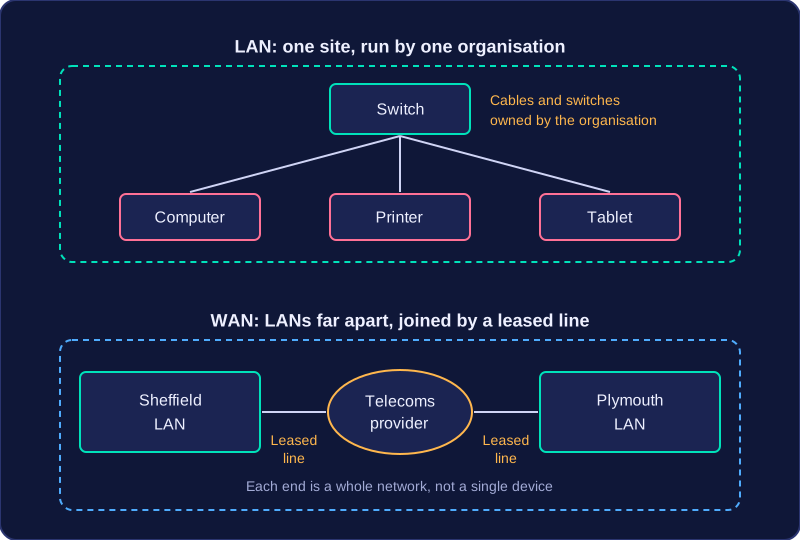
A local area network (LAN) covers a small area, usually one site such as a building. A wide area network (WAN) covers a large area and connects LANs and computers across towns, cities or countries.
LANs
The organisation using a LAN owns and manages its hardware, so it controls who can connect and how the network is secured. A LAN uses dedicated internal hardware and needs no external third-party infrastructure. It links individual devices, called nodes, on one site.
Nodes typically connect using Ethernet cables or Wi-Fi. Data travels short distances through few devices, so a LAN has high bandwidth and answers come back quickly. It is also cheap to set up compared with a WAN. For example, the public computers, staff laptops and catalogue server in a library could all be nodes on its LAN.
WANs
A WAN links separate LANs and individual computers over long distances; it does not mean wireless. The cables, masts and exchanges behind a WAN normally belong to telecommunications companies, and the organisation using the WAN leases access to them. WANs rely on links built for long distances, such as fibre optic cable, telephone lines and satellite links. Signals travel much further through more equipment, so answers usually take longer than on a LAN. Building a WAN is very costly, so organisations rent capacity from a provider instead.
For example, the variable speed limit signs along a motorway each connect to a regional control centre many miles away. The centre's own computers form a LAN, while the long-distance mobile data links, leased from a telecommunications company, make the signs part of a WAN.
Comparing LANs and WANs
| Characteristic | LAN | WAN |
|---|---|---|
| Area | Small, usually one site | Large, may span sites or countries |
| Ownership | User or organisation owns the hardware | Usually rented from a telecoms company |
| Media | Ethernet cables, Wi-Fi | Fibre optic, phone lines, satellite |
| Speed | Usually faster | Usually slower |
| Cost | Cheap to set up | Expensive to set up |
A WAN can be formed by connecting separate LANs: each site keeps its own LAN, while the link between sites is part of the WAN.
Practise this
OCR GCSE Computer Science · LAN / WAN