Memory
Read Only Memory ROM
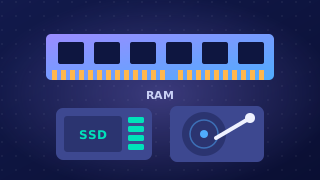
ROM (read only memory) is primary memory that keeps everything it stores even when the power is switched off, so it is non-volatile. As the name suggests, the processor can read from it but cannot write to it during normal use.
What ROM holds
ROM holds the start-up instructions: a small, fixed set of instructions the computer needs the instant it is switched on. They run straight away and start loading the operating system into RAM from secondary storage, so the computer becomes ready to use. The contents of ROM are fixed when the chip is manufactured, so during normal use they cannot be altered or removed.
Only those fixed instructions need to be stored there, so ROM has a small capacity — just enough for the start-up instructions and any fixed data. ROM can also store fixed data that must stay available without power and must not be altered.
Why start-up instructions must be in ROM rather than RAM
RAM is volatile: it loses everything when the power goes off, and at the moment the computer is switched on it holds nothing the computer can use, so any start-up instructions kept in RAM would be lost. ROM is non-volatile, so the instructions are there the moment power arrives, and because it is read only they cannot be accidentally altered or removed. The operating system itself is stored long-term on secondary storage; ROM only holds the instructions that load it.
RAM and ROM compared
| Feature | RAM | ROM |
|---|---|---|
| Volatility | Volatile — contents are lost when the power is off | Non-volatile — contents are kept without power |
| Reading and writing | Can be read from and written to | Can only be read; contents are set when made |
| What it holds | The operating system in use, open programs and data in use | The start-up instructions |
| Capacity | Much larger | Small |
| Contents over time | Change constantly as programs run | Stay the same |
Practise this
OCR GCSE Computer Science · Memory