Software Basics
What is an Operating System?

System software is the software that runs the computer itself, and its most important type is the operating system. The operating system (OS) is the system software that manages the computer's hardware, its users and the resources that other software needs. It is loaded when you switch the computer on and keeps running the whole time the computer is on. Hardware on its own cannot do anything useful without software to direct it.
The purpose of an operating system
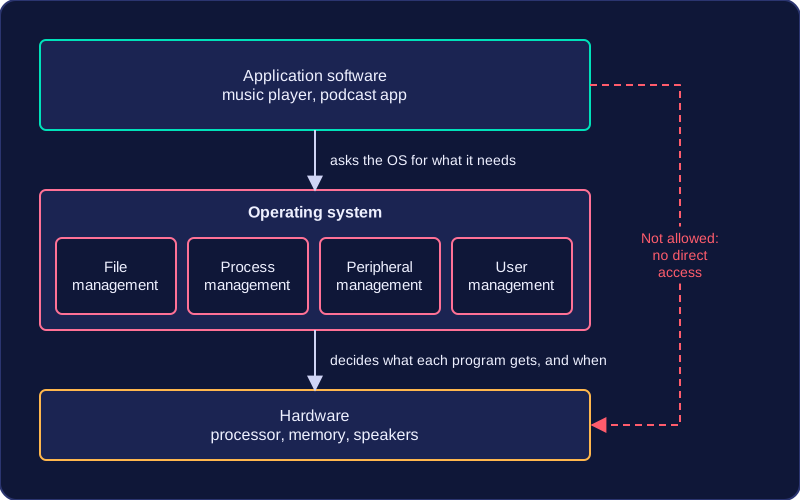
The purpose of the OS is to manage the hardware and resources of the computer and to provide an environment in which application software can run. Application software is the software you choose to use, such as a music player or a podcast app. It is not allowed to grab memory, processor time or the speakers directly, because two programs doing that at once would clash. Instead it asks the OS, which decides what each program gets and when.
Core functions
To do this job the OS provides core functions that allow the computer system to operate at all. Each one manages a different part of the system:
- File management – controls how files and folders are stored, named and found.
- Process management – shares the processor between the programs that are running.
- Peripheral management – controls input and output devices such as keyboards and screens.
- User management – creates accounts and sets what each user is allowed to access.
Think of a school site manager: they teach no lessons, but they unlock the rooms, run the heating and control who gets into which building, so that teachers can teach. The OS works the same way: it does not do the task you want done, it makes sure everything needed is ready so the software you chose can get on with it.
The OS is system software, not application software, and it is not the same as utility software, which only adds extra maintenance jobs. A computer can start up and be used with no utilities installed, but it cannot work without an OS.
Practise this
Edexcel GCSE Computer Science · Software Basics
Edexcel GCSE Computer Science · Purpose & Function of Operating Systems