Wireless Connections
Shared Bandwidth and Congestion
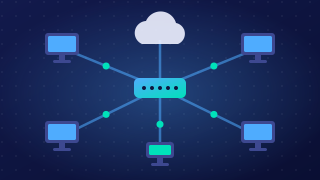
On a wireless network, devices share the same radio channel instead of having a cable of their own. The bandwidth of a wireless access point — the maximum amount of data it can carry each second — is shared out among every device connected to it.
More devices, less each
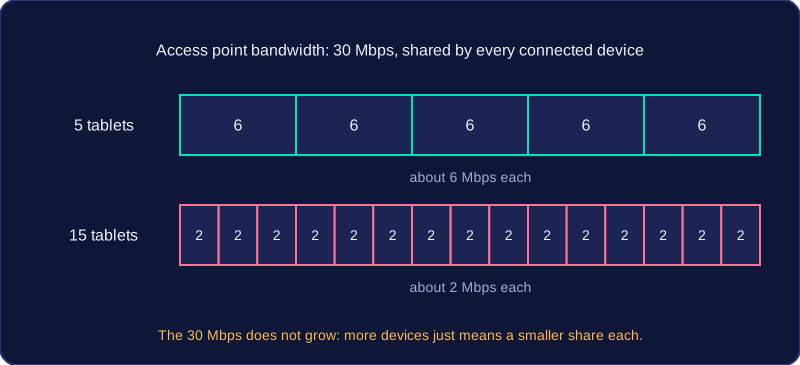
Because the radio channel is one shared medium, every extra laptop, tablet or phone joins the queue for the same capacity. Add more devices and the share each one gets shrinks, so downloads, video and file transfers slow down. The bandwidth of the access point has not changed; it is just divided more ways.
For example, an art classroom access point can carry 30 Mbps. With 5 tablets connected, each could get about 6 Mbps. With 15 tablets, each gets about 2 Mbps, so the same video clip loads more slowly. The split is rarely exact, because not every device is busy at the same moment.
Congestion and latency
Congestion happens when many devices try to transmit at the same time. A wireless device cannot send and listen at the same moment on the same channel, so data has to wait its turn. That extra waiting raises latency, which is why a video call can stutter in a crowded hall even when the signal looks strong.
Adding devices therefore never adds bandwidth — it shares out the bandwidth already there, and busy periods make the delays worse.
Practise this
Edexcel GCSE Computer Science · Wireless Connections