Wireless Connections
Mobile Networks
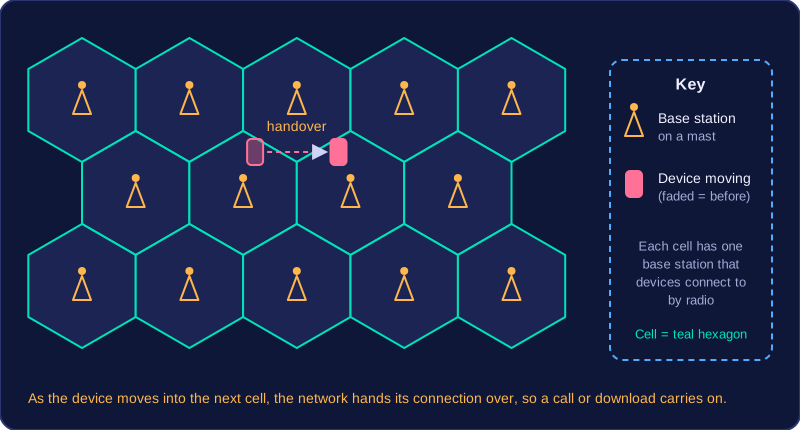
A mobile network (also called a cellular network) provides wireless connectivity over a wide area rather than inside a single building. The land is divided into cells, and each cell has a base station, often on a mast, that devices connect to by radio. As you travel, the network hands your connection from one cell to the next — a handover — so a call or a download carries on while you move.
Because masts are spread across the country, a mobile network reaches places one home router could never cover: a bus travelling between towns, a delivery driver's handheld scanner, a stall at an outdoor market taking card payments. That wide reach is the point of a mobile network: one connection that follows the user around.
Generations
Mobile networks are improved in generations, such as 2G, 3G, 4G and 5G. Each generation is a set of standards describing how devices and masts talk to each other, and later generations generally offer higher speeds and lower latency, so data moves faster and the delay before it arrives is shorter. For example, a courier's newer handheld uploads a photo of a customer's signature in a second or two, while an older handheld on an older generation may take far longer over the same image.
| Characteristic | Earlier generation | Later generation |
|---|---|---|
| Speed | Lower | Higher |
| Latency | Higher | Lower |
| Typical uses | Calls and text messages | Maps, video calls, live tracking |
Coverage varies
Masts are not spread evenly. In a remote village, a deep valley or the basement of a large building you may get a weak signal or none at all, and the device might drop to an older generation or lose its data connection altogether. With a weak signal, a transfer takes longer and the delay before data arrives grows, so a smaller distance is the range you can actually rely on.
Practise this
Edexcel GCSE Computer Science · Wireless Connections