Wired Connections
Copper and Fibre Optic Cable
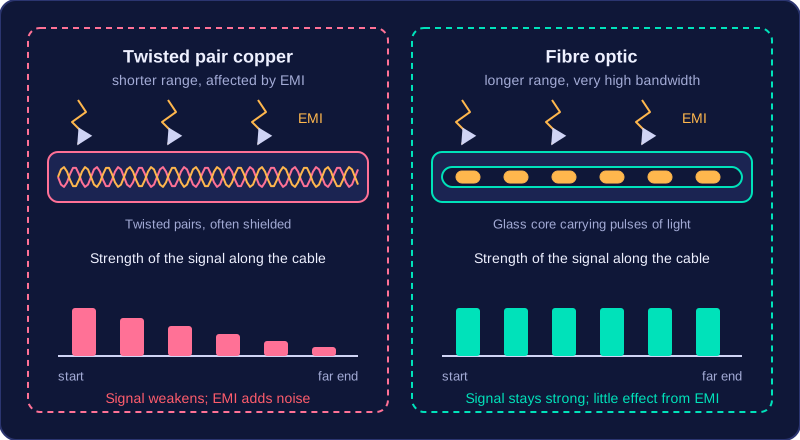
Wired networks carry data through cables. Two of the most common are twisted pair copper cable, which carries data as electrical pulses, and fibre optic cable, which carries data as pulses of light along thin strands of glass.
Fibre optic cable: longer range, higher bandwidth
Light travels through glass with far less signal loss than an electrical signal suffers in copper, so fibre optic cable carries data over much longer distances before the signal becomes too weak to read. A single fibre also offers very high bandwidth, so a large amount of data travels every second, which helps when many users stream video at once.
Because fibre uses light rather than an electric current, it is largely unaffected by electromagnetic interference (EMI), the unwanted electrical noise given off by motors, power cables and fluorescent lights.
Copper cable: shorter range, more interference
Twisted pair copper cable has a shorter effective range, because its electrical signal weakens quickly as the cable gets longer. It is also affected by EMI, which adds noise to the signal and can corrupt data, so the link becomes less reliable and data must be sent again. Shielding — metal foil or braid wrapped around the pairs — blocks much of this interference, and twisting the pairs helps because noise picked up on both wires tends to cancel out.
| Cable | Bandwidth | Effective range | Effect of EMI |
|---|---|---|---|
| Fibre optic | Very high | Long | Very little |
| Twisted pair copper | Lower | Short | Significant, reduced by shielding |
What decides wired performance
Performance depends on the cable type, the cable length and the quality of the physical connection. Fibre beats copper over the same distance, a short cable beats a long one, and a neatly fitted, undamaged plug with clean contacts beats a loose or worn one — even excellent cable performs badly if the connector is poorly attached.
For example, a theme park's entrance card reader connects to the ticket office computer 300 m away, with its cable running beside the ride motors' power cables. Copper over that distance would lose too much signal and pick up interference from the motors, so the park uses fibre. For the 3 m link from the office computer to its printer, copper is perfectly adequate.
Practise this
Edexcel GCSE Computer Science · Wired Connections