Protocols & Layers
Ethernet

Ethernet is the standard, or protocol, for wired network connections between devices. When computers, printers and switches are joined together with cables, Ethernet is the set of rules they all follow so that the data one device sends is understood by the device that receives it.
A shared set of rules is needed because hardware alone cannot make devices able to talk to each other. Every device must package the data in the same way, send it along the cable in the same way and read incoming data in the same way. Ethernet sets out those rules, which is why equipment built by different companies still works together on the same network.
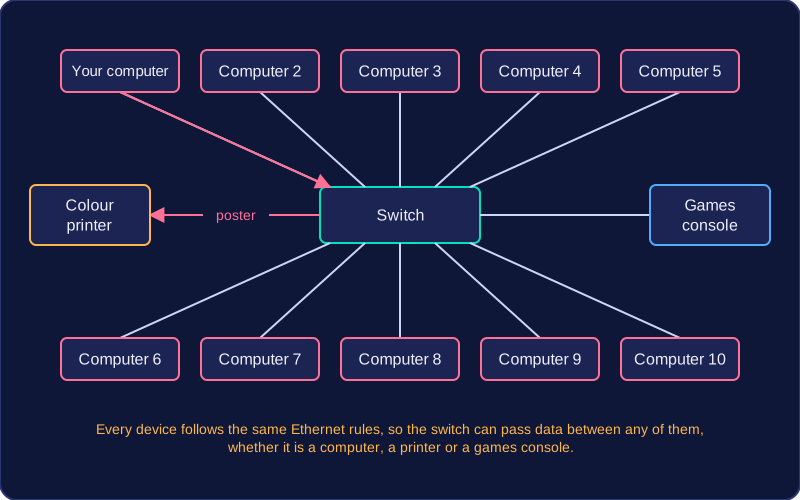
Worked example: a school art room has ten computers and one shared colour printer, all plugged into a central switch with cables. You send a poster to print. Your computer packages the data following Ethernet rules and sends it down its cable to the switch, which passes it on to the printer. The printer recognises the same rules and prints the poster. It makes no difference what the device is, either: plug a games console into a spare port on the switch and it sends its data in exactly the same way, and the printer is understood just as well, because every device follows Ethernet rather than its own private rules.
Ethernet is not a wireless standard. Wireless devices such as tablets connect using Wi-Fi instead; Ethernet always needs a physical cable between the device and the network.
Practise this
Edexcel GCSE Computer Science · Protocols & Layers