Preventing Network Security Risks
Firewalls
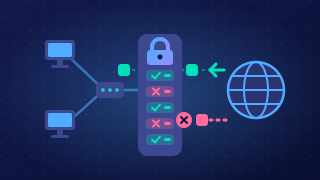
A firewall is a security system that separates a trusted network, such as a school's network, from an untrusted network such as the internet. It sits on the boundary and controls what traffic can pass between the two. It is a network security measure, not a physical lock on a door.
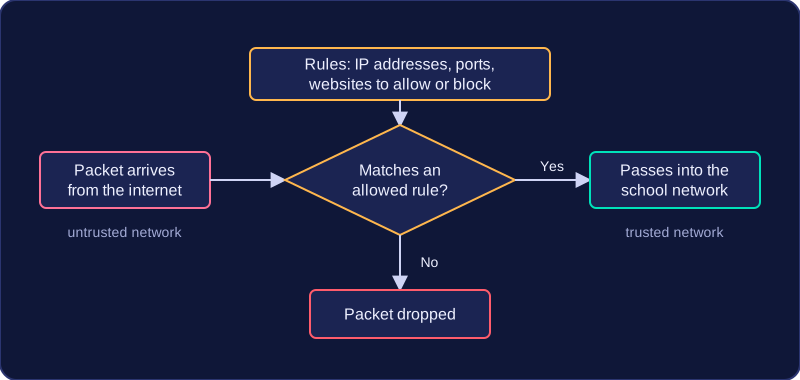
Data sent across a network is split into packets. The firewall monitors and checks each packet against a set of rules. A rule might allow only authorised computers, IP addresses or protocols to communicate, or allow data out but not in. If a packet matches an allowed rule, it passes; if it does not match, it is dropped. Dropping packets that fail the rules is called packet filtering.
What firewalls can block
- Malicious IP addresses: packets from a known harmful computer can be filtered out, so it cannot reach devices on your network.
- Ports: a firewall can prevent access to certain ports, which are numbered entry points for services. For example, a school could block the port used for remote desktop access from outside, while allowing the port used for secure web pages. This is port blocking.
- Websites: a firewall can block addresses of malicious or inappropriate websites, stopping users from opening them.
Hardware and software
A hardware firewall is a physical device, either a dedicated unit at the edge of a network or built into a router. It protects every device behind it. A dedicated unit costs more, because it is separate equipment that needs power, space and someone to set it up. A software firewall is installed on an individual computer. It is cheaper and travels with that device, but it uses the computer's processing power, so it can slow the computer down.
Practise this
Edexcel GCSE Computer Science · Preventing Network Security Risks