Stored Program Computers
Von Neumann Architecture
Von Neumann architecture is a design for a computer in which a program's instructions and the data those instructions work on are held together in the same main memory. This idea is called the stored program concept.
When a program runs, its instructions are loaded into main memory, and the data it is using is kept there too. For example, a quiz program's instructions sit in the same memory as the player's current score and the text of each question. There is no separate memory just for instructions: when the CPU needs an instruction or a data value, it fetches it from this one shared main memory.
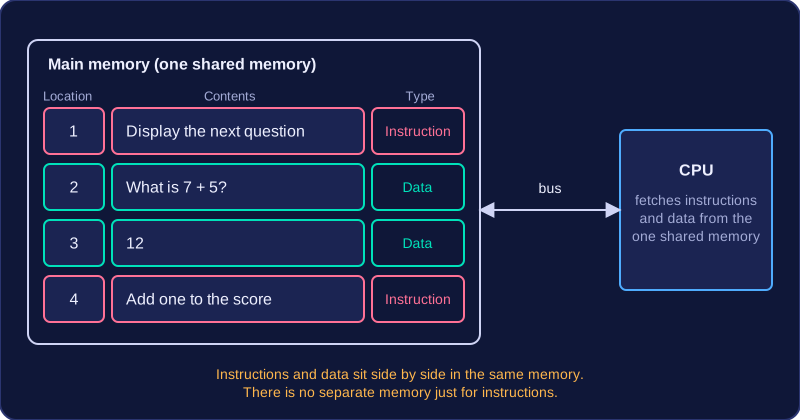
| Memory location | Contents | Type |
|---|---|---|
| 1 | Display the next question | Instruction |
| 2 | What is 7 + 5? | Data |
| 3 | 12 | Data |
| 4 | Add one to the score | Instruction |
Because instructions and data share one main memory, a computer does not need its circuits changing to run a different job. You can close a photo editor, load a music player, and the same hardware will run the new program. The change is in what is stored in main memory, not in the hardware itself.
Practise this
Edexcel GCSE Computer Science · Stored Program Computers
Edexcel GCSE Computer Science · Primary Memory
Edexcel GCSE Computer Science · Fetch Decode Execute Cycle