Stored Program Computers
Stored Program Computers
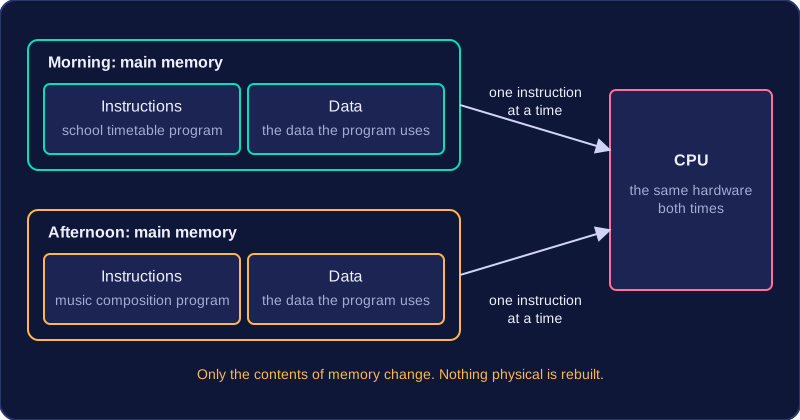
The stored program concept means that a program's instructions and the data it works on are both held in main memory. The computer works through the stored instructions one at a time, using the data also held in memory.
Before this idea, computers could hold data in memory but not their instructions. Each instruction had to be supplied to the machine separately, so changing what the computer did meant setting it up again, often by rewiring or resetting switches. That made computers expensive and inflexible.
Why it matters
When instructions are stored in memory, loading a program just means placing its instructions into memory. The same computer can run a school timetable program in the morning and a music composition program in the afternoon. Nothing physical has to be rebuilt; only the contents of memory change.
This makes a general-purpose computer possible. One machine can do many different jobs because the job is defined by the program it is running, not by its physical design. A program can be loaded and run, and a different program can be loaded later, without changing the hardware.
| Before stored programs | With stored programs | |
|---|---|---|
| What memory holds | Data only | Instructions and data |
| To change the task | Reconfigure the hardware | Load a different program |
| Type of machine | Set up by its hardware for a task | General-purpose |
Practise this
Edexcel GCSE Computer Science · Stored Program Computers