Secondary Memory
Optical Storage

Optical storage saves data on a disc in a form that a laser can write and read. It is secondary storage, so the data is kept when the power is switched off.
Writing and reading with light
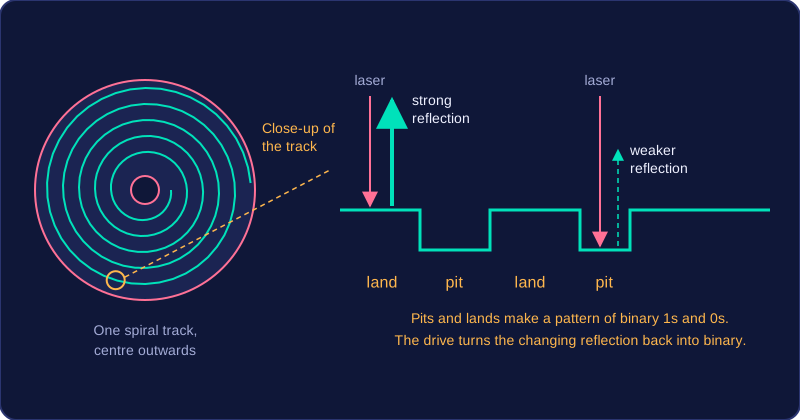
The laser writes data by burning tiny dips called pits into a spiral track running from the centre of the disc outwards. The flat areas between the pits are lands, and this pattern of pits and lands represents binary 1s and 0s. The surface has to be reflective so that light bounces back from it.
To read the disc, the drive shines a laser at the track and measures how strongly the light is reflected. A pit reflects less light than a land, so the reflection keeps changing as the disc spins, and the drive turns that pattern back into binary.
CDs, DVDs and Blu-ray discs
CDs, DVDs and Blu-ray discs are the common optical media. They are the same physical size, but each format holds a different amount of data, with Blu-ray discs storing far more than CDs.
Advantages, disadvantages and uses
- Cheap to buy and to produce, so a free disc on a magazine cover costs the publisher very little.
- Small, light and portable, so a driver disc for a printer can be posted to a customer for the price of a letter.
- Lower capacity than a hard disk or SSD, so a disc suits a single narrated slideshow rather than the school's whole photo archive.
- Easily damaged: a scratch scatters the laser and that part of the disc can no longer be read.
- Needs a suitable drive, and many new laptops do not have one.
- Slow to write, so saving a term's photo folder to a disc takes far longer than saving it to the computer's internal drive.
Optical discs are used to store and distribute music, films and other multimedia, such as a museum gift shop's audio tour. They are also used for backup and archiving, such as a hospital radio station's past interviews.
Practise this
Edexcel GCSE Computer Science · Secondary Memory