Secondary Memory
Magnetic Storage

Magnetic storage keeps data as tiny areas on a disk or tape that are magnetised in one of two directions: one direction stands for a 1, the other for a 0. A read/write head moves over the surface, writing by setting the direction of each area and reading by detecting the direction already stored.
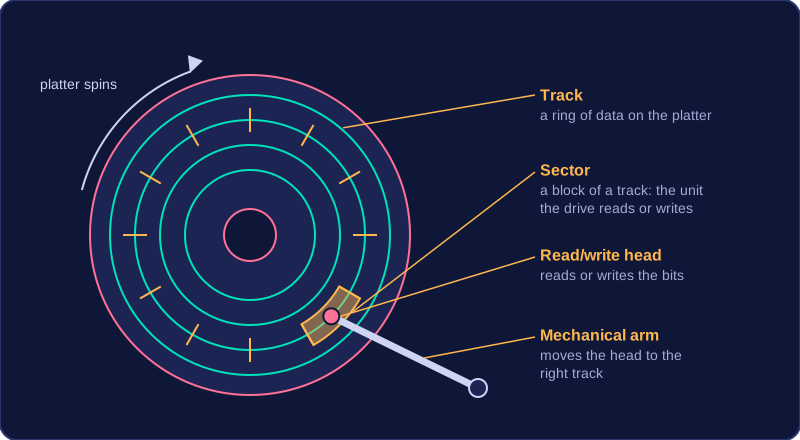
In a magnetic hard disk, those areas sit on a rigid magnetic platter. The data is arranged in rings known as tracks. Each ring is split into small sectors, the blocks the drive reads or writes at a time. The platter spins while a mechanical arm moves the read/write head to the right track, then waits for the correct sector to pass underneath, which is why a hard disk makes a faint whirring sound while it works.
Advantages and disadvantages
Magnetic disks are cheap for the amount of storage they provide, so very large capacities come at a modest price. Reading and writing are also relatively fast, quicker than an optical disc, which helps when loading large files. However, a hard disk contains many moving mechanical parts. A knock can damage the spinning platter or the arm carrying the head, so durability is a weakness. The sealed unit is also fairly heavy, making it less portable than a small flash drive.
Common uses
Magnetic hard disks give computers a large internal store for their programs and files. Magnetic tape, wound on reels inside a cartridge, is used for backups: it is cheap per gigabyte, so huge collections of data can be copied and kept safely. Portable magnetic drives let you carry large files between machines.
Practise this
Edexcel GCSE Computer Science · Secondary Memory